Employee Retention: The Complete Guide
Most regretted resignations look obvious in hindsight. The signals were there for weeks (a stalled growth conversation, quieter one-on-ones, a refreshed professional profile) and no one connected them in time. Employee retention is the discipline of closing that gap: keeping the people you most want to keep by understanding why people stay, noticing concerns early, and acting while the relationship is still strong. This guide is the hub for that discipline. It defines retention, makes the case for why it matters, breaks down what it actually costs to lose people, maps the drivers that move the needle, gives you a practical framework and the metrics to track, and shows where early-warning signals fit. Along the way it points to deeper guides on each piece, so you can go from "we should retain people better" to a concrete plan.
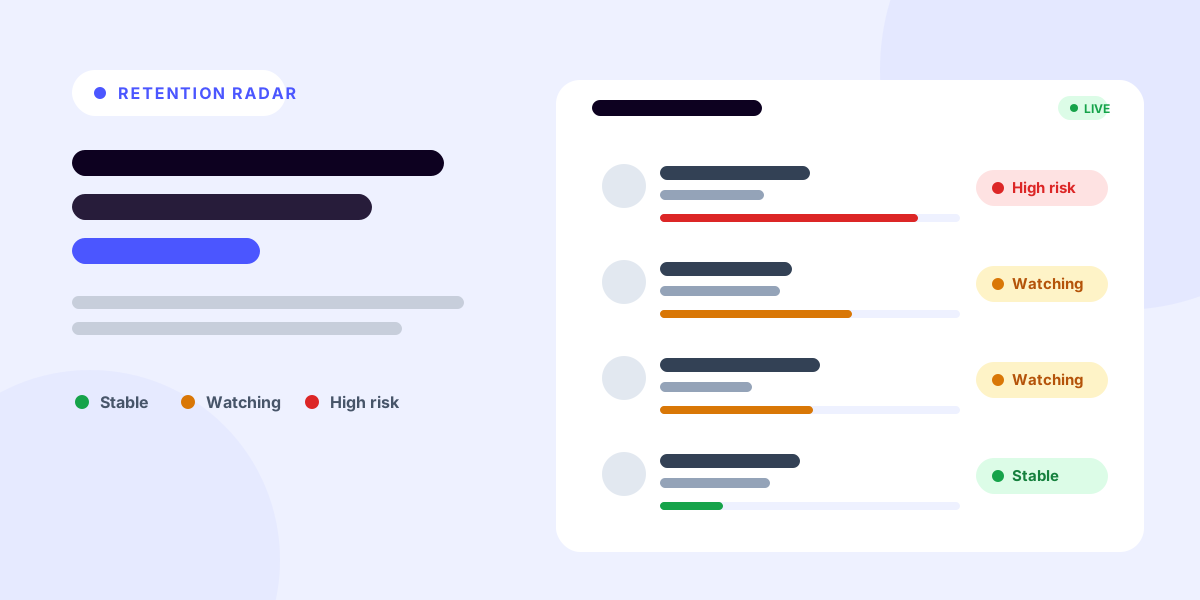
Tag each teammate Stable, Watching, or High risk, and act while you still have lead time.
What is employee retention?
At its simplest, employee retention is an organization's ability to keep its employees over a given period - most importantly, the ones it would least want to lose. It's the inverse of turnover: where turnover counts who left, retention counts who stayed.
That makes it tempting to treat retention as a single metric. It isn't. The number is just a scoreboard. Retention itself is the cumulative experience an employee has, from their first day, through the quality of their manager relationship, to their sense of progress a year in, that makes staying the path of least resistance. You can't move the scoreboard directly; you move it by improving that experience for the people who matter most.
It's also worth drawing one distinction up front, because it shapes everything else: not all turnover is equal. Losing a struggling hire who wasn't a fit is non-regrettable turnover, and it's often healthy. Losing your most capable, hardest-to-replace people is regrettable turnover, and it's where nearly all the cost and pain concentrates. Good retention work is overwhelmingly about reducing the regrettable kind rather than chasing a low headline number for its own sake.
Why employee retention matters
Retention often loses the budget argument to more measurable line items, because its value is mostly invisible until it's gone. But the case is strong once you look at the full picture.
Retention protects momentum, compounds team skill, and steadies the people who stay. Every departure interrupts in-flight work; stable teams keep their velocity while churning ones spend it on recovery. A team that stays together also gets measurably better over time, building the tacit knowledge of codebases, accounts, and customers that no job description captures. And when a respected colleague leaves and nothing visibly changes, everyone else quietly recalculates whether staying is worth it: turnover seeds more turnover. Keeping someone through an early conversation, a growth opportunity, or a workload fix typically costs a fraction of a full replacement cycle. We'll size that gap next.
If you want to understand the human side of why this matters - the specific reasons capable people walk - our breakdown of why good employees leave and how to keep them maps the root causes that surface again and again.
The cost of losing people
The most common reason retention gets underfunded is that few leaders can say what turnover actually costs their business. The visible costs (a recruiter's fee, a job ad) are the tip of the iceberg. The full cost of employee turnover is a stack of visible and hidden costs that compound every time someone you wanted to keep walks out the door.
The visible costs are the ones finance already recognizes: recruiting and sourcing, agency fees, hiring administration, onboarding, equipment, and any overlap while one person transitions out. Add them up and you have a real number. But stop there and you'll understate the true cost by a wide margin.
The hidden costs are where the real damage lives, and they usually dwarf the visible ones:
- Lost productivity before and after the departure, as disengagement sets in early and the seat then sits empty.
- Ramp time (weeks for a frontline role, many months for a senior or specialized one) before a replacement performs at the level of who they replaced.
- Knowledge loss, the hardest cost to see and the slowest to recover, as undocumented context walks out the door.
- Morale and team overload, as the remaining team absorbs the work and their own flight risk rises.
A useful rule of thumb is that replacing someone costs a meaningful fraction of their annual salary - often more for senior, specialized, or hard-to-fill roles. But generic percentages are easy to dismiss in a budget meeting; a number you built from your own roles is far harder to argue with. For a simple formula and a fully worked example you can adapt, see our guide to the real cost of employee turnover. Estimate it for even one role and the case for proactive retention usually makes itself.
The main drivers of employee retention
People rarely leave over a single bad day. They leave after a slow accumulation of unaddressed frustrations across a handful of recurring drivers. Understanding these is what lets you target the root cause instead of papering over it with perks.
The manager relationship
The manager relationship is one of the strongest predictors of whether someone stays. People often join a company and leave a manager. A manager promoted for technical skill but never taught to coach, give feedback, or run a good one-on-one is a quiet, common retention risk. Consistent, recurring one-on-ones are the most reliable lever a manager has.
Growth and progression
"I can't see a future here" is one of the most common reasons capable people start looking. When the only way up is out, your strongest performers leave first. Visible career paths and real internal mobility keep that ambition inside the building.
Fair, transparent pay
Pay rarely buys loyalty on its own, but unfair or below-market pay is a fast, hard-to-recover reason to leave. Once someone feels underpaid, every other frustration weighs heavier. Pay is also only one part of a wider employee value proposition: the full set of rewards, growth, and meaning people get in exchange for their work. Being clear about that whole package helps every other driver land.
Recognition
Feeling unseen erodes motivation faster than almost anything, and it costs almost nothing to fix. Specific, timely acknowledgment tied to real impact lands as respect; generic praise lands as noise.
Sustainable workload
Chronic overload is a top driver of burnout, and burnout is a top driver of resignation. Your most reliable people are often the most overloaded precisely because they never say no, which makes them silent flight risks.
Meaning and trust
People stay longer when they understand how their work matters and who it helps, and when they trust where the company is headed. Uncertainty breeds anxiety, and anxious people start hedging their bets - including by updating their resumes. Transparency, even about hard news, builds the safety that makes people willing to stay through change.
For the engagement side of these drivers specifically (how to build the day-to-day environment that keeps people invested), our guide to employee engagement strategies goes deeper.
A practical retention framework
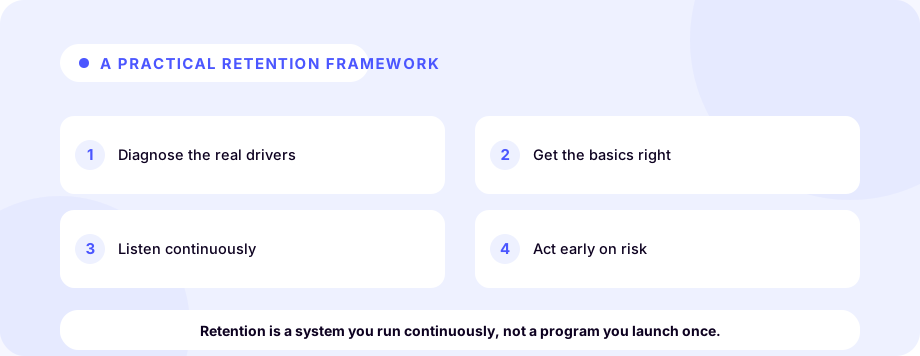
Knowing the drivers isn't the same as improving retention. The teams that consistently keep their best people aren't running flashy programs; they're running a quiet, repeatable loop. Think of it in four steps.
1. Diagnose risk early
You can't retain someone you didn't realize was leaving. The expensive surprises are the quiet ones: the steady performer who seemed fine right up until the notice. The first job is to shorten the gap between "something's off" and "you know about it," by combining attentive management with structured early signals. We'll return to the early-warning piece below, and our guide on how to identify and reduce employee flight risk covers the mechanics in depth.
2. Have the right conversations
A risk signal tells you who to talk to; it doesn't tell you why. The only way to learn the why is to ask, well, before someone has made up their mind. Make consistent one-on-ones the foundation, and when someone seems to be wavering, escalate to a deliberate stay interview: a short, structured conversation about what keeps them engaged and what might tempt them away. Unlike an exit interview, which collects feedback after the decision is final, a stay interview gives you the chance to act while the relationship is intact. Our stay interview questions and template give you a ready bank to pull from.
3. Act on the drivers that matter most
This is where most retention efforts quietly die: managers diagnose, they have the conversation, and then nothing changes. The discipline of this step is focus: for each at-risk person, identify the one or two drivers that would most move their decision, and act on those. The underpaid mid-career engineer and the plateaued high performer need different things.
4. Follow through visibly
Asking for feedback and then doing nothing is worse than never asking: it teaches people their voice doesn't matter. Close the loop explicitly: name what you heard, what you're changing, and what you can't change yet. People will stay through an imperfect answer if they believe it's honest and that they were heard.
For the full operating manual on running this loop (the conversations, the drivers, the follow-through), see our manager's playbook on how to retain employees. For the broader catalogue of tactics that sit underneath it, our list of 15 employee retention strategies that actually work lays them out with a concrete first step for each.
The metrics that matter
You can't manage retention without measuring it, but the goal is a small, honest set of numbers rather than a sprawling dashboard. Start here:
- Retention rate and turnover rate. These are two sides of the same coin and the foundation for everything else. If you're not yet tracking your baseline, our guide to how to calculate employee turnover rate gives you the exact formula and a worked example.
- Regrettable vs. non-regrettable attrition. This is the single most important refinement. A high attrition rate driven by low-performer exits is far less concerning than a smaller rate concentrated among your best people. Tagging departures this way is what makes every other metric meaningful.
- Engagement and eNPS. A periodic read on how people feel, useful for spotting themes by team or manager - though, being aggregate and lagging, it tells you about groups rather than individuals. Our guide to employee Net Promoter Score (eNPS) covers the formula and how to read the score.
- Tenure distribution. Where do people tend to leave - in the first 90 days, around the two-year mark? The shape of your tenure curve points you at which driver to fix first.
- Cost per departure. Turning retention into a defensible business case, as covered above.
The most valuable additions are leading indicators (early signals of rising flight risk), because lagging metrics only ever confirm what you've already lost. For a fuller breakdown of which numbers to track and how to read them together, see our guide to employee retention metrics and KPIs every people team should track.
Early-warning: catching risk before the resignation
Almost every lever in this guide (a career conversation, a pay adjustment, a workload fix, a successor groomed quietly in the background) works far better when you start early. The thread connecting all of them is lead time. The most expensive turnover is the kind you only learn about when the resignation lands on your desk, because by then the decision is usually made and you've already absorbed weeks of disengaged output.
The trouble is that most retention data looks inward - at survey responses, performance records, and HRIS history - and by the time disengagement shows up clearly in those internal systems, the person has often already started looking elsewhere. The earliest, most honest signal that someone is exploring the market frequently appears outside your walls. Managers can watch for the signs an employee is about to quit, and they should. But human attention is uneven, and the quietest flight risks are often your most self-sufficient people, the ones who never complain.
This is the specific gap TeamPredict was built to close. It surfaces early, proactive signals of resignation risk from publicly available LinkedIn profile activity and summarizes them into a simple resignation-risk level for each tracked employee. Instead of an anonymous aggregate score, a manager gets a clear, person-level read on who may be at risk, and the lead time to do something about it.
A few honest notes on where this fits:
- Early-warning signals work best alongside your engagement and HRIS data. Keep both; each answers a different question.
- A "high" risk level is a reason to have a supportive conversation. It is never proof someone is leaving, or grounds to treat them differently.
- TeamPredict reads only public LinkedIn activity. Treat a rising risk level as a reason to schedule a supportive one-on-one, and nothing more.
When the diagnosis step of your framework has reliable early signals feeding it, the whole loop gets easier: you spend your energy on the right conversations, at the right time, with the people who matter most. And if a departure is genuinely coming, you get time to groom a successor and plan a clean handoff: the difference between a calm transition and a fire drill. Our guide to succession planning covers how to use that lead time. If you're evaluating tooling more broadly, our vendor-neutral guide on how to choose employee retention software walks through the categories and where early-warning tools sit.
Putting it all together
Employee retention is a practice you maintain, not a program you launch once. Define it honestly (keeping the people you most want to keep) and resist the pull of vanity metrics. Make the case with a real cost number built from your own roles. Target the handful of drivers that actually move people: manager quality, growth, fair pay, recognition, sustainable workload, meaning, and trust. Run the diagnose-converse-act-follow-through loop on a rhythm, for the people you'd least want to lose. Measure a small, honest set of numbers, and weight your attention toward the leading indicators that buy you lead time. Do that consistently, and the surprises get rarer.
If you'd like that lead time for your own team, the chance to act on rising risk before it becomes a resignation, you can start a free TeamPredict trial and see your team's resignation-risk signals in one place. It takes minutes to set up, runs for 30 days, and costs nothing until the trial ends; cancel anytime before then and pay nothing. Worst case, you learn your retention is healthier than you feared. Best case, you get the lead time to keep someone you would otherwise have lost.
Frequently asked questions
- What is employee retention?
- Employee retention is an organization's ability to keep its people over time - especially the people it most wants to keep. It's usually expressed as a rate (the share of employees who stay across a period) and is the flip side of turnover. But retention is less a number than a practice: the cumulative experience an employee has, from onboarding through their manager relationship to their sense of growth, that makes staying the easy choice.
- Why is employee retention important?
- Because losing people is expensive and disruptive in ways that rarely show up on a single invoice. Every regrettable departure costs recruiting and onboarding spend, months of lost productivity and ramp time, institutional knowledge that walks out the door, and added load on the team left behind. Strong retention protects momentum, customer relationships, culture, and morale - and it compounds, because stable teams keep getting better at what they do.
- How do you improve employee retention?
- Start from evidence, not initiatives. Calculate your turnover and tag which departures were regrettable, diagnose the real drivers behind them, then act on the few that carry the most weight - usually manager quality, growth, fair pay, recognition, and sustainable workload. Run it as a repeatable loop: diagnose risk early, have honest conversations, fix what matters most to each person, and follow through visibly. Catching concerns early, while you can still act, is what separates retention from damage control.
- What are the main drivers of employee retention?
- The drivers that show up most consistently are the manager relationship, clear paths for growth and progression, fair and transparent pay, genuine recognition, sustainable workload, meaningful work, and trust in leadership. No single one retains anyone on its own - people leave after a slow accumulation of unaddressed frustrations across several of these, which is why a deliberate retention practice targets the root causes rather than chasing perks.
- What metrics should I use to measure employee retention?
- Begin with retention rate and its mirror, turnover rate, then separate regrettable from non-regrettable attrition so you're measuring the losses that actually hurt. Layer in eNPS or engagement scores, tenure distribution, time-to-fill, and an estimated cost per departure. The most valuable additions are leading indicators - early signals of rising flight risk - because lagging metrics only confirm what you've already lost.
About TeamPredict
TeamPredict Team
We build TeamPredict - retention early-warning software that flags resignation risk from public LinkedIn signals. We write about the patterns that precede a resignation and how people-first teams act on them early. Learn more about TeamPredict
What is turnover actually costing you?
Put a number on it in about two minutes with the free turnover cost calculator. No email, no signup.
Calculate your turnover costFree, no signup required.