Employee Retention Metrics and KPIs Every People Team Should Track
You can't manage what you don't measure - but in retention, you also can't manage what you only measure after the fact. Most employee retention metrics are lagging by nature: they tell you, precisely and too late, about people who have already left. A People team that wants to actually keep good people needs a small, honest set of numbers that combines the lagging metrics that explain the past with the leading indicators that let you change the future. This guide walks through the metrics and KPIs worth tracking, what each one measures, how to read them together, and where early-warning signals fit into the picture.
A note before we start: more metrics is not better. A focused scorecard that managers actually look at beats a sprawling dashboard no one opens. The aim here is to help you choose a handful, not collect all of them.
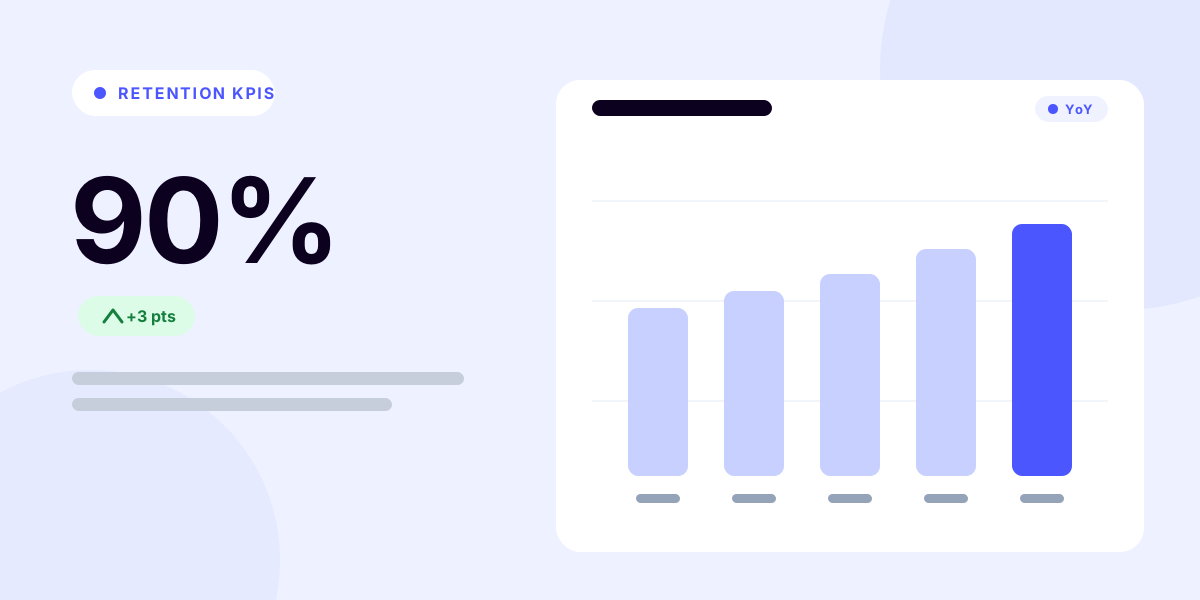
Retention climbs quarter over quarter once people teams track the signals that matter.
Start with the foundation: retention rate and turnover rate
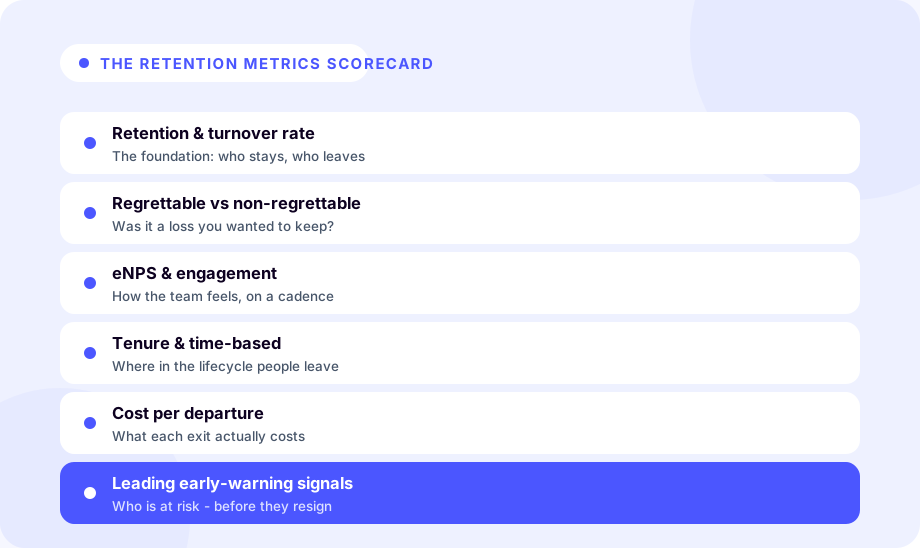
Every retention scorecard starts with two numbers that are really one number viewed from opposite sides.
Retention rate measures the share of people who stayed:
Retention rate = (employees who stayed the whole period / employees at the start of the period) x 100
Turnover rate measures the share who left:
Turnover rate = (separations during the period / average number of employees) x 100
They move in opposite directions, and you'll typically lead with one and use the other as a cross-check. What they do not do is add up to 100%: retention is measured against the people you started the period with, while turnover counts every separation against average headcount, so anyone hired and lost inside the same period moves one number and not the other. The mechanics matter more than they look - how you handle new hires within the period, whether you average headcount monthly or just take start-and-end, and whether you report monthly or annually all change the number. For the exact formulas, a fully worked example, and the choices that trip people up, see our guide to how to calculate employee turnover rate.
The calculator below is the free employee retention rate calculator from our tools pages. It splits leavers into the people who were there at the start and the people you hired during the period, which is what makes the retention figure exact and shows you why the two rates don't sum to 100%.
Only people who were already on the payroll on day one of the period. This is the number the retention formula is built on.
Joined and left inside the same period. These people never touch the retention rate, but they do move your turnover rate.
Employee retention rate
92%
(100 − 8) ÷ 100 × 100: the share of the people you started with who were still there at the end
Turnover rate
11.5%
all 12 separations ÷ average headcount (104) × 100
Retention + turnover
103.5%
not 100%, and it is not meant to be: retention looks at the starting group, turnover counts every leaver against average headcount
New-hire retention rate
80%
how many of the people you hired this period were still there at the end. Headcount at the end of the period: 108
Two practical habits make these foundational metrics far more useful:
- Report both a monthly and an annual figure. Monthly turnover is an early-warning signal that surfaces spikes quickly; annual turnover smooths seasonal noise and is better for benchmarking and board reporting.
- Segment, don't just total. A healthy company-wide rate can hide a single team quietly bleeding talent. Break the number down by team, manager, location, and tenure band, and the actionable story usually appears.
The most important refinement: regrettable vs. non-regrettable attrition
If you only add one metric beyond the headline attrition rate, make it this one. Regrettable attrition is the subset of departures you genuinely wanted to keep - your strongest, hardest-to-replace people. Non-regrettable attrition covers the exits that are neutral or even healthy: a poor fit, a managed-out underperformer, a planned retirement.
This distinction reframes everything. A 20% turnover rate made up mostly of non-regrettable exits is a very different situation from a 10% rate concentrated among your best engineers - yet the headline number alone would tell you the first company has the bigger problem. It usually doesn't. Because nearly all the cost and disruption of turnover lives in the regrettable bucket, tagging each departure as regrettable or not is what makes your retention metrics measure the thing that actually matters.
The wider vocabulary around this (regretted attrition, functional and dysfunctional turnover, average tenure, span of control) is collected in our glossary of retention and people analytics terms, which is worth agreeing on before a scorecard goes to leadership.
It takes a small amount of discipline: when someone leaves, the hiring manager or HR records whether the departure was regrettable, ideally with a short, consistent reason code. Do that for a few quarters and your retention reporting goes from "how many left" to "how many of the right people left, and why" - which is the only version worth presenting to leadership.
Sentiment metrics: eNPS and engagement
Rates tell you what happened; sentiment metrics try to tell you how people feel before it happens. The most common is eNPS (employee Net Promoter Score), which asks how likely someone is to recommend the company as a place to work and nets the promoters against the detractors - our eNPS guide covers the formula and scale in depth, and the free eNPS calculator does the math from your survey counts. Broader engagement scores roll up survey responses across themes like recognition, growth, and management.
Used well, these are valuable for spotting patterns: "managers in this region score low on recognition" is the kind of theme they surface cleanly. But it's worth being honest about their limits:
- They're aggregate. Surveys are anonymous and periodic by design, so they describe groups, not individuals. A team can look fine on a quarterly survey while your single most critical person is quietly interviewing.
- They're lagging. By the time sentiment drops in a survey, the underlying erosion has usually been building for a while.
- There's no universal benchmark. Chasing a target eNPS number across industries is a distraction. Your own trend over time, and the gaps between teams, are the useful reads.
Treat eNPS and engagement as a directional, group-level instrument - necessary, but never a substitute for the individual conversations where retention is actually won.
Tenure and time-based metrics
How long people stay, and when they tend to leave, is some of the most diagnostic data you have.
Tenure distribution plots how long current employees have been with you, and the shape of that curve points you at which problem to fix first. A cliff in the first 90 days points at onboarding or hiring-fit; a wave around the two-year mark often points at stalled growth or a missing next step. Average tenure alone can be misleading - a single long-serving founder skews it - so look at the distribution, not just the mean.
Time-to-fill measures how long a vacant role stays open. It's strictly speaking a recruiting metric, but it belongs on a retention scorecard because it's a multiplier on cost: the longer a regrettable departure leaves a seat empty, the more lost productivity you absorb before ramp even begins. Rising time-to-fill on critical roles is also a quiet argument for getting ahead of departures rather than reacting to them.
Cost metrics: cost per departure
Numbers move budgets, and cost per departure is the metric that turns retention from a soft priority into a defensible business case. It combines the direct, visible costs of replacing someone - recruiting, agency fees, onboarding, equipment - with the larger hidden costs: lost productivity, ramp time, knowledge loss, and the load on the remaining team.
You don't need perfect precision. A defensible estimate built from your own roles beats a generic industry percentage every time, and it's far harder to dismiss in a budget meeting. For a simple formula and a clearly-labeled worked example you can adapt, see our guide to the real cost of employee turnover. Multiply your cost per departure by your expected regrettable departures per year, and you have the number that makes the case for every early intervention below.
Leading vs. lagging indicators (and why the distinction is everything)
Here's the uncomfortable truth about most of the metrics so far: they're lagging indicators. Turnover rate, regrettable attrition, exit reasons, even a dropping eNPS - they all measure something that has already happened or is well underway. They're essential for understanding the past and explaining it to leadership, but they're useless for changing it, because by the time they move, the people are already gone or going.
Leading indicators measure rising risk before a departure. They include:
- A drop in someone's discretionary effort or engagement relative to their own baseline.
- Withdrawal from long-term projects or a cooler attitude in one-on-ones.
- Publicly available signs of renewed job-market interest - visible activity on a professional profile, for instance.
Leading indicators are noisier than lagging ones - no early signal is proof of anything on its own - but they're the only metrics that buy you lead time. And lead time is what makes every retention lever work: a growth conversation, a comp adjustment, a workload fix, or, if a departure is genuinely coming, time to plan a clean handoff. A scorecard built entirely from lagging metrics is a scorecard that can only ever tell you what you've already lost. For the broader prediction problem - turning scattered signals into something you can act on - see our guide on how to predict employee turnover before it happens.
Where early-warning signals fit on your scorecard
The challenge with leading indicators is that most of them live inside your systems - and by the time disengagement shows up clearly in survey data or performance records, the person has often already started looking elsewhere. The earliest, most honest signal that someone is exploring the market frequently appears outside your walls, in their public professional activity.
This is the gap TeamPredict is built to fill, as a leading indicator that complements the lagging metrics on your scorecard. It surfaces early, proactive signals of resignation risk from publicly available LinkedIn profile activity and summarizes them into a simple resignation-risk level for each tracked employee. On a metrics scorecard dominated by aggregate, backward-looking numbers, that's a rare thing: a forward-looking, person-level signal that tells a manager who needs attention now rather than what already happened last quarter.
A few honest framings for how it belongs on the scorecard. Read the risk level alongside your engagement, tenure, and turnover numbers; each answers a different question, and no single metric tells the whole story. Treat a high level as a reason to check in with someone, never as proof they are leaving or grounds to treat them differently. And any individual-level signal should come from a source you can explain plainly: TeamPredict's is public professional activity, framed around proactive retention.
At $5 per tracked employee per month, with a 30-day free trial (no charge until the trial ends; cancel anytime), it's a low-cost way to add the one type of metric most scorecards are missing: a leading indicator with enough lead time to actually act.
Building a scorecard that drives action
Pull it together and a strong retention scorecard is short, layered, and biased toward action:
- Headline rates - retention and turnover, reported monthly and annually, segmented by team and manager.
- Regrettable attrition - the share of departures you wanted to keep, with reason codes.
- Sentiment - eNPS or engagement, read as a trend and by segment, not against an external benchmark.
- Tenure distribution and time-to-fill - to locate when people leave and how costly the gaps are.
- Cost per departure - built from your own roles, to make the business case.
- Leading indicators of flight risk - the forward-looking layer that turns the whole scorecard from a postmortem into an early-warning system.
The first five tell you how you're doing and why. The sixth is the one that lets you do something about it before it's too late. A People team that tracks all six - and weights its attention toward the last one - stops being surprised by the departures it would least want.
If you'd like to add that leading-indicator layer to your own scorecard, a person-level read on rising resignation risk early enough to act, you can start a free TeamPredict trial and see your team's signals in one place. It takes minutes to set up, runs for 30 days, and there's no charge until the trial ends; cancel anytime before then and pay nothing.
These numbers only matter if they drive action: make them part of your wider employee retention program. For the tooling side, see our vendor-neutral guide to employee retention software.
Frequently asked questions
- What are the most important employee retention metrics?
- The foundational ones are retention rate and its mirror, turnover rate. The single most important refinement is splitting regrettable from non-regrettable attrition, so you measure the losses that actually hurt. From there, the highest-value additions are eNPS or engagement scores, tenure distribution, time-to-fill, and an estimated cost per departure - plus leading indicators of flight risk, which are the only metrics that give you time to act before someone leaves.
- What's the difference between leading and lagging retention indicators?
- Lagging indicators measure what already happened - turnover rate, regrettable attrition, exit reasons. They're essential for understanding the past but useless for changing it, because by the time they move, the people are already gone. Leading indicators measure rising risk before a departure - falling engagement, withdrawal from long-term work, or publicly available signs of renewed job-market interest. They're noisier, but they're the only metrics that buy you lead time to act.
- How do you calculate employee retention rate?
- Retention rate = (number of employees who stayed for the whole period / number of employees at the start of the period) x 100. Count only people who were present at the start and remained through the end - new hires within the period are usually excluded so the number isn't distorted. Retention rate and turnover rate are two sides of the same coin and are best read together.
- What is regrettable attrition and why does it matter?
- Regrettable attrition is the subset of departures you genuinely wanted to keep - your strongest and hardest-to-replace people. It matters because nearly all the cost and disruption of turnover concentrates here. A high overall turnover rate driven by low-performer exits is far less worrying than a smaller rate concentrated among your best people, so tagging departures as regrettable or not is what makes every other metric meaningful.
- What is a good eNPS score?
- There's no universal eNPS benchmark - the common rules of thumb and the full interpretation bands are covered in our dedicated employee Net Promoter Score (eNPS) guide. For your own company, the trend over time and the gaps between teams matter more than any single target number.
About TeamPredict
TeamPredict Team
We build TeamPredict - retention early-warning software that flags resignation risk from public LinkedIn signals. We write about the patterns that precede a resignation and how people-first teams act on them early. Learn more about TeamPredict
Work out your own turnover rate.
Enter your headcount and departures - the free calculator runs the formula and shows the annualized figure.
Calculate your turnover rateFree, no signup required.