How to Calculate Employee Turnover Rate (Formula, Benchmarks & How to Improve It)
If you manage people, sooner or later someone asks for "the turnover number" - and you need it to be right. Knowing how to calculate employee turnover rate correctly is the foundation of every retention decision you'll make, from headcount planning to spotting which teams are quietly bleeding talent. This guide gives you the exact formula, a fully worked example, the different types of turnover that actually matter, and concrete ways to bring the number down.
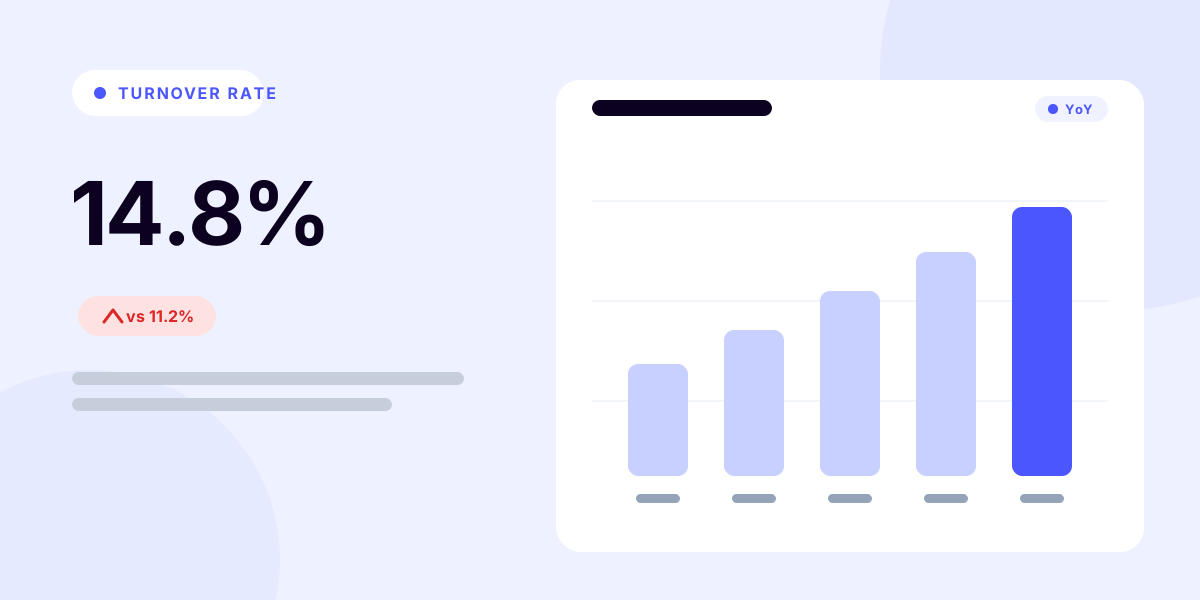
A clear rate, charted against your own trend, with time to act before exits cluster.
The employee turnover rate formula
The standard employee turnover rate formula is simple:
Turnover rate = (number of separations during a period / average number of employees during that period) x 100
Three terms do all the work here:
- Separations - everyone who left the organization during the period, for any reason: resignations, terminations, layoffs, and retirements.
- Average number of employees - your headcount at the start of the period plus your headcount at the end, divided by two. (For an annual figure, averaging your twelve month-end headcounts is more accurate.)
- x 100 - converts the ratio into the percentage everyone expects to see.
A few rules keep your number clean and comparable:
- Use headcount, not full-time equivalents (FTE), unless you report FTE consistently everywhere. Mixing the two quietly distorts the result.
- Count people, not events. Someone who was hired and left in the same period still counts as one separation.
- Be consistent about who's in scope. Decide up front whether contractors, interns, and seasonal staff are included, and apply that rule every time so your trend stays comparable.
A fully worked example
Numbers make this concrete. The following figures are purely illustrative - a made-up company, not an industry statistic - to show the math end to end.
Imagine a company called Northwind Labs. Over one calendar year:
- Headcount on January 1: 220 employees
- Headcount on December 31: 240 employees
- People who left during the year: 34 separations
Step 1 - Find the average number of employees.
(220 + 240) / 2 = 230
Step 2 - Divide separations by the average headcount.
34 / 230 = 0.1478
Step 3 - Multiply by 100.
0.1478 x 100 = 14.8%
So Northwind Labs had an annual turnover rate of roughly 14.8%. Note that the company grew during the year (220 to 240), yet still lost 34 people - a reminder that turnover and growth are separate stories. Net headcount can rise while you're losing people you'd rather have kept, which is exactly why the type of turnover matters as much as the headline rate.
Want the math done for you? The calculator below - the same free turnover & retention rate calculator from our tools pages - computes turnover, retention, and annualized rates from these same three inputs. And if your company reports "attrition" instead, the formula is the same - the difference is what you count, which we unpack in our attrition rate guide. UK readers who say "staff turnover" will find the same method, worked through in our staff turnover guide.
If retention rather than turnover is the number you report, use the employee retention rate calculator instead. It asks separately about the people who were there at the start and the people you hired mid-period, so the retention figure is exact rather than an approximation, and it shows why retention and turnover never add up to 100%. If a colleague reads the number differently than you do, the argument is usually about wording rather than arithmetic, and each metric has its own glossary definition you can point at.
Count everyone who left, voluntary and involuntary. For attrition rate, count only the departures you didn't backfill.
Annual turnover rate
12.2%
separations ÷ average headcount (98) × 100
Retention rate
88%
share of the starting headcount that stayed the whole period (assumes all leavers were part of the starting headcount)
Voluntary, involuntary, and regrettable turnover
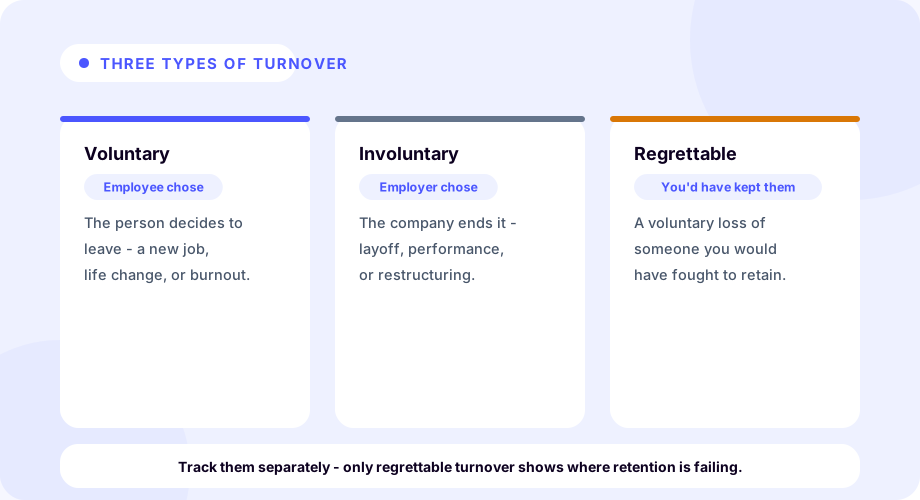
A single blended percentage hides more than it reveals. To make the number useful, break it into categories.
Voluntary turnover
Voluntary turnover covers everyone who chose to leave - they resigned, retired, or moved on. This is the figure most retention work targets, because these departures are the ones you can often influence with better management, growth paths, and pay.
Involuntary turnover
Involuntary turnover covers exits the company initiated: terminations for performance or conduct, and layoffs or role eliminations. A spike here usually points to hiring quality, performance management, or restructuring - not to a culture problem that's pushing people out the door.
Regrettable vs. non-regrettable turnover
This is the cut that experienced People Ops leaders care about most. Within voluntary turnover:
- Regrettable turnover is the departure of people you genuinely wanted to keep - strong performers, key knowledge holders, hard-to-replace skills.
- Non-regrettable turnover is the departure of people whose exit is neutral or even healthy for the team.
Two companies can post the same 14.8% and be in completely different situations. If most of that number is non-regrettable, it may be a sign of healthy churn. If it's concentrated among your best people, you have a serious, expensive problem hiding behind an average-looking figure. Always tag leavers as regrettable or not - it's the single most valuable refinement you can add to the basic calculation, and it's what turns turnover from a backward-looking report into a management signal. Turnover rate is also just one number on a broader scorecard; for the full set of employee retention metrics and KPIs worth tracking - and how they fit together - see our dedicated guide. For the deeper question of why your strongest people walk, see our guide on why good employees leave and how to keep them.
Monthly vs. annual turnover
The formula doesn't change with the time window - but what you learn from it does.
Monthly turnover uses the same equation over a single month. It's your early-warning instrument: a sudden jump in one team's monthly rate is something you want to see in weeks, not discover in next year's annual review. Because the numbers are small, expect monthly figures to be noisier - one or two departures can swing the percentage a lot in a small team.
Annual turnover smooths out that noise and seasonality. It's the right figure for benchmarking against your industry, reporting to a board, and tracking your long-term trend.
One caution: don't simply multiply a single month by 12 to estimate the year. A quiet January says little about a busy hiring season, and one rough month can badly overstate your annual reality. If you need an annualized view from monthly data, average several months first, then annualize - or better, calculate the annual figure directly from twelve months of headcount.
A practical cadence for most teams:
- Monthly: track turnover by team and flag any spike for a closer look.
- Quarterly: review regrettable turnover and the reasons behind exits.
- Annually: report the headline rate, benchmark it, and set goals.
What counts as a "good" turnover rate?
This is the question everyone asks, and the honest answer is: it depends, and the benchmark matters less than you'd think.
There's no universal "good" number, because healthy turnover varies enormously by industry, role type, and company stage. In general terms:
- Industries with hourly, frontline, or seasonal roles tend to run structurally higher turnover, and that's normal for the work rather than a sign of failure.
- Specialized, salaried, knowledge-worker roles tend to run lower, and a small jump there can be more painful and costly than a large swing in a high-volume role.
- Fast-growing companies often see more movement simply because more is changing around people.
Rather than chasing someone else's percentage, judge your rate against three more useful reference points:
- Your own trend. Is turnover rising, flat, or falling over the last several quarters? Direction beats any single snapshot.
- The regrettable share. A higher overall rate made up of non-regrettable exits can be healthier than a lower rate concentrated in your best people.
- Your industry and role mix, in broad strokes. Use benchmarks as rough orientation, not as a target to hit.
A turnover rate is a thermometer, not a diagnosis. It tells you something is worth investigating; it doesn't tell you what or why. For the forward-looking side of this work, our guide on how to predict employee turnover before it happens covers the leading indicators that show up well before a resignation letter.
How to reduce employee turnover
Once you can measure turnover and split it by type, you can act on it. Some churn is healthy and inevitable, so zero turnover is the wrong target. The goal is to protect against regrettable losses and address the conditions that push good people out. The most effective levers tend to be:
- Managers, first and always. People leave managers more than companies. Equip frontline managers to hold regular, honest one-on-ones and to surface concerns before they harden into a decision.
- Growth and progression. Stalled careers are a leading cause of regrettable exits. Make development paths visible and real, not just an annual promise.
- Fair, transparent pay. You don't have to top the market, but unexplained or below-band pay is a fast route to resignations once people compare notes.
- Recognition and meaningful work. Consistent, specific recognition and a clear line from daily work to impact keep engaged people engaged.
- Onboarding and early experience. A meaningful share of turnover happens in the first months. A strong onboarding experience pays off for years.
- Act on exit and stay interviews. Patterns in why people leave, plus stay interviews with current employees, point straight at your highest-impact fixes.
For a fuller playbook, see our deep dive on employee retention strategies that actually work and our breakdown of employee flight risk and how to reduce it.
The thread connecting all of these is lead time. Almost every effective retention move - a career conversation, a pay adjustment, a project change, a successor groomed quietly in the background - works far better when you start early. The hardest cases are the ones you only learn about when the resignation lands on your desk, because by then the decision is usually made.
This is the gap TeamPredict is built to close. By surfacing early, proactive signals of resignation risk from publicly available LinkedIn activity and summarizing them into a simple resignation-risk level per tracked employee, it gives leaders the one thing turnover data alone can't: time to act before someone has already decided to go. Used well, it simply moves the conversation earlier, while the person at risk still has reasons to stay.
A simple step-by-step to calculate your turnover rate
Here's the whole process condensed into repeatable steps:
- Pick your period. Decide whether you're calculating monthly, quarterly, or annual turnover, and use the same window every time so your trend stays comparable.
- Count separations. Total everyone who left during the period - voluntary and involuntary - and decide up front whether contractors and temps are in scope.
- Find your average headcount. Add starting and ending headcount and divide by two (or average your month-end headcounts across the period for more accuracy).
- Apply the formula. Divide separations by average headcount, then multiply by 100.
- Segment the result. Split into voluntary vs. involuntary, then flag the regrettable share - this is where the real insight lives.
- Compare and act. Track the trend over time, look at it by team and manager, and focus your retention effort where regrettable turnover is highest.
Do this consistently and turnover stops being a number you scramble to produce once a year. It becomes a living signal that tells you where to look - and, paired with early warning, when to act.
Track the number that matters, then get ahead of it
Calculating your turnover rate is the easy part: separations divided by average headcount, times 100. The hard part is acting on it early enough to change the outcome, which means knowing who's at risk before they hand in notice rather than after. If you want that lead time for your team, you can start a free 30-day TeamPredict trial. You won't be charged until the trial ends, and you can cancel anytime. It turns employee retention from a year-end report into a proactive, week-by-week practice.
Frequently asked questions
- What is the formula for employee turnover rate?
- Turnover rate = (number of separations during a period / average number of employees during that period) x 100. Count everyone who left, divide by the average of your starting and ending headcount, and multiply by 100 to get a percentage.
- How do I calculate average number of employees?
- Add your headcount at the start of the period to your headcount at the end of the period, then divide by two. For more accuracy over a year, average your month-end headcounts across all twelve months instead.
- What is a good employee turnover rate?
- There is no single universal number. A 'good' rate is low relative to your own industry, role mix, and history, and it is mostly made up of non-regrettable departures. Watch your regrettable turnover and your trend over time more than any benchmark figure.
- What is the difference between voluntary and regrettable turnover?
- Voluntary turnover is anyone who chooses to leave. Regrettable turnover is the subset of those leavers you genuinely wanted to keep. A high voluntary rate driven by low-performer exits is far less concerning than a smaller rate concentrated among your best people.
- Should I calculate turnover monthly or annually?
- Both. Monthly turnover gives you an early-warning signal and lets you spot spikes quickly, while annual turnover smooths out seasonal noise and is better for benchmarking and board reporting.
About TeamPredict
TeamPredict Team
We build TeamPredict - retention early-warning software that flags resignation risk from public LinkedIn signals. We write about the patterns that precede a resignation and how people-first teams act on them early. Learn more about TeamPredict
What is turnover actually costing you?
Put a number on it in about two minutes with the free turnover cost calculator. No email, no signup.
Calculate your turnover costFree, no signup required.