15 Employee Retention Strategies That Actually Work
Losing a good employee is rarely a surprise in hindsight - the signals were usually there for weeks. The best employee retention strategies work because they help you act on those signals early, while the relationship is still strong and the person can still be persuaded to stay. This guide walks through 15 retention strategies that actually move the needle for SMB and mid-market teams, with a clear focus on proactive, human management rather than reactive scrambling. For each one, you'll get what it is, why it works, and a concrete first step you can take this week.
Retention isn't one program. It's the cumulative experience an employee has - from their first day, through their manager relationship, to their sense of growth a year in. Treat these as a menu to prioritize against your own evidence, not a checklist to launch all at once. If you want the wider context first - what retention is, why it matters, and how these tactics fit a broader framework - start with our complete guide to employee retention, which this article expands on.
Stack the proven moves one at a time so people feel the change rather than the churn.
Why a deliberate retention strategy matters
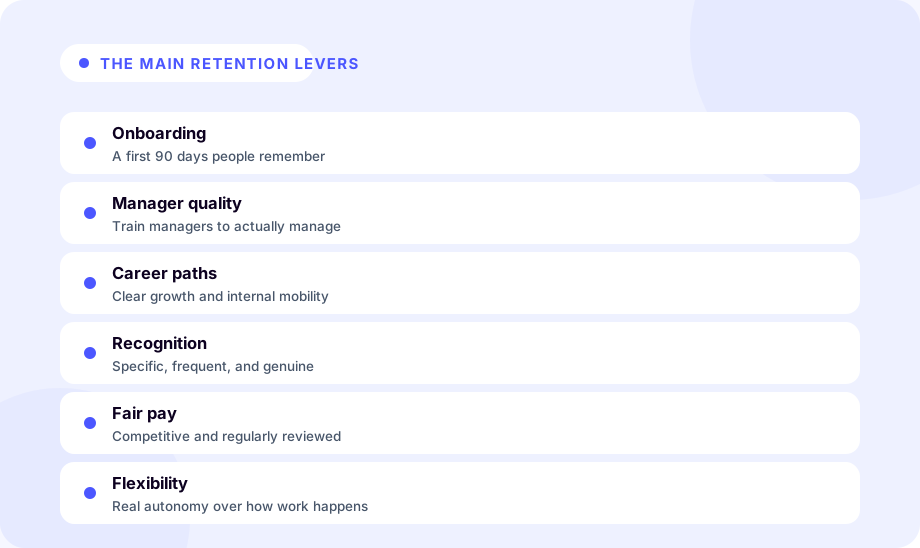
When someone resigns, the visible cost - recruiting and ramp-up - is only part of the picture. You also lose institutional knowledge, momentum on in-flight projects, and sometimes the trust of teammates who wonder why no one saw it coming. The hidden tax is the productivity dip while a role sits open and a replacement gets up to speed.
The encouraging part: most regretted departures are preventable. People rarely leave over a single bad day. They leave after a slow accumulation of unaddressed frustrations - stalled growth, an unsupportive manager, feeling unseen. Each of the strategies below targets one of those root causes, which is why combining a handful of them compounds. If you want a deeper look at the underlying drivers, our breakdown of why good employees leave and how to keep them pairs well with the playbooks here.
1. Build an onboarding experience people remember
What it is: A structured first 30–90 days that covers relationships, role clarity, and early wins on top of the paperwork and tools.
Why it works: The first few weeks set the tone for the entire tenure. New hires who feel lost, under-supported, or unsure of what success looks like start quietly questioning their decision early - and that doubt is hard to reverse later.
First step: Map your current onboarding from the new hire's point of view. Write down every touchpoint in week one and flag the gaps - a missing buddy, an unclear 90-day goal, a manager who's traveling on day one. Fix the single biggest gap before your next start date.
2. Train your managers to actually manage
What it is: Equipping frontline managers with the skills to coach, give feedback, run effective one-on-ones, and have hard conversations well.
Why it works: The manager relationship is one of the strongest predictors of whether someone stays. People often join a company and leave a manager. A manager promoted for technical skill but never taught to lead is a quiet, common retention risk.
First step: Audit whether your managers are running consistent, recurring one-on-ones. If they're not, make weekly or biweekly one-on-ones non-negotiable and give managers a simple agenda template to structure them.
3. Create clear career paths and internal mobility
What it is: Visible routes for advancement - promotions, lateral moves, and skill-based growth - plus a culture that fills open roles from within first.
Why it works: "I can't see a future here" is one of the most common reasons capable people start looking elsewhere. When the only way up is out, your strongest performers leave first. Internal mobility keeps that ambition inside the building.
First step: For each role on your team, sketch one realistic next step and the two or three skills required to get there. Share it in your next one-on-one so people can see a path.
4. Recognize good work specifically and often
What it is: Consistent, specific acknowledgment of contributions - from a manager's thank-you to peer recognition and public credit.
Why it works: Feeling unseen erodes motivation faster than almost anything. Recognition is low-cost and high-impact, but only when it's specific and timely. Generic praise lands as noise; "the way you handled that escalation kept the account" lands as respect.
First step: At the end of this week, send two specific, genuine notes of recognition tied to a concrete outcome - not "great job," but what they did and why it mattered.
5. Pay fairly and keep compensation competitive
What it is: Salary, equity, and benefits that are internally fair and externally competitive for your market and roles.
Why it works: Pay rarely buys loyalty on its own, but unfair or below-market pay is a fast, hard-to-recover reason to leave. Once someone feels underpaid, every other frustration weighs heavier. Fair comp removes a reason to look elsewhere. Pay is also only one part of a wider employee value proposition - the full set of rewards, growth, and meaning people get in exchange for their work - and being clear about that whole package helps the rest of these strategies land.
First step: Identify your highest-impact, highest-risk roles and sanity-check their pay against current market data. Address the most glaring gap before it becomes a resignation letter.
6. Offer real flexibility
What it is: Genuine control over where, when, or how people work - remote or hybrid options, flexible hours, or outcome-based schedules - calibrated to what your work actually allows.
Why it works: Flexibility has become a baseline expectation for many knowledge workers, and it directly supports the life logistics that otherwise create burnout and resentment. Trusting people with autonomy also signals respect, which compounds loyalty.
First step: Ask your team what one change to flexibility would most improve their week. You'll often find the highest-value adjustment is smaller and cheaper than you assumed.
7. Run regular stay interviews
What it is: Short, structured conversations with current employees about what keeps them engaged, what frustrates them, and what might tempt them to leave.
Why it works: Exit interviews tell you what you already lost. Stay interviews give you the same insight while you can still act on it - and the act of asking signals that you care about the answer.
First step: Pick three people you'd least want to lose. Schedule a 30-minute stay interview with each and ask: "What would make you consider leaving, and what keeps you here?" Then act on at least one thing you hear.
8. Build an early-warning system for flight risk
What it is: A proactive way to spot rising resignation risk early - combining attentive management with structured signals, including publicly available indicators that an employee may be re-entering the job market.
Why it works: The earlier you know someone is at risk, the more options you have: a candid conversation, a growth opportunity, a workload fix, or - if a departure is genuinely coming - time to groom a successor and plan a clean handoff. Acting on early signals is the difference between a calm transition and a fire drill. This is exactly the gap TeamPredict was built to close, by surfacing early, publicly available signals into a simple resignation-risk level per tracked employee so leaders get lead time, not surprises.
First step: Define what "at risk" looks like on your team and decide in advance how you'll respond. For a practical foundation, learn how to predict employee turnover before it happens and review the common signs an employee is about to quit so your managers know what to watch for.
9. Invest in growth and learning
What it is: Ongoing development - stretch assignments, mentorship, training budgets, and time to learn - that helps people get measurably better at their craft.
Why it works: High performers are often the most ambitious, and stagnation drives them out fastest. When people feel they're growing, staying is the path of least resistance; when they plateau, leaving becomes the only way to keep developing.
First step: In your next one-on-one, ask each person what skill they want to build this quarter, then connect them to one concrete opportunity - a project, a course, or a mentor - to build it.
10. Manage workload and protect wellbeing
What it is: Actively monitoring and balancing how much is on people's plates, and treating sustainable pace as a leadership responsibility rather than an individual problem.
Why it works: Chronic overload is a top driver of burnout, and burnout is a top driver of resignation. Your most reliable people are often the most overloaded precisely because they never say no - which makes them silent flight risks.
First step: Review your team's current workload honestly. Find the one person carrying the most and have a direct conversation about what to offload, defer, or stop entirely.
11. Close the loop on feedback
What it is: A reliable cycle where you collect employee input - through surveys, one-on-ones, or town halls - and visibly act on it.
Why it works: Asking for feedback and then doing nothing is worse than not asking at all; it teaches people their voice doesn't matter. Closing the loop builds trust, and trust is what keeps people engaged through rough patches.
First step: Take one piece of feedback you've already received, act on it this month, and tell the team explicitly: "You said X, so we changed Y." Visible follow-through is the whole point.
12. Communicate transparently
What it is: Honest, timely communication about company direction, challenges, changes, and the reasoning behind decisions.
Why it works: Uncertainty breeds anxiety, and anxious people start hedging their bets - including by updating their resumes. Transparency, even about hard news, builds the psychological safety that makes people willing to stay through change.
First step: Identify one thing your team is uncertain about right now and address it directly in your next team meeting, including the "why" behind it. Default to sharing more, not less.
13. Connect daily work to purpose
What it is: Helping people see how their specific work ladders up to the team's mission and the company's larger purpose.
Why it works: Meaning is a powerful retention force. When people understand why their work matters and who it helps, ordinary tasks become more motivating - and a higher salary elsewhere becomes less tempting on its own.
First step: In your next team meeting, explicitly connect a recent project to a customer outcome or company goal. Make the line from "what we did" to "why it mattered" impossible to miss.
14. Distribute work fairly
What it is: Ensuring that high-visibility opportunities, undesirable tasks, and overall load are spread equitably rather than concentrated on a few people.
Why it works: Perceived unfairness corrodes morale quietly. When the same people always get the glamour projects - or always get stuck with the grunt work - resentment builds, and your best contributors notice. Fairness keeps trust intact.
First step: Look at who got the last few stretch assignments and who's been handling the thankless tasks. If there's an imbalance, rebalance the next round deliberately.
15. Treat departures as the start of a relationship
What it is: A graceful offboarding and alumni approach that keeps the door open for strong leavers to return as "boomerang" employees.
Why it works: Not every departure is preventable, and that's fine. People who leave on good terms become referral sources, future customers, and - surprisingly often - returning hires who come back more skilled and more committed. How you handle the exit shapes whether that door stays open.
First step: Build a simple, respectful offboarding checklist that ends with a genuine "we'd welcome you back." Stay in light touch with your best alumni a few times a year.
How to prioritize your employee retention strategies
Don't attempt all 15 at once. Use your own evidence to sequence them:
- If new hires leave early, start with onboarding (#1) and manager training (#2).
- If tenured people leave, focus on growth (#9), career pathing (#3), and recognition (#4).
- If you're losing people you didn't see coming, build your early-warning system (#8) and start stay interviews (#7).
- If burnout themes keep surfacing, tackle workload (#10) and fairness (#14) first.
A useful companion step is to get honest about your baseline. Knowing how to calculate your employee turnover rate and understanding how to identify and reduce flight risk turns "we should retain people better" into measurable goals you can actually track over time.
Employee retention strategy examples
These illustrative examples show how the strategies above tend to play out in practice. They're composite scenarios built to make the moves concrete for teams of different sizes - not real customer data, and deliberately free of invented numbers. Your own results will depend on your team, your starting point, and how reliably you run each move.
-
A 25-person agency (onboarding + manager training). New hires kept leaving inside their first six months, and exit conversations pointed to a rough, sink-or-swim start. The owner rebuilt onboarding around a structured first 90 days with a buddy and clear early wins (strategy #1) and coached team leads to run consistent one-on-ones (strategy #2). Before, new starters felt lost and quietly questioned their decision; after a full year of the new rhythm, early departures became the exception rather than the pattern and people reported feeling oriented far sooner.
-
A 120-person software company (career pathing + stay interviews). Several strong mid-level engineers left within a few months of each other, each citing "no room to grow." Leadership sketched a visible next step for every role (strategy #3) and introduced twice-yearly stay interviews with their highest-impact people (strategy #7). The change was qualitative rather than a headline number: growth frustrations that used to surface in exit interviews now came up months earlier, and two engineers who had been quietly looking chose to stay after a concrete internal move.
-
A 60-person operations team (workload + early-warning signals). A handful of dependable people were silently absorbing every overflow until two of them burned out and resigned in the same quarter. The team started reviewing real workload openly (strategy #10) and paired attentive management with earlier flight-risk signals (strategy #8). The shift was less about a metric and more about lead time: managers began having supportive conversations weeks before someone reached a breaking point, instead of reading about it in a resignation email.
How engagement and retention strategies work together
Engagement and retention are two views of the same reality, not separate initiatives. Engagement strategies shape how work feels day to day - recognition, autonomy, a manager who listens - while retention strategies hold the structure together over time: onboarding, fair pay, career paths, and graceful exits. The teams that keep their best people run engagement and retention strategies as one system, because day-to-day engagement is where you first notice trouble and the structural retention moves are what let someone act on it and stay. For the day-to-day half of that system, our guide to employee engagement strategies that actually reduce turnover is the natural companion to this playbook.
Putting it into practice
Retention rewards consistency over intensity. The teams that keep their best people do the fundamentals reliably rather than running flashy programs: managers who listen, growth that's visible, recognition that's specific, and an honest read on who might be quietly heading for the door. Pick one or two strategies, implement them fully, and let the results compound.
If you'd like earlier lead time on the people you'd least want to lose, so you can have the supportive conversation before a resignation is final, start a free TeamPredict trial and see your team's resignation-risk signals in one place. It takes minutes to set up, and you won't be charged until the trial ends; cancel anytime before then and pay nothing.
Track whether your efforts are working with the right employee retention metrics, and if you are deciding between an employee retention platform and a single-purpose tool, our buyer's guide walks through the trade-off. The simplest place to start is one number you can rerun each quarter: put your starting headcount, hires, and leavers into the free tool that will measure your retention rate and keep the result somewhere you will see it again.
Frequently asked questions
- What are the most effective employee retention strategies?
- The most effective strategies tend to be the unglamorous ones: a strong onboarding experience, well-trained managers, clear paths for growth and internal mobility, fair and transparent pay, genuine flexibility, and regular stay interviews. No single tactic retains people on its own - retention comes from the cumulative experience an employee has across their first weeks, their manager relationship, and their sense of progress over time.
- How do I know which retention strategy to start with?
- Start where your evidence points. Look at exit interview themes, engagement survey comments, and which teams lose the most people. If new hires leave early, fix onboarding first. If tenured people leave, look at growth, recognition, and manager quality. Pick one or two changes you can fully implement rather than launching ten half-finished initiatives.
- Can you retain employees without raising salaries?
- Often, yes - though pay still has to be fair and competitive. Once compensation is in a reasonable band, growth opportunities, good management, recognition, flexibility, and meaningful work frequently weigh more heavily in someone's decision to stay. Pay gets people in the door and prevents an obvious reason to leave, but the day-to-day experience is usually what keeps them.
- What is a stay interview and how is it different from an exit interview?
- A stay interview is a short, structured conversation with a current employee about what keeps them engaged, what frustrates them, and what would make them consider leaving. Unlike an exit interview, which happens after someone has already decided to go, a stay interview gives you the chance to act while the person is still on your team and the relationship is intact.
- How can managers spot flight risk before someone resigns?
- Managers can watch for shifts in engagement, withdrawal from longer-term projects, changes in tone during one-on-ones, and a quiet drop in discretionary effort. Combining attentive management with structured signals - including publicly available indicators of renewed job-market interest - gives leaders earlier lead time to have a supportive conversation before a resignation is final.
About TeamPredict
TeamPredict Team
We build TeamPredict - retention early-warning software that flags resignation risk from public LinkedIn signals. We write about the patterns that precede a resignation and how people-first teams act on them early. Learn more about TeamPredict
Don't wait for the resignation letter.
TeamPredict flags resignation risk early from public LinkedIn signals, so you have lead time to retain your best people.
Start 30-Day Free TrialNo charge today · Cancel anytime