Employee Flight Risk: How to Identify and Reduce It
Most resignations feel sudden to the manager and obvious in hindsight. The signs were usually there for months - quieter one-on-ones, a stalled growth conversation, a refreshed LinkedIn profile - but no one connected them in time. Employee flight risk is the discipline of connecting those dots early: understanding which of your people are most likely to leave, why, and what you can do about it while you still have room to act. This guide breaks down what flight risk really is, how to assess it without crossing into surveillance, and a concrete playbook to reduce it.
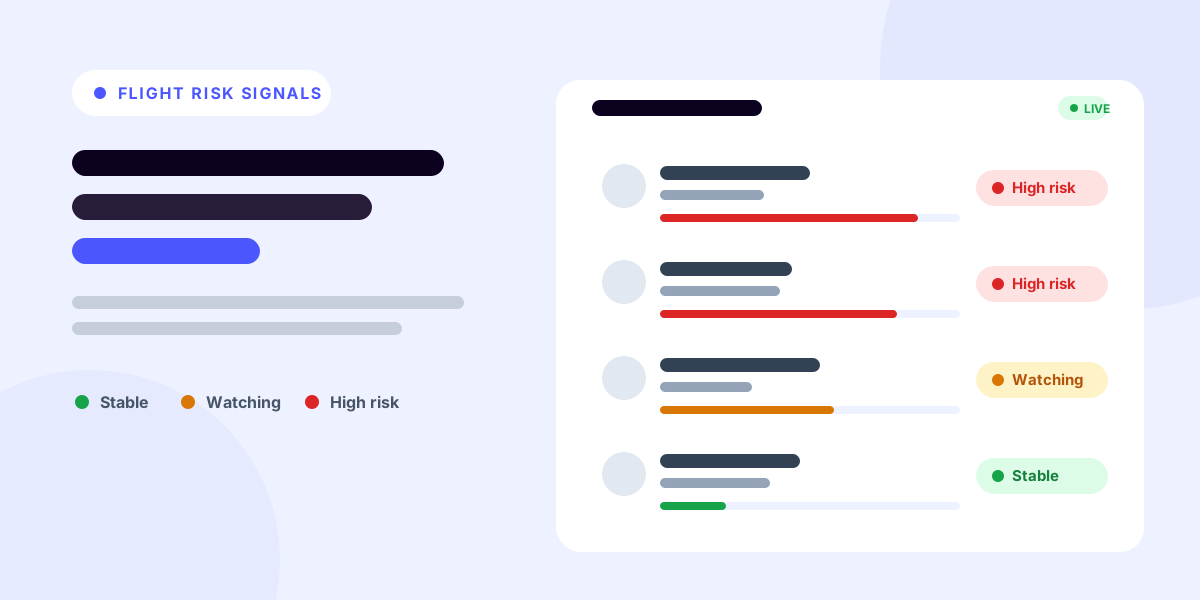
Sorted highest-risk first, so you see who to retain before the resignation lands.
What is employee flight risk?
Employee flight risk is the likelihood that a specific person on your team will voluntarily resign in the foreseeable future. It is a forward-looking read on an individual, where turnover rate is a backward-looking statistic about your whole company. It says nothing about someone's character or loyalty. You will also see it called employee retention risk - the same idea framed around what you stand to lose - and the two terms are used interchangeably throughout this guide.
Two distinctions matter:
- Flight risk vs. turnover rate. Turnover rate is a lagging, aggregate measure of who already left. (If you need to calculate yours, see our guide on how to calculate employee turnover rate.) Flight risk is a leading, individual measure of who might leave next. One tells you about the past; the other gives you time to change the future.
- Risk is not a verdict. A "high" flight-risk read is a prompt to have a conversation; it proves nothing on its own. Treated well, it is one of the most useful early-warning signals a manager has.
If the surrounding vocabulary is new (resignation signal, leading versus lagging indicator, regretted attrition), the HR glossary defines each one in a sentence.
The point of naming flight risk is lead time. A resignation handled reactively gives you two weeks. The same situation caught two months earlier gives you room to address the real concern, adjust scope or pay, groom a successor, or, at minimum, plan a clean transition instead of a scramble.
High performers at risk vs. general churn
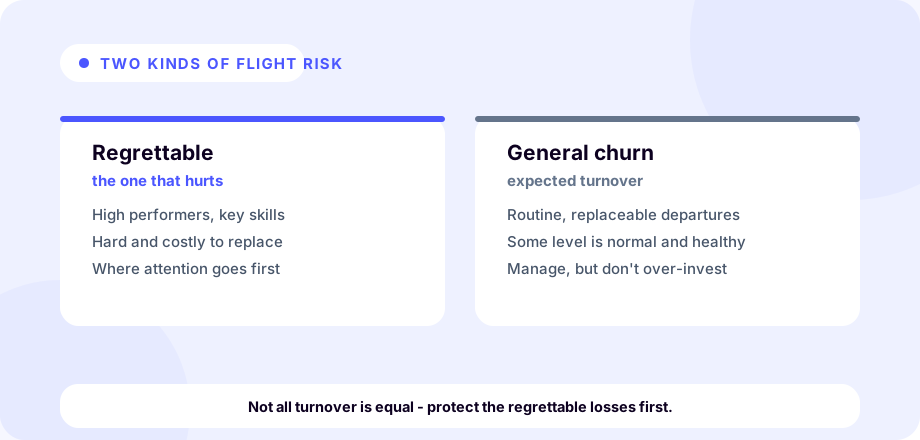
Not all turnover deserves the same level of worry, and treating it as one undifferentiated number hides the problem that matters most.
General churn is the steady, expected background rate of departures: people relocating, changing careers, retiring, or moving on after a natural tenure. Some of it is healthy. A team with zero turnover often has a stagnation problem in disguise.
High-performer flight risk is different, and far more expensive. When your strongest people - or anyone in a critical, hard-to-replace role - start drifting toward the door, the impact compounds:
- Output drops before and after they leave, as disengagement sets in and then the work goes unstaffed.
- Knowledge walks out - context, relationships, and undocumented institutional memory that no job description captures.
- Other people notice. When a respected colleague leaves and nothing visibly changes, it quietly raises flight risk across the team.
This is why a smart flight-risk program is weighted by impact, not just probability. A modest chance of losing someone whose departure would stall an entire product line deserves more attention than a near-certain departure from a role you can backfill in two weeks. For a deeper look at why your best people leave in the first place, see why good employees leave - and how to keep them.
The real cost of losing a flight-risk employee
It is tempting to reduce attrition to a single replacement cost, but the true cost of losing a high-risk, high-value employee is broader and mostly hidden. Qualitatively, it shows up as:
- Recruiting and ramp. Sourcing, interviewing, onboarding, and the months before a replacement is fully productive. For senior or specialized roles, that runway is long.
- Lost momentum. Projects slip, decisions stall, and customers or stakeholders feel the gap - sometimes well before the person actually leaves.
- Knowledge erosion. The hardest cost to see and the slowest to recover: the "how things really work here" that lived in one person's head.
- Manager and team load. Remaining team members absorb extra work, which raises their flight risk - the failure mode where one departure quietly seeds the next.
- Morale and signal. Each unaddressed exit of a valued colleague tells everyone else something about whether staying is worth it.
The encouraging flip side: because most of these costs accrue before the resignation, the earlier you act, the more of them you can avoid. Prevention is dramatically cheaper than replacement - which is the entire case for treating flight risk proactively.
How to build a simple flight-risk assessment
You can assess flight risk without a data-science team. What it takes is a repeatable way to combine three inputs: observable signals, manager judgment, and available data. Keep it simple enough that managers will actually use it every month.
1. Watch for observable signals
These are work-related, mostly visible patterns that tend to shift before someone leaves. No single one means much; clusters and changes from a person's baseline are what matter:
- Engagement dips - less initiative, quieter in meetings, going through the motions on work they used to own.
- Withdrawal - pulling back from long-term planning, optional projects, or team social fabric.
- Frustration signals - repeated concerns about growth, pay, workload, or a manager relationship that haven't been resolved.
- Life and career inflection points - a work anniversary, a missed promotion, a reorg, or a new manager.
- Increased external professional activity - visibly updating a public profile, expanding a professional network, or re-engaging with their industry presence.
For a fuller catalog, our list of 12 signs an employee is about to quit is a useful reference to share with managers.
2. Add manager judgment
Signals are noisy; the manager who has weekly one-on-ones with someone holds context no dashboard can. Ask managers to assess each direct report on two simple axes:
- How likely is this person to leave in the next few months? (low / medium / high)
- How much would it hurt if they did? (low / medium / high)
The combination - likelihood times impact - is your real priority map. A "high/high" name belongs at the top of your retention attention this quarter.
3. Layer in data
Finally, ground judgment with what your systems already know:
- Tenure and role data - time in role, time since last promotion or raise, criticality of the position.
- Engagement inputs - survey trends, one-on-one notes, recognition frequency.
- Compensation position - how someone sits relative to current market and internal peers.
- Public professional signals - TeamPredict turns publicly available LinkedIn profile activity into a simple resignation-risk level per tracked employee, so a meaningful change surfaces as a prompt rather than getting lost. It is built for proactive retention: a nudge to have a timely conversation, on top of the human judgment that always comes first.
Combine the three into a lightweight rating - even a simple low / medium / high label per person, reviewed monthly - and you have a working flight-risk assessment. For the broader methodology, see how to predict employee turnover before it happens.
A note on framing: flight risk is a management tool. The output should always be a conversation with the person, and if a practice would feel invasive to the employee if they knew about it, it does not belong in your program.
A playbook to reduce employee flight risk
Identifying risk is only useful if you act on it. The good news is that the most effective interventions are also just good management. Here is a practical sequence.
Run a real stay interview
The single highest-leverage move is a stay interview - a deliberate conversation with someone you value, before there is a problem. Keep it honest and forward-looking:
- "What makes you want to keep working here?"
- "What frustrates you or makes you think about other options?"
- "What do you want to be doing in a year that you aren't doing now?"
- "Is there anything that would make you seriously consider leaving?"
Then close the loop. The fastest way to increase flight risk is to ask these questions and do nothing. Commit to one or two concrete changes and follow up within weeks.
Open or unblock a growth path
Stalled growth is one of the most common reasons strong people leave. For at-risk employees:
- Map a visible next step - a promotion track, a stretch project, a skill they want to build, or a path into leadership.
- Remove a specific blocker rather than offering vague reassurance.
- Make sure the people who hold opportunities know who is ready for them.
Recognize meaningfully and often
Recognition is low-cost and chronically underused. Make it specific, timely, and tied to impact - not a generic shout-out. People rarely leave roles where they feel genuinely seen for the work they do.
Get ahead of compensation
You do not have to win every market bid, but you cannot let a strong performer quietly fall well below their value. For high-risk, high-impact people:
- Run a proactive comp review instead of waiting for a competing offer.
- Fix obvious internal-equity gaps before they become resignation reasons.
- Be transparent about what you can and can't do, and when.
Rebalance workload and scope
Burnout and chronic overload are quiet but powerful drivers of flight risk - and they often hit your most reliable people hardest, because they absorb the overflow. Audit whether your at-risk employees are carrying unsustainable load, redistribute or resource it, and protect recovery time. Sometimes the most effective retention move is simply taking something off someone's plate.
Plan for resilience either way
Acting early does not always change the outcome, and that is fine. Use the lead time to groom successors, document critical knowledge, and de-risk single points of failure so that any departure is a planned transition rather than an emergency. A team built for resilience is, paradoxically, a calmer and more attractive place to stay. For more durable approaches, see 15 employee retention strategies that actually work.
Make flight-risk reviews a monthly habit
The teams that retain best do not run heroic, one-off save campaigns. They make a small, steady practice routine:
- Review monthly. A 20-minute manager check on likelihood-times-impact for each direct report.
- Act on the top few. Don't boil the ocean - focus on the handful of high/high names that matter most.
- Track what worked. Note which interventions moved someone from high to stable, and build your own playbook over time.
Done consistently, this turns retention from a reactive scramble into an ordinary management rhythm - and turns flight risk from a threat you discover too late into a signal you act on early.
Reducing employee flight risk is ultimately about paying attention to your people a little earlier and a little more deliberately than you do today. The signals are usually there; the difference is whether you catch them while there's still time to respond. If you'd like a simple early-warning layer on top of your own judgment, start a free 30-day TeamPredict trial - no charge until the trial ends, cancel anytime - and give your managers the lead time to keep the people who matter most.
Spotting flight risk early pays off most when it feeds a broader employee retention strategy. If you are shortlisting vendors, our guide to talent retention software covers where early-warning tools sit alongside the rest of the market.
Frequently asked questions
- What does 'employee flight risk' mean?
- Employee flight risk is the likelihood that a specific employee will voluntarily leave in the near future. It is a forward-looking signal, not a verdict - a way to flag where attention and conversation are needed before a resignation lands.
- How do you assess flight risk without being intrusive?
- Focus on observable, work-related patterns and open conversation, not surveillance. Combine manager judgment, engagement and one-on-one signals, tenure and role data, and public professional activity. The goal is to start a supportive retention conversation earlier, never to police people.
- Which employees should we watch most closely for flight risk?
- Prioritize people whose departure would hurt most: high performers, those in hard-to-fill or single-point-of-failure roles, recently passed over for promotion or raises, and anyone who has quietly absorbed extra workload. Risk and impact together determine where to focus.
- What is the fastest way to reduce an employee's flight risk?
- Have a genuine stay interview. Ask what would make them want to stay, what is frustrating them, and what they want next - then act visibly on one or two things within weeks. Speed and follow-through matter more than a perfect plan.
- Can you predict flight risk before someone decides to leave?
- You can rarely predict it with certainty, but you can spot rising risk early. Disengagement, frustration over growth or pay, and increased external professional activity often build for months before a resignation, which gives proactive managers real lead time to respond.
- Is flight risk the same as employee retention risk?
- They describe the same concern from two angles. Employee retention risk is the broader term for the chance that a valued person leaves before you would want them to; flight risk is the individual, forward-looking read on that same probability for a specific employee. In practice managers use 'flight risk' and 'retention risk' interchangeably - both point to who needs a proactive, supportive conversation now rather than after a resignation lands.
About TeamPredict
TeamPredict Team
We build TeamPredict - retention early-warning software that flags resignation risk from public LinkedIn signals. We write about the patterns that precede a resignation and how people-first teams act on them early. Learn more about TeamPredict
Find out who's showing exit signals.
Score one person's flight risk in a couple of minutes with the free assessment - then let TeamPredict watch the rest daily.
Run the free flight-risk assessmentFree, no signup required.