Why Good Employees Leave - and How to Keep Them
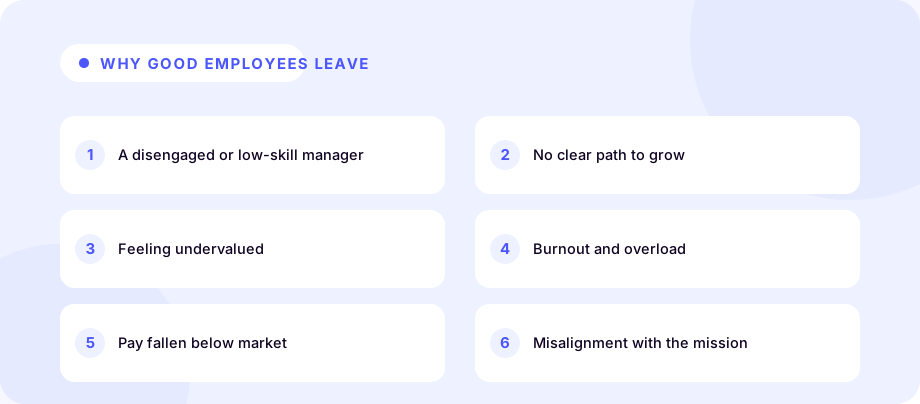
Most leaders are blindsided when a great employee resigns, but the truth is that the decision was usually months in the making. Understanding why good employees leave is the first step to keeping them, and the reasons are remarkably consistent: disengaged managers, no path to grow, feeling undervalued, burnout, below-market pay, values misalignment, and rigidity around how and where work gets done. The encouraging part is that almost every one of these causes is within a leader's control to fix.
This guide walks through the seven root causes one by one. For each, you will get a clear explanation of what is really happening beneath the surface and a concrete, practical fix you can start applying this week.
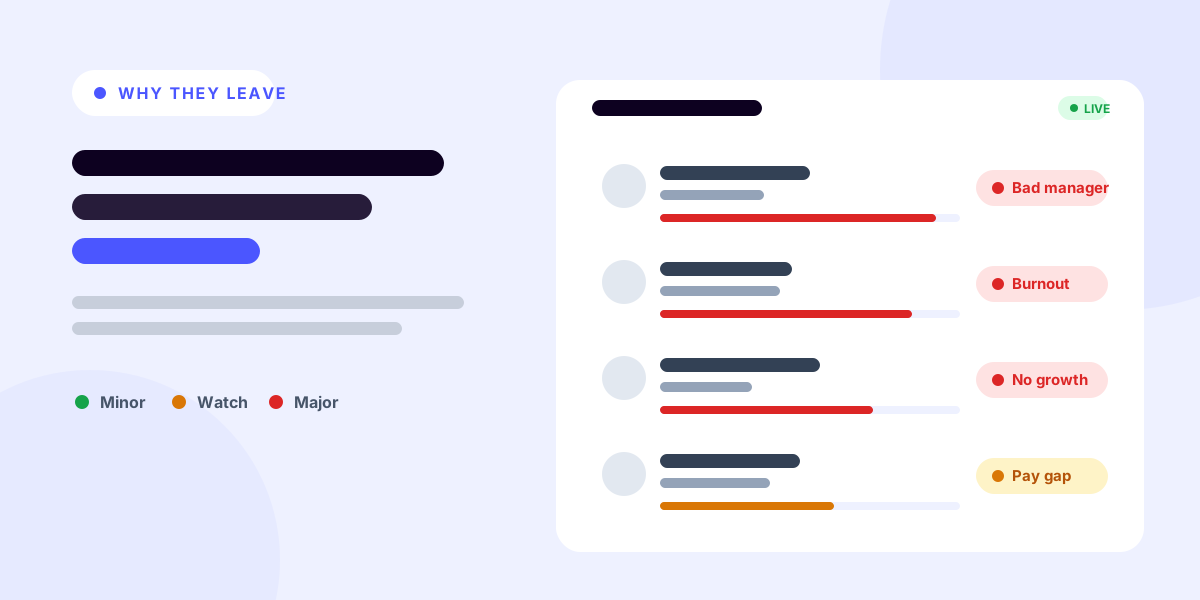
Manager and burnout signals outrank pay - and they're the ones you can still act on.
Why good employees leave: it is rarely sudden
When a top performer hands in their notice, it can feel like it came out of nowhere. It almost never does. By the time someone resigns, they have usually spent weeks or months quietly disengaging, weighing options, and waiting for a reason to stay that never materialized.
This is why the most effective approach is proactive retention rather than reactive damage control. Reacting to a resignation letter with a hurried counteroffer treats the symptom. Understanding the underlying causes - and catching the early signals - lets you address the disease. If you want a deeper look at the behavioral cues that precede a departure, our guide to the 12 signs an employee is about to quit breaks them down in detail.
A few principles hold across every cause below:
- People leave situations, not just jobs. The same person can thrive on one team and quit on another in the same company.
- The reason on the exit interview is often not the real reason. People give socially safe answers like "a better opportunity." The deeper drivers are usually here.
- Most causes compound. A burned-out employee with a distant manager and no growth path is far more at risk than someone with just one of those issues.
Let's get into the seven.
1. A disengaged or low-skill manager
No driver of voluntary turnover comes up more often than the relationship with a direct manager. People join companies and leave managers. A manager who micromanages, takes credit, gives no feedback, plays favorites, or is simply absent can erode even a deeply committed employee's desire to stay.
What makes this cause so dangerous is that it is often invisible from the top. Senior leaders see a competent manager hitting targets; the team sees someone who makes work harder.
The fix: treat management as a craft that deserves real investment.
- Stop promoting people into management by default. Being a strong individual contributor does not make someone a strong manager. Create a senior IC track so people can advance without managing others.
- Train managers on the fundamentals: giving feedback, running effective one-on-ones, delegating, and coaching. These are learnable skills, not innate traits.
- Measure managers on retention and engagement, not just output. If one team consistently loses good people, treat that as a leadership signal rather than bad luck.
- Run skip-level conversations so employees have a safe channel beyond their direct manager.
When you fix management quality, you often fix several of the causes below at once, because good managers naturally handle growth, recognition, and workload.
2. No clear path to grow
High performers are, almost by definition, people who want to get better. When they stop learning, stop being challenged, or cannot see a future for themselves at your company, they start looking for that growth elsewhere.
This is especially acute in smaller companies where formal ladders may not exist. The employee is not necessarily chasing a title - they are chasing progress. The absence of a visible next step reads as a ceiling.
The fix: make growth explicit and personal.
- Build career conversations into your regular cadence, separate from performance reviews. Ask: where do you want to be in two years, and what would help you get there?
- Create development plans with concrete stretch assignments, not vague encouragement. A new project, a mentorship, ownership of a customer relationship - growth does not always require a promotion.
- Promote from within visibly. When people see peers advancing, the ceiling disappears.
- Fund learning within whatever budget you have. Even modest support for courses, conferences, or certifications signals investment.
Growth and turnover are tightly linked, which is why anticipating who is at risk matters. Our piece on how to predict employee turnover before it happens covers the leading indicators worth tracking.
3. Feeling undervalued and unrecognized
Recognition is one of the cheapest and most underused retention tools. People want to know their work matters and that someone noticed. When effort consistently goes unacknowledged - especially the quiet, reliable contributions that hold a team together - even loyal employees start to feel invisible.
Trophies and forced fun are beside the point; what matters is whether people feel genuinely seen and appreciated for what they contribute.
The fix: make recognition specific, timely, and real.
- Be specific. "Great job" lands flat. "The way you defused that client call on Tuesday saved the account" lands because it proves you were paying attention.
- Recognize in the moment, not just at review time. A quick, sincere thank-you the same week beats a generic mention months later.
- Recognize the unglamorous work, not only the visible wins. The people quietly preventing fires rarely get credit and are often your highest flight risks.
- Match recognition to the person. Some want public praise; others find it mortifying and prefer a private note or more autonomy.
4. Burnout and an unsustainable workload
Your best employees are often the ones you lean on most, which is precisely how you lose them. When the reward for great work is simply more work, capable people burn out. Chronic overload, always-on expectations, and no recovery time erode both performance and the will to stay.
Burnout rarely announces itself. It shows up as cynicism, withdrawal, slipping quality from someone usually excellent, or a subtle pulling-back - all early signals that a once-engaged person is becoming a flight risk.
The fix: manage workload as deliberately as you manage output.
- Watch for the "reward is more work" trap. Distribute high-stakes projects more evenly instead of repeatedly defaulting to your strongest people.
- Protect recovery time. Encourage real time off and model it yourself. If leaders email at midnight and on weekends, no policy will convince people to unplug.
- Audit the workload, not just the person. When someone is drowning, ask what can be removed, automated, or reprioritized before asking them to push harder.
- Have honest capacity conversations. A simple "how sustainable does your current load feel?" surfaces problems while you can still act.
For a fuller toolkit, our guide on employee flight risk and how to reduce it goes deeper on spotting and easing the conditions that drive people out.
5. Pay that has fallen below market
Compensation is rarely the first reason good employees leave, but it is often the final straw. Pay that drifts below the market - especially when new hires arrive at higher rates than loyal long-tenured staff - sends a clear message about how the company values people. Even employees who love their work will eventually act on a large, persistent gap.
The trap many companies fall into is pay compression: external offers rise faster than internal raises, so the people who stayed end up underpaid relative to those who left and came back, or to newcomers.
The fix: be proactive and transparent about compensation.
- Benchmark roles regularly against current market data, not the salary you set three years ago.
- Fix compression before it festers. If a tenured employee is underpaid relative to the market or to peers, address it before they discover it themselves.
- Be transparent about how pay works - the bands, the criteria, the path to a raise. Ambiguity breeds suspicion and resentment.
- Remember total rewards. Flexibility, growth, and a great manager genuinely offset some pay gap - but they cannot offset a large one indefinitely. Articulating all of this as a clear employee value proposition helps people see the full picture of what they get by staying, beyond the salary line.
The aim is simply that pay is never the reason a great person starts looking, which rarely requires winning a bidding war.
6. Misalignment with mission and values
Talented people increasingly want their work to mean something and to happen somewhere whose values they respect. When there is a gap between what a company says and what it does - stated values that leaders ignore, a mission that feels hollow, or decisions that contradict the culture on the wall - engaged employees disengage. This cause hits your most principled, mission-driven people hardest, and those are often your best.
The fix: close the say-do gap.
- Audit the gap between stated and lived values. Where do your everyday decisions contradict what you claim to stand for? Employees notice these gaps long before leaders do.
- Connect daily work to purpose. People sustain effort when they understand how their work affects customers, colleagues, or a larger goal. Make that line of sight explicit.
- Make values real in decisions - hiring, promotions, who gets rewarded. Values are demonstrated by what you tolerate and celebrate, not what you frame on a wall.
- Be honest in tough moments. Trust is built when leaders tell the truth during layoffs, missed targets, or hard pivots, not just when things go well.
7. Lack of flexibility in how and where work happens
For many employees, autonomy over how and where they work has become a baseline expectation rather than a perk. Rigid policies that ignore how people actually do their best work - mandatory in-office days that serve no real purpose, inflexible hours, distrust of remote work - push good people toward employers who offer more control over their own time.
This is rarely about avoiding work. It is about trust and autonomy. Treating capable adults as if they need to be watched is corrosive, and it is also exactly the wrong instinct: retention comes from trust, not monitoring.
The fix: lead with trust and outcomes.
- Default to flexibility where the role allows it. Judge people on outcomes and impact rather than hours logged or a seat occupied.
- Make in-person time purposeful. If you ask people to gather, make it worth the commute - collaboration, connection, problem-solving - not solitary work they could do anywhere.
- Co-create norms with the team rather than dictating from the top. People honor agreements they helped shape.
- Extend trust first. Autonomy is one of the strongest, lowest-cost retention levers you have, and it compounds the goodwill behind every other fix above.
Turning root causes into proactive retention
Knowing the seven causes is the foundation. The leaders who actually keep their best people do three things consistently:
- They run regular stay conversations. Don't wait for exit interviews to learn what people need. Ask current high performers what would make them more likely to stay - and then act on it. When someone does leave, run a consistent debrief using a structured exit interview template so the patterns behind these seven causes become visible over time.
- They watch for early signals. Disengagement leaves traces well before a resignation: pulling back from long-term work, reduced energy, quietly refreshing skills. The aim is to notice meaningful changes early and respond with genuine care.
- They give themselves lead time. Even with great management, some departures will happen. Knowing earlier, so you can address concerns, plan, and groom a successor calmly rather than scramble, changes everything.
This is exactly the gap TeamPredict is built to close. It surfaces early, proactive signals of resignation risk from publicly available LinkedIn activity, summarized into a simple risk level per tracked employee, so leaders get lead time to have the right conversation before it is too late. It is a complement to good management, not a replacement for it.
For the broader playbook, pair this article with our 15 employee retention strategies that actually work, and if you want to quantify the problem, how to calculate your employee turnover rate is a useful starting point.
Every cause is a leadership choice
Good employees rarely leave for mysterious reasons. They leave because of managers who do not develop them, growth that never comes, recognition that never lands, workloads that never let up, pay that quietly falls behind, values that do not hold up, and rigidity that signals distrust. Every one of those is a leadership choice you can revisit, and the earlier you act, the more options you have.
If you want a clearer, earlier read on which of your best people might be quietly heading for the door, so you can act while you still can, start a free 30-day trial of TeamPredict. There is no charge until the trial ends and you can cancel anytime: just earlier lead time to keep the people you have worked so hard to build a team around.
Understanding why people leave is the starting point for better employee retention. When someone does decide to go, know how to weigh employee counteroffers.
If you are evaluating tooling to catch these signals earlier, start with our guide to employee retention software.
Frequently asked questions
- What is the number one reason good employees leave?
- There is rarely a single cause, but the relationship with a direct manager is consistently one of the strongest factors. When a high performer feels unsupported, micromanaged, or unseen by their manager, even great pay and perks struggle to keep them. That is also good news for leaders: manager behavior is something you can coach and change.
- Do good employees leave mainly because of money?
- Pay matters and below-market pay will eventually drive people out, but money is often the reason people give rather than the reason they decide. When someone feels growth, recognition, and good management are all in place, they rarely leave for a small raise. When those are missing, pay becomes the easy thing to point to on the way out.
- How can I tell a good employee is thinking about leaving before they resign?
- Watch for shifts from their own baseline: less engagement in meetings, withdrawal from longer-term projects, reduced discretionary effort, or quietly refreshing skills and networks. The goal is not to surveil anyone but to notice changes early and open an honest, caring conversation while you still have time to act.
- Can you stop a good employee from leaving once they have decided?
- Sometimes, but it is far harder and counteroffers often only delay the exit. The reliable approach is proactive retention: addressing growth, recognition, workload, and management quality continuously, so concerns get resolved long before someone reaches the decision to leave.
- How is proactive retention different from just doing exit interviews?
- Exit interviews tell you why people already left, which is useful but always too late for that person. Proactive retention means surfacing concerns and risk signals early, then acting on them through stay conversations, growth plans, and workload adjustments while the employee is still on your team.
About TeamPredict
TeamPredict Team
We build TeamPredict - retention early-warning software that flags resignation risk from public LinkedIn signals. We write about the patterns that precede a resignation and how people-first teams act on them early. Learn more about TeamPredict
Find out who's showing exit signals.
Score one person's flight risk in a couple of minutes with the free assessment - then let TeamPredict watch the rest daily.
Run the free flight-risk assessmentFree, no signup required.