Exit Interview Template: A Free, Ready-to-Use Form
Most companies run exit interviews, but few run them in a way that produces anything useful - usually because there is no consistent structure behind the conversation. A good exit interview template fixes that: it turns an awkward final chat into a repeatable, comparable record you can actually learn from. This guide gives you a free, copyable exit interview form with rating scales and open-response sections, plus a practical walkthrough of how to run it, who should conduct it, and how to turn the answers into themes that drive real retention change.

Logistics, 1-5 ratings, and open responses, structured so every departure stays comparable.
What a good exit interview template does
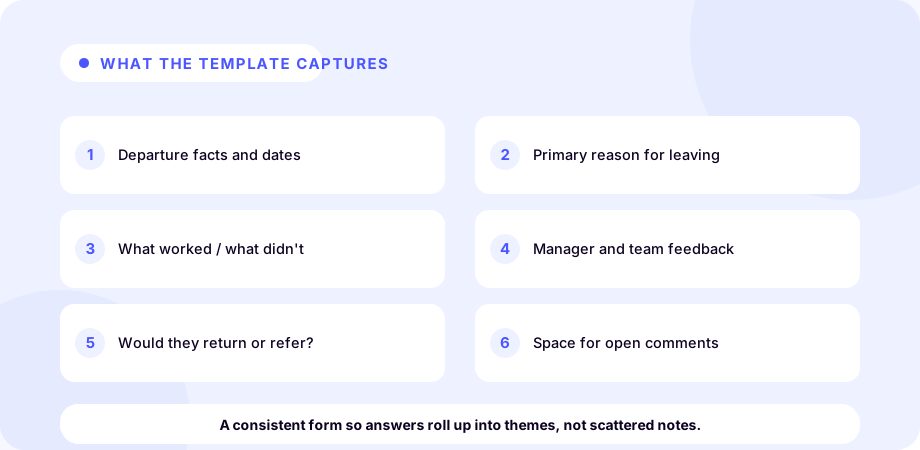
An exit interview template is not paperwork for its own sake. Its job is to make every departure produce the same kind of structured data, so that the tenth exit interview can be compared to the first. Without that structure, you get a folder of unique stories and no way to tell an anecdote from a trend.
A strong template does three things at once:
- Captures structured ratings you can compare across people, teams, and time using a consistent scale.
- Leaves room for candor through short, open-response prompts grouped by theme.
- Records the logistics - who left, from which team, after how long, and whether they were a regretted, rehire-eligible departure.
That combination is what separates a form you can analyze from a transcript you will never reread. If you want the full bank of conversation questions to draw from, our exit interview questions and complete template covers more than 35 categorized prompts; this article focuses on the form itself - the fields, scales, and structure you can copy and reuse.
The exit interview template
Below is a complete, copyable exit interview form. Paste it into a shared doc, a survey tool, or your HRIS, keep the structured fields consistent for every departure, and adapt the open-response prompts to your context. The rating scales are deliberately mapped to the most common drivers of turnover so the numbers tell you where to look.
EXIT INTERVIEW FORM
====================================================

SECTION 1 - LOGISTICS
Employee name: ____________________   Employee ID: __________
Role / title: _____________________   Department / team: __________
Manager: __________________________   Tenure: ______ years ______ months
Start date: ______________   Last working day: ______________
Interviewer: ______________   Interview date: ______________
Format:  [ ] In-person   [ ] Video   [ ] Phone   [ ] Written survey

SECTION 2 - PRIMARY REASON FOR LEAVING
Single best fit (check one):
  [ ] Better opportunity / career growth   [ ] Compensation
  [ ] Manager / leadership                  [ ] Workload / burnout
  [ ] Role no longer a fit                  [ ] Relocation / life change
  [ ] Company direction / culture           [ ] Other: __________
Destination (if shared): ________________________________________
In your own words, what ultimately prompted the decision?
__________________________________________________________________

SECTION 3 - RATING SCALES  (1 = Strongly disagree, 5 = Strongly agree)

Role & growth
  My role matched what I expected when I joined ........... 1  2  3  4  5
  I had room to grow and advance here ..................... 1  2  3  4  5
  My skills were used well ................................ 1  2  3  4  5

Manager & feedback
  My manager supported me and removed obstacles ........... 1  2  3  4  5
  I received useful, regular feedback ..................... 1  2  3  4  5
  I felt recognized for my contributions .................. 1  2  3  4  5

Compensation & benefits
  My pay was fair for my work ............................. 1  2  3  4  5
  Our benefits met my needs ............................... 1  2  3  4  5

Workload & wellbeing
  My workload was sustainable ............................. 1  2  3  4  5
  I had the tools and resources to do my job well ......... 1  2  3  4  5

Culture & belonging
  I felt I belonged and was respected ..................... 1  2  3  4  5
  Our stated values matched how we operated .............. 1  2  3  4  5

Overall
  I would recommend this company as a place to work ....... 1  2  3  4  5
  Overall, my experience here was positive ............... 1  2  3  4  5

SECTION 4 - OPEN RESPONSES  (keep brief; 1–3 sentences each)

What did we do well that we should keep?
__________________________________________________________________

What is the single thing that, if changed, might have kept you?
__________________________________________________________________

What advice would you give leadership about retention?
__________________________________________________________________

Anything we did not ask that we should know?
__________________________________________________________________

SECTION 5 - CLOSING & LOGISTICS
Would you consider returning in the future?  [ ] Yes  [ ] Maybe  [ ] No
Eligible for rehire (HR use):                [ ] Yes  [ ] No  [ ] TBD
Regretted departure (HR use):                [ ] Yes  [ ] No
Confidentiality: Individual responses are shared only in aggregate or
de-identified form and will not affect references.

Employee signature (optional): ______________   Date: __________
Interviewer signature: ______________________   Date: __________
Two design choices in that form matter. First, the rating scales use a single 1–5 direction (5 is always good) so you never have to remember which way a number points when you analyze it later. Second, the open-response prompts are short and capped on purpose - long free-text fields produce rambling answers that are hard to code into themes. A handful of focused prompts beats a blank page.
How to run the exit interview
A template only works if the conversation around it earns honesty. The same form produces wildly different answers depending on how you administer it. A few practices consistently raise the quality of what you hear.
- Send the ratings ahead of time. Let the employee complete Sections 1–3 a day or two before the conversation. It gives them time to reflect and frees the live time for the open-ended discussion.
- Lead with safety. Open by explaining how the feedback will be used, who will see attributed comments, and that honesty will not affect references. The confidentiality line on the form is a promise - keep it.
- Use the ratings as a map, not a script. A low score on "my workload was sustainable" is your cue to ask "tell me more about that." The numbers tell you where to dig; the conversation tells you why.
- Ask open questions, then stay quiet. The most useful material usually comes after a pause. Resist filling silence or getting defensive about what you hear.
- Time it well. Late enough that the person feels free to be honest, early enough that they have not fully checked out. The middle of the notice period often works best.
- Take structured notes. Capture answers against the same sections every time so the data stays comparable across departures.
In-person vs. written survey
The template works in both formats, and each has trade-offs.
A written exit survey - the form filled out independently, usually online - gives you clean, comparable, scalable data. It is ideal when you have high volume, want to remove interviewer bias, or are trying to compare ratings across teams. The cost is nuance: a form cannot ask a follow-up question or read a hesitation.
An in-person (or video) exit interview captures tone, context, and the follow-up threads that a form cannot. It is better for senior or regretted departures where the story behind the ratings matters. The cost is consistency and scale, plus the risk that people soften feedback when speaking face to face.
The strongest approach combines them: send the rating scales as a short survey to capture structured data, then hold a brief conversation to go deeper on whatever the ratings reveal. You get comparable numbers and human nuance from the same template.
Who should conduct it
As a rule, the departing employee's direct manager should not run the exit interview, because so much of what you most need to hear is about the manager relationship itself. A neutral party - HR, People Ops, or a manager once removed - gets more candid answers, especially on management, culture, and pay. For senior exits, a skip-level leader or an external facilitator can work well. Whoever runs it needs the standing to keep the conversation confidential and to carry the themes forward into action.
How to analyze the responses into themes
A drawer full of completed forms is not insight. The value comes from turning individual exits into patterns you can act on. Here is a simple framework that the template is built to support.
1. Aggregate the ratings first. Because every form uses the same 1–5 scales, you can average each item across departures and watch for the categories that score consistently low. A run of 2s on "I had room to grow" across a single team is a louder signal than any one person's comment.
2. Code the open responses into stable themes. Map each free-text answer to a small, fixed set of categories - for example: growth, manager, pay, workload, culture, role fit, and life circumstances. Consistent coding is what lets you compare a departure this quarter with one from last year.
3. Separate regretted from non-regretted exits. Not every departure is a loss. The "regretted departure" flag on the form exists for exactly this reason: patterns among the people you wanted to keep are where your retention attention belongs.
4. Look for clusters, not anecdotes. One person leaving over compensation is a data point. Five regretted exits from the same team in six months, all citing the same manager or the same broken process, is a signal that demands action. Slice your themes by team, manager, tenure, and time.
5. Connect the themes to your numbers. Pair the qualitative patterns with your actual employee turnover rate and the real cost of employee turnover so you can quantify which patterns are costing you the most people and prioritize accordingly.
6. Translate themes into owned actions, then close the loop. Each recurring theme should become a specific change with an owner and a date - not a slide in a deck. Then tell the remaining team, in general terms, what you heard and what you are changing. Exit feedback that no one acts on is worse than none, because it teaches people that speaking up is pointless.
The catch: a template cannot stop a resignation
A form cannot save the person filling it out. By the time Section 2 gets a checkmark, the offer is signed and your influence over that person is gone. The template's job is to protect the people who stay: it helps you fix systemic issues for the team that remains, and it will never tell you who is about to leave next.
To actually retain people, you have to move earlier in the timeline, well before the resignation conversation. That means running stay interviews on a regular cadence to surface fixable frustrations while people are still here, watching for the signs an employee is about to quit, and learning how to predict employee turnover before it happens. The whole point is to give yourself the one thing an exit interview can never provide: lead time.
Bringing it together
A good exit interview template earns its keep by making every departure comparable: consistent ratings you can aggregate, focused open responses you can code into themes, and the logistics that let you separate the exits that hurt from the ones that did not. Copy the form above, run it with a neutral interviewer who can keep it confidential, analyze in aggregate rather than one story at a time, and act visibly on what you learn.
But keep the template in its proper place: it explains departures, it does not prevent them. The most durable retention happens long before the form ever comes out, when you catch the early signals and have the conversation that keeps a good person from updating their resume in the first place. TeamPredict summarizes publicly available LinkedIn profile activity into a simple resignation-risk level for each employee you track, so you get a proactive nudge while there is still time to act, not a post-mortem after they are gone. If you want the early warning rather than the paperwork, start a free 30-day trial (no charge until the trial ends, cancel anytime) and pair your offboarding form with early flight-risk detection.
Frequently asked questions
- What should an exit interview template include?
- A good exit interview template includes a header with logistics (employee name, role, manager, department, tenure, last day, interviewer, and date), a set of 1–5 rating scales covering the main drivers of turnover (role and growth, manager, compensation, workload, culture, and overall experience), short open-response sections grouped by theme, a primary reason-for-leaving field, an eligible-for-rehire flag, and a confidentiality note plus optional signature line. Keeping the structured fields consistent across every departure is what lets you compare answers and spot patterns over time.
- What is the difference between an exit interview and an exit survey?
- An exit survey is a written, structured questionnaire the departing employee fills out on their own, usually online, while an exit interview is a live conversation. The survey gives you clean, comparable data and works at scale; the conversation captures nuance, tone, and follow-up that a form cannot. The strongest approach uses both: send the survey a few days before the person's last day to capture ratings, then have a short conversation to go deeper on what the ratings reveal. The template in this article works for both formats.
- Who should conduct an exit interview?
- A neutral party usually gets the most candid answers, which is why HR or People Ops typically runs the exit interview rather than the departing employee's direct manager. People are far more honest about management, culture, or pay issues when their soon-to-be-former boss is not in the room. For senior departures, a skip-level leader or an external facilitator can work well. Whoever runs it should be able to keep the conversation confidential and act on the themes afterward.
- How long should an exit interview take?
- Plan for 30 to 45 minutes for the conversation, plus a few minutes for the employee to complete the rating scales beforehand. That is long enough to move past surface answers and follow interesting threads, but short enough to respect the time of someone who is on their way out. If you are using a written survey only, aim for a form that takes 10 to 15 minutes to complete so people actually finish it.
- Should exit interviews be anonymous?
- It depends on your goal. Attributed exit interviews let you tie feedback to specific teams, managers, and segments, which is essential for spotting patterns - but people may hold back. Anonymous or aggregated exit surveys produce more candor but less ability to act on specifics. A common compromise is to collect attributed data, promise that individual comments will only ever be shared in aggregate or de-identified form, and be transparent about who will see what. Whatever you choose, state it clearly on the form.
About TeamPredict
TeamPredict Team
We build TeamPredict - retention early-warning software that flags resignation risk from public LinkedIn signals. We write about the patterns that precede a resignation and how people-first teams act on them early. Learn more about TeamPredict
Find out who's showing exit signals.
Score one person's flight risk in a couple of minutes with the free assessment - then let TeamPredict watch the rest daily.
Run the free flight-risk assessmentFree, no signup required.