Employee Exit Survey: Questions, Examples, and Template
An employee exit survey is the written, structured counterpart to the exit interview: a short questionnaire a departing employee fills out on their own, usually online, in their final days. Where the interview is a live conversation, the survey is async, consistent, and easy to run at scale. That makes it the better tool when you want clean, comparable data across every departure rather than the nuance of a single story. This guide covers how an exit survey differs from an interview, how to design one people actually finish, a usable bank of exit survey questions and examples, a copyable template, and how to turn the results into action. If you only need the form, the exit survey template is ready to fill in, copy or print.
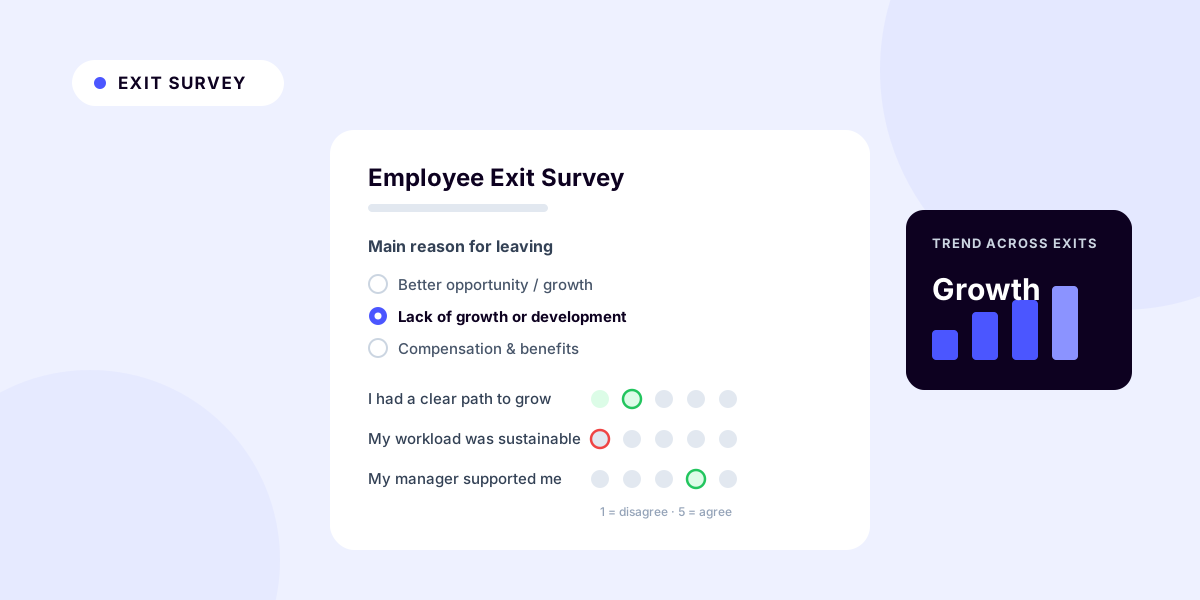
An exit survey turns each departure into the same rating scales, so you can compare and benchmark them.
What is an employee exit survey?
An employee exit survey is a standardized questionnaire sent to people who are leaving, usually during offboarding in their final week or two. It captures their experience through rating scales, a reason-for-leaving question, and a handful of open-ended prompts. The point is not paperwork. It is to make every departure produce the same kind of structured data, so the fiftieth survey can be compared to the first.
That word, comparable, is the whole reason the format exists. A pile of unique conversations tells you a lot about individuals and little about your company. A stack of surveys built on the same scales shows you the pattern: when "I had a clear path to grow" scores low across a whole team, quarter after quarter, no single conversation would have surfaced it.
Exit surveys lean quantitative, they are often anonymous or confidential, and they scale without a scheduler or a meeting. Exit interviews lean qualitative and personal. Neither one replaces the other. If you want the conversation side, our exit interview questions bank covers the live version in depth, and our exit interview template turns it into a reusable form. This article is about the survey.
Exit survey vs. exit interview: when to use which
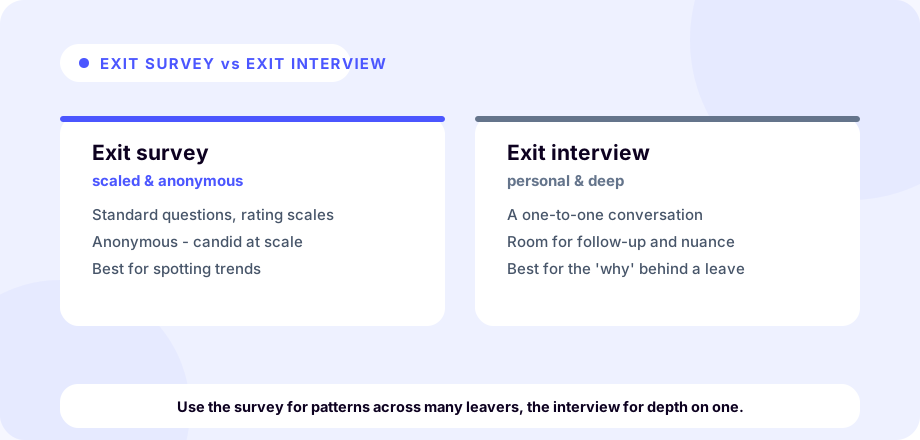
The two formats are complements, not competitors, and each is better at a different job.
Reach for the exit survey when you want:
- Scale. Every leaver gets the same form. No calendar coordination, no interviewer time.
- Comparable numbers. Consistent rating scales let you average scores and benchmark them over time.
- Candor through distance. People often say more in a form than to a person's face, especially about their manager.
- Anonymity. A survey can be genuinely anonymous or aggregated in a way a face-to-face conversation cannot.
- Coverage of routine and bulk departures. For the many exits that do not warrant a 45-minute meeting, the survey still captures the data.
Reach for the exit interview when you want:
- Depth on a specific exit. Senior roles, regretted departures, or a surprise resignation where the story behind the ratings matters.
- Follow-up. A form cannot ask "tell me more about that" or read a hesitation.
- Tone and context. How something is said often carries as much signal as what is said.
The strongest offboarding process uses both. Send the survey a few days before the last day to capture structured ratings from everyone, then hold a short conversation with the departures that matter most to go deeper on what the ratings reveal. You get comparable numbers from the whole population and human nuance where it counts.
How to design an exit survey people actually finish
A survey nobody completes teaches you nothing. A few design choices consistently raise both completion and the quality of what you learn.
Keep it short. Aim for something a person can finish in 10 to 15 minutes. A long survey at the end of someone's tenure gets abandoned or rushed. A focused one gets finished.
Use one consistent rating scale. A 1-to-5 agreement scale (1 = strongly disagree, 5 = strongly agree) is the workhorse. Phrase every statement so that agreeing is the positive answer, which means 5 is always good. You never want to remember which way a number points when you analyze it later.
Mix the question types deliberately. Three types do most of the work:
- Likert (rating) items are statements the person rates on the 1-5 scale. These produce the comparable numbers that make a survey worth running.
- Multiple choice is best for the single most important structured field: the main reason for leaving. One clean, single-select question here beats a paragraph you have to interpret.
- Open-ended prompts capture the "why" and the things your scales did not anticipate. Keep these few and short. Three or four focused prompts beat a blank page, which produces rambling answers that are hard to code.
Decide anonymity vs. confidentiality on purpose. This is the most important design call, and a genuine trade-off. Fully anonymous surveys get you more candor but less ability to act on specifics, because you cannot tell which team a comment is about. Attributed surveys let you segment the data, where most patterns live, but some people hold back. A practical middle path: attribute responses, promise that individual answers are only ever reported in aggregate or de-identified form, and offer optional segment fields (department, tenure band) people can leave blank. Whatever you pick, say it plainly at the top of the form and mean it.
Time it and route it well. Send the survey late enough that the person feels free to be honest, early enough that they have not fully checked out. The middle of the notice period usually works. And route it through a neutral owner, HR or People Ops, not the departing employee's direct manager, since so much of what you need to hear is about that relationship.
Exit survey questions and examples
Below is a usable bank of exit survey questions and examples, grouped by theme. You do not need all of them. Pick a core set that fits your context, keep it consistent across departures, and phrase every rating item so that agreement is positive.
Main reason for leaving (multiple choice)
Lead with one clean, single-select question. It becomes your most-analyzed field.
Which best describes the main reason you decided to leave?
- Better opportunity or career growth
- Compensation and benefits
- Relationship with manager or leadership
- Workload, stress, or burnout
- Lack of growth or development
- Role was no longer the right fit
- Company direction, culture, or values
- Relocation or personal reasons
- Other
Role, growth, and development (rate 1-5)
Lack of growth is one of the most common reasons strong performers leave, so cover it well.
- My role matched what I was told to expect when I joined.
- I had a clear path to grow and advance here.
- My skills and strengths were used well.
- I got the development, training, or mentorship I wanted.
Manager and feedback (rate 1-5)
- My manager gave me useful, regular feedback.
- My manager supported my growth and removed obstacles.
- I felt recognized for the work I did.
- I could raise concerns without fear, and they were taken seriously.
Compensation and benefits (rate 1-5)
Pay rarely leads the story, but it often sits underneath other complaints.
- I was satisfied with my total compensation.
- Our benefits met my needs.
Workload and wellbeing (rate 1-5)
- My workload was sustainable.
- I had the tools and resources to do my job well.
- I was able to maintain a healthy balance between work and the rest of my life.
Culture and belonging (rate 1-5)
- I felt I belonged and was respected.
- Our stated values matched how we actually worked day to day.
- This was a psychologically safe place to speak up.
Overall experience (rate 1-5 and 0-10)
- Overall, my experience working here was positive. (1-5)
- How likely are you to recommend this company as a place to work? (0-10)
That last item is an eNPS-style question, and it is worth including because it gives you one number you can track across every departure and benchmark over time. Our free eNPS calculator turns those 0-10 answers into a single score.
Open-ended prompts (keep to three or four)
These capture what the scales miss. Keep them short and capped.
- What is the single thing that, if it had been different, might have kept you?
- What did we do well that we should keep doing?
- What advice would you give leadership about keeping good people?
- Is there anything we did not ask about that you think we should know?
A copyable exit survey template
Here is the full set assembled into a form. Paste it into your survey tool or HRIS, keep the rating statements consistent for every departure, and adapt the wording to your context.
EMPLOYEE EXIT SURVEY
=====================================================

Your answers help us make this a better place for the people who
stay. Responses are reviewed only in aggregate or de-identified
form and will never affect your reference. Completing this is
voluntary.

SEGMENT (optional - helps us spot team-level patterns; leave blank
to stay fully anonymous)
  Department / team: __________
  Tenure:  [ ] Under 1 year   [ ] 1-3 years   [ ] 3+ years

1. MAIN REASON FOR LEAVING  (choose one)
   [ ] Better opportunity / career growth
   [ ] Compensation & benefits
   [ ] Manager / leadership
   [ ] Workload, stress, or burnout
   [ ] Lack of growth or development
   [ ] Role no longer the right fit
   [ ] Company direction / culture / values
   [ ] Relocation / personal
   [ ] Other: __________

2. RATE EACH STATEMENT  (1 = Strongly disagree, 5 = Strongly agree)
   Role & growth
     My role matched what I expected when I joined ..... 1 2 3 4 5
     I had a clear path to grow and advance ............ 1 2 3 4 5
     My skills were used well .......................... 1 2 3 4 5
     I got the development I wanted .................... 1 2 3 4 5
   Manager & feedback
     My manager gave useful, regular feedback .......... 1 2 3 4 5
     My manager supported me and removed obstacles ..... 1 2 3 4 5
     I felt recognized for my work ..................... 1 2 3 4 5
     I could raise concerns without fear ............... 1 2 3 4 5
   Compensation
     I was satisfied with my total compensation ........ 1 2 3 4 5
     Our benefits met my needs ......................... 1 2 3 4 5
   Workload & wellbeing
     My workload was sustainable ....................... 1 2 3 4 5
     I had the tools and resources to do my job ........ 1 2 3 4 5
     I could keep a healthy work-life balance .......... 1 2 3 4 5
   Culture & belonging
     I felt I belonged and was respected ............... 1 2 3 4 5
     Our stated values matched how we worked ........... 1 2 3 4 5

3. OVERALL
   Overall, my experience here was positive ............ 1 2 3 4 5
   How likely are you to recommend us as a place
   to work?  (0 = not at all, 10 = extremely) .......... 0-10

4. IN YOUR OWN WORDS  (optional, 1-3 sentences each)
   What one change might have kept you?
   ________________________________________________
   What did we do well that we should keep?
   ________________________________________________
   Advice for leadership on keeping good people?
   ________________________________________________
   Anything we did not ask that we should know?
   ________________________________________________
Turn exit survey results into action
A folder of completed surveys is not insight. The value comes from turning individual departures into patterns, and the survey format is built to support exactly that.
Aggregate the ratings first. Because every survey uses the same 1-5 scales, you can average each item across departures and watch for the ones that score consistently low. A run of 2s on "I had a clear path to grow" across one team is a louder signal than any single comment.
Code the open text into stable themes. Map each free-text answer to a small, fixed set of categories such as growth, manager, pay, workload, culture, role fit, and life circumstances. Consistent coding is what lets you compare this quarter's departures to last year's.
Segment everything. Slice your themes and scores by team, manager, and tenure band. A company-wide average can look fine while one team quietly bleeds people for the same reason every month.
Separate regretted from non-regretted exits. Not every departure is a loss. Tag whether each person was someone you wanted to keep, and put your attention on the patterns among the regretted ones. Those are the exits worth preventing, and they usually point straight at your most fixable problems. If regretted attrition, eNPS, or average tenure are terms your team defines differently from meeting to meeting, our people analytics glossary gives each one a single written definition to point at.
Benchmark trends over time. The biggest advantage of a survey over an interview is that its numbers stack up. Track your key scores and eNPS by quarter and watch the direction. A metric drifting down for three quarters is a problem forming in slow motion.
Translate themes into owned actions, then close the loop. Each recurring theme should become a specific change with an owner and a date, not a slide in a deck. If "lack of growth" keeps surfacing, that is a direct input to your employee retention strategies. Then tell the remaining team, in general terms, what you heard and what you are changing. Survey feedback that no one acts on is worse than none, because it teaches people that speaking up is pointless.
The limit: an exit survey is a lagging signal
Here is the uncomfortable truth about even a perfectly designed exit survey. By the time someone is filling it out, the offer is signed and your influence over that person is gone. The survey tells you, with hindsight, why the last person left. It cannot tell you who is about to leave next.
That is why the survey belongs in a pair. It is the lagging half. To actually keep people, you need a leading half: signals that show up while there is still time to act. There are usually signs an employee is about to quit weeks or months ahead, from a quiet drop in engagement to public flight-risk signals like a refreshed headline, new skills, an "Open to Work" badge, or a cluster of LinkedIn profile edits. If you want to gauge one person now, our free flight risk assessment scores the known signals in about a minute. The whole idea is to give yourself the one thing an exit survey can never provide, which is lead time.
This is the gap TeamPredict is built to close. It reads only public LinkedIn activity, never contacts anyone, and never touches private data, then summarizes those public signals into a simple resignation-risk level for each employee you track. Instead of a post-mortem after someone is gone, you get a proactive nudge while you can still have the conversation that keeps a good person from ever opening a new tab. Pair that early warning with a solid exit survey and you close the loop from both ends: you prevent the departures you can see coming, and you learn from the ones you could not.
Bringing it together
A good employee exit survey earns its keep by making every departure comparable. Consistent rating scales you can aggregate and benchmark, one clean reason-for-leaving field, and a few focused open prompts you can code into themes. Keep it short, decide the anonymity question on purpose, run it through a neutral owner, and analyze it in aggregate rather than one story at a time.
Then keep it in its proper place. The survey explains departures, it does not prevent them. The most durable retention happens long before the survey ever goes out, when you catch the early signal and have the conversation that keeps a good person from updating their resume in the first place. If you would rather get the early warning than perfect the post-mortem, start a free 30-day trial of TeamPredict (no charge until the trial ends, cancel anytime) and pair your exit survey with proactive flight-risk detection.
Frequently asked questions
- What is an employee exit survey?
- An employee exit survey is a short, structured questionnaire a departing employee completes on their own, usually online, during their final days. It captures their experience through rating scales and a few open-ended questions so you get clean, comparable data across every departure. It is the written, async counterpart to the live exit interview, and the two work best together.
- What questions should be on an exit survey?
- A strong exit survey has three parts: one multiple-choice question on the main reason for leaving, a set of 1-5 rating-scale statements covering role and growth, manager, pay, workload, and culture, and three or four short open-ended prompts. Keep the rating scales pointed in one direction so 5 is always good, and keep the whole thing to 10-15 minutes so people finish it.
- Should an exit survey be anonymous or confidential?
- It is a trade-off. Anonymous surveys produce more candor but less ability to act on specifics. Confidential but attributed surveys let you segment by team, manager, and tenure, which is where the patterns live, but people may hold back. A common compromise is to attribute responses, promise that individual answers are only ever reported in aggregate or de-identified form, and offer optional segment fields people can leave blank. State whichever you choose clearly on the form.
- What is the difference between an exit survey and an exit interview?
- An exit survey is written, structured, and async, so it scales across every departure and produces comparable numbers. An exit interview is a live conversation that captures tone, context, and follow-up a form cannot. Surveys are better for volume, anonymity, and benchmarking trends over time; interviews are better for senior or regretted exits where the story behind the ratings matters. The strongest offboarding uses both.
- How do you analyze exit survey results?
- Aggregate the rating scales first and watch for items that score consistently low, then code the open-ended answers into a small, stable set of themes such as growth, manager, pay, workload, and culture. Slice by team, manager, and tenure, separate regretted from non-regretted exits, and track scores over time so you can see drift. The goal is to turn individual departures into trends you can act on, then assign each recurring theme an owner and a date.
About TeamPredict
TeamPredict Team
We build TeamPredict - retention early-warning software that flags resignation risk from public LinkedIn signals. We write about the patterns that precede a resignation and how people-first teams act on them early. Learn more about TeamPredict
Find out who's showing exit signals.
Score one person's flight risk in a couple of minutes with the free assessment - then let TeamPredict watch the rest daily.
Run the free flight-risk assessmentFree, no signup required.