Staff Turnover: What It Is, How to Measure It, and How to Reduce It
If you manage people in the UK, "what's our staff turnover?" is a question that turns up sooner or later - from a board, a finance director, or your own gut feeling that a team is quietly losing people. Getting the answer right matters, because staff turnover sits underneath almost every workforce decision you make, from recruitment budgets to succession planning. This guide covers what staff turnover means, how to calculate your staff turnover rate with a worked example, what a "good" rate actually looks like, and the levers that genuinely bring it down.
What staff turnover means
Staff turnover is the rate at which employees leave your organisation and have to be replaced over a period - usually measured across a year and expressed as a percentage of your average headcount. If you employ around 100 people and 15 leave over the year, your staff turnover is roughly 15%.
You'll also see the term labour turnover, especially in textbooks, academic work, and CIPD research. It means exactly the same thing and is calculated the same way - "staff turnover" is simply the more everyday phrase. (In US-worded sources the same idea appears as employee turnover or attrition rate; the maths is identical.)
A few other phrases float around for the same thing. You may hear it called staff churn or personnel turnover - both are informal synonyms rather than separate metrics. "Staff churn" tends to show up in fast-moving, high-volume workforces where people cycle through quickly, and "personnel turnover" lingers in older HR and public-sector documents, but neither changes the underlying measure or the way you work it out.
It's worth separating two flavours from the start:
- Voluntary turnover - people who choose to leave.
- Regretted turnover - the subset of leavers you genuinely wanted to keep.
A high figure made up mostly of people you were happy to see move on is very different from a smaller figure concentrated among your best performers. The headline number alone can flatter or frighten you; the composition is what matters.
Labour turnover vs staff turnover
If you've searched for labour turnover and landed here, you're in the right place - there is no difference to learn. Labour turnover and staff turnover are the same concept: the proportion of your people who leave and have to be replaced over a period, expressed against your average headcount. The only thing that changes is the label.
"Labour turnover" (British spelling, with the u) is the term you'll meet in CIPD research, HR textbooks, and academic papers, where it's often the house style. "Staff turnover" is the plainer, more everyday version most UK managers actually say out loud. There's no methodological gap between them - same formula, same inputs, same interpretation - so any advice written about one applies directly to the other. Throughout the rest of this guide we use "staff turnover", but read it as "labour turnover" wherever that's the phrase your board or your textbook prefers.
How to calculate your staff turnover rate
The staff turnover rate formula is simple:
Staff turnover rate = (leavers during the period ÷ average number of staff during the period) × 100
Count everyone who left over the period, divide by your average headcount (the simplest version is your start and end headcount averaged), and multiply by 100. If 18 people left a team that averaged 150 staff over the year, that's a staff turnover rate of 12%.
That's the headline number. For the detailed version - annualised rates, averaging your headcount month by month, and splitting voluntary from regretted turnover - see how to calculate employee turnover rate, or let our free turnover rate calculator do it for you (it works the same for UK "staff turnover" figures).
A worked staff turnover example
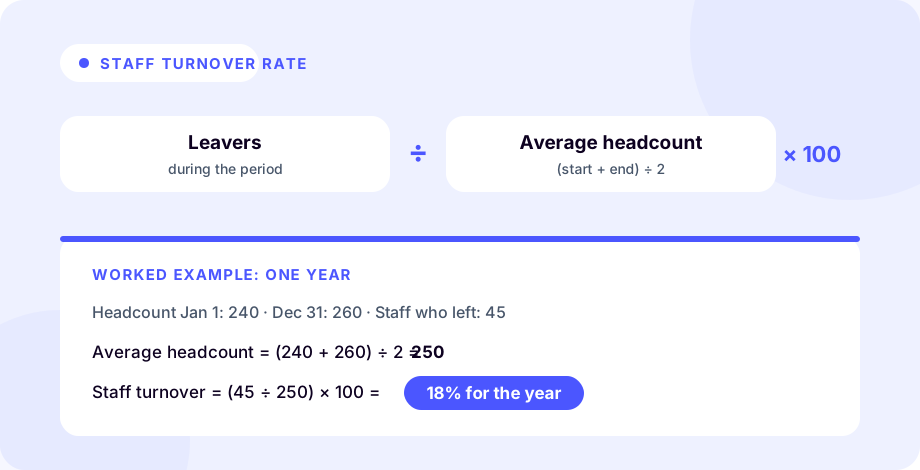
A step-by-step example makes the formula concrete. The figures below are purely illustrative - a made-up UK company, not a benchmark or an industry statistic - chosen with round numbers so the arithmetic is easy to follow.
Picture a hypothetical UK retailer, Riverside Retail Ltd. Over a single calendar year:
- Headcount on 1 January: 240 staff
- Headcount on 31 December: 260 staff
- People who left during the year: 40 leavers
Step 1 - Work out the average headcount.
(240 + 260) ÷ 2 = 250 staff
Step 2 - Divide leavers by the average headcount.
40 ÷ 250 = 0.16
Step 3 - Multiply by 100 to get a percentage.
0.16 × 100 = 16%
So Riverside Retail's annual staff turnover rate is 16%. Notice that headcount actually grew over the year (240 up to 260) while the business still lost 40 people - proof that turnover and growth are separate stories. A rate that looks middling for a retailer could be alarming for a professional-services firm, which is exactly why the next section treats "good" as a matter of context rather than a single number.
To run your own figures, use the free staff turnover calculator below - the same tool from our tools pages. Enter your starting headcount, ending headcount, and leavers, and it returns your staff turnover and retention rates from those three inputs.
Count everyone who left, voluntary and involuntary. For attrition rate, count only the departures you didn't backfill.
Annual turnover rate
12.2%
separations ÷ average headcount (98) × 100
Retention rate
88%
share of the starting headcount that stayed the whole period (assumes all leavers were part of the starting headcount)
What is a good staff turnover rate?
There's no universal target, and anyone who quotes you one without context is guessing. Healthy rates vary enormously by sector - hospitality and retail run far higher than, say, professional services - as well as by region and the mix of roles you employ. A degree of turnover is also genuinely healthy: it brings in fresh skills and creates progression for the people who stay.
For orientation, UK employers commonly look to the CIPD's annual resourcing and turnover research as a reference point rather than a hard target. But two internal measures tell you far more than any external benchmark:
- Your own trend over time. Is the rate climbing, and if so, where?
- Your regretted turnover. How much of it is made up of people you actively wanted to keep?
A rising trend concentrated in one team or under one manager is a far more useful finding than knowing whether you're a point above or below a national average. For a fuller treatment of what these numbers mean and how to read them, see our guide to attrition rate.
UK staff turnover benchmarks by sector
The single most reliable thing anyone can say about UK sector benchmarks is that turnover varies widely by sector - which is precisely the framing the CIPD uses in its resourcing and turnover research. Rather than chase a headline percentage, it helps to know the direction different sectors typically sit in:
- Higher-turnover sectors. Hospitality, retail, care, and call-centre or contact-centre roles tend to report some of the highest staff turnover, driven by seasonal demand, shift work, and large front-line workforces.
- Lower-turnover sectors. Professional services, the public sector, skilled technical and engineering roles, and specialist functions usually sit lower, where hiring is slower and roles are harder to replace.
This is illustrative direction, not a fixed table of figures - the exact rates vary by source, region, and year, so treat any specific number you see (including in CIPD reporting) as a moving reference point rather than a target. The practical takeaway: compare yourself against your own sector's typical pattern and your own trend over time, not against a cross-industry average that lumps a seasonal retailer in with a law firm.
What drives high staff turnover
When turnover climbs beyond what's healthy for your sector, the causes are usually some combination of:
- Line-manager quality. People leave managers more often than companies. It's often the biggest controllable factor.
- Pay and progression that lag. When reward and growth stall, your best people - the ones with options - move first.
- Workload and burnout. Sustained overload pushes people out and quietly disengages the ones who stay.
- Weak onboarding and unclear expectations, which show up as early leavers in the first year.
Understanding the true cost of employee turnover - recruitment, lost productivity, and the time a replacement takes to get up to speed - is often what turns "we should look at retention" into an actual budget.
First-year staff turnover: the early-leaver signal
One figure worth pulling out on its own is first-year staff turnover - the share of new joiners who leave within twelve months. It's often where the sharpest, most fixable losses hide. A spike in early leavers usually points at something specific and addressable: a gap between how the role was sold and what it turned out to be, a rocky onboarding, or a manager relationship that never got going.
Tracking it separately matters because early leavers are expensive twice over - you carry the full recruitment and ramp-up cost and get almost none of the productivity back. If your headline staff turnover looks acceptable but a large slice of it is people who left inside a year, the problem isn't retention across the board; it's the first ninety days. Tightening onboarding, setting honest expectations during hiring, and giving new joiners a real manager check-in early are among the highest-return moves you can make on the whole number.
How to reduce staff turnover
Reducing staff turnover and improving staff retention are two sides of the same coin - the same handful of levers drives both, and they're less about perks than about fundamentals:
- Invest in your line managers. Better one-to-ones, clearer feedback, and real support for managers pay back faster than almost anything else.
- Make pay reviews fair and proactive. Fix pay before someone has to threaten to leave to get it looked at.
- Make progression visible. People stay when they can see a next step and believe it's real.
- Protect workloads. Sustainable pace keeps your steady performers steady.
- Catch flight risk early. The earlier you notice someone drifting, the more options you have to keep them.
For the full playbook, see how to retain employees and our practical employee retention strategies.
Spotting turnover risk early
Most of what pushes staff turnover up is fixable - but only if you notice in time. Exit interviews tell you why someone left after the decision is made; the real advantage is in the weeks before a resignation, when a supportive conversation can still change the outcome.
That's where TeamPredict fits. It reads the public LinkedIn signals your team already shares and flags rising resignation risk early - often weeks ahead - so you can act on pay, progression, or workload before a valued person becomes another line in your turnover figures. It works alongside your existing HR data, not instead of it, and it's framed as a prompt to have the right conversation sooner - never as surveillance.
Measured honestly and read by trend, staff turnover stops being a number you report after the fact and becomes an early-warning system for the health of your teams.
If you are weighing up tooling to support that, our buyer's guide to staff retention software compares the categories and what each one is actually good at.
Frequently asked questions
- What is staff turnover?
- Staff turnover is the rate at which people leave an organisation and have to be replaced over a given period, usually a year. It's expressed as a percentage of your average headcount. 'Labour turnover' means the same thing - the terms are used interchangeably in the UK, with 'labour turnover' more common in academic and CIPD contexts.
- How do you calculate staff turnover rate?
- Staff turnover rate = (number of leavers during the period ÷ average number of staff during the period) × 100. Average headcount is usually the average of your starting and ending numbers. For example, 18 leavers across a year against an average of 150 staff gives a turnover rate of 12%.
- What is a good staff turnover rate?
- There's no single 'good' figure - healthy rates vary widely by sector, region, and role mix, and some turnover is genuinely healthy. UK employers often use the CIPD's annual resourcing and turnover research as a reference point, but your own trend over time and how much of your turnover is 'regretted' (the people you wanted to keep) tell you far more than any headline benchmark.
- What's the difference between staff turnover and labour turnover?
- None in practice - they describe the same measure, the proportion of staff who leave and are replaced over a period. 'Labour turnover' is the more formal term you'll see in textbooks and CIPD reports, while 'staff turnover' is the everyday phrase. Both are calculated the same way.
- Is staff churn the same as staff turnover?
- Yes. 'Staff churn' and 'personnel turnover' are informal synonyms for staff turnover - the same rate of people leaving and being replaced over a period. 'Staff churn' tends to crop up in fast-moving, high-volume workforces, and 'personnel turnover' in older or public-sector HR documents, but all three are measured with the same leavers-over-average-headcount formula.
- How can you reduce staff turnover?
- Focus on regretted turnover first. The levers that consistently work are good line managers, fair and proactive pay reviews, visible progression, sensible workloads, and catching flight risk early enough to act. Exit interviews explain why people left after the fact; stay conversations and early warning signals are what actually change the number.
About TeamPredict
TeamPredict Team
We build TeamPredict - retention early-warning software that flags resignation risk from public LinkedIn signals. We write about the patterns that precede a resignation and how people-first teams act on them early. Learn more about TeamPredict
What is turnover actually costing you?
Put a number on it in about two minutes with the free turnover cost calculator. No email, no signup.
Calculate your turnover costFree, no signup required.