How to Retain Employees: A Manager's Playbook
Keeping good people is an operating rhythm, not a perk budget. Learning how to retain employees comes down to a loop: spot risk early, have the right conversations, fix what actually matters to each person, and follow through so they believe it. This playbook walks managers and People Ops leaders through that loop step by step, with an emphasis on catching flight risk early and focusing your energy where it makes the most difference.
If you want a full catalogue of tactics - onboarding, recognition, flexibility, career pathing, and more - our guide to 15 employee retention strategies that actually work lays them out. This article is the operating manual for running those tactics: the process a manager can repeat every quarter to keep their best people.
Diagnose, converse, act, then close the loop: the last step is the one most teams skip.
How to retain employees: run a loop, not a launch
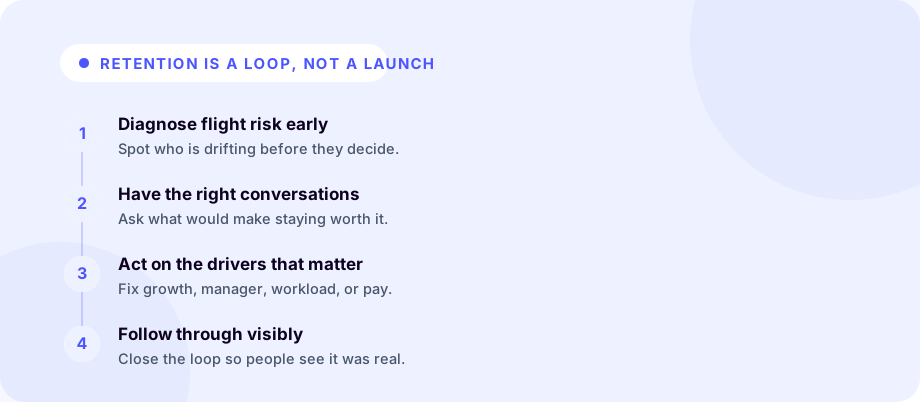
The teams that consistently keep good people aren't the ones with the flashiest benefits. They're the ones whose managers run a quiet, repeatable cycle:
- Diagnose who is at risk, early enough to do something about it.
- Converse - have the honest conversations that surface what would make someone leave or stay.
- Act on the one or two drivers that matter most to that person.
- Follow through visibly, so people see that speaking up actually changed something.
Each step feeds the next, and the whole loop turns over a few times a year per person. Skip the diagnosis and you're reacting to resignation letters. Skip the conversation and you're guessing. Skip the action and you've turned a hopeful employee into a cynical one. Skip the follow-through and you've taught your team that feedback goes into a void. The discipline is in doing all four, consistently, for the people you'd least want to lose.
Let's walk through each step.
Step 1: Diagnose flight risk early
You can't retain someone you didn't realize was leaving. The expensive surprises are the quiet ones - the steady performer who seemed fine right up until the notice. So the first job is to shorten the gap between "something's off" and "you know about it."
Watch the human signals
Disengagement is usually gradual and visible if you're paying attention. The patterns worth noticing:
- Pulling back from longer-term projects or declining work they'd normally jump on.
- Going quieter in one-on-ones and team meetings; fewer ideas, less pushback.
- A drop in discretionary effort - doing the job, but not the extra mile they used to.
- Noticeable changes in tone, energy, or how they talk about the future of their role.
None of these is proof on its own. Together, and especially as a change from someone's baseline, they're a prompt to lean in. For a fuller list, our breakdown of the 12 signs an employee is about to quit gives managers a shared vocabulary for what to watch.
Add structured, earlier signals
Human attention is essential but uneven - managers are busy, and the quietest flight risks are often your most self-sufficient people, the ones who never complain. That's the gap structured early-warning fills. Publicly available indicators that someone may be re-entering the job market - visible activity on their LinkedIn profile, for instance - can surface rising risk before the behavioral changes are obvious in the day-to-day.
This is exactly what TeamPredict was built for: it turns early, publicly available signals into a simple resignation-risk level per tracked employee, so leaders get lead time instead of surprises. That lead time means you can have the supportive conversation while it still counts, rather than reading about the decision in a resignation email. For the underlying mechanics, see our guide on how to identify and reduce flight risk.
Decide your response in advance
The mistake here is treating each signal as a one-off scramble. Instead, define what "at risk" looks like on your team and agree, ahead of time, how you'll respond - usually a conversation, not an intervention. Risk detection only has value if it reliably triggers the next step.
Step 2: Have the right conversations
A risk signal tells you who to talk to. It doesn't tell you why - and the why is where retention is won or lost. The only way to learn it is to ask, well, before someone has made up their mind.
Make one-on-ones the foundation
Consistent, recurring one-on-ones are the single most important habit a manager can build for retention. They create a standing, low-stakes channel where concerns surface gradually instead of erupting at resignation. If your one-on-ones have drifted into status updates, reclaim them: status can go in writing, and the live time should go to how the person is actually doing, what's frustrating them, and where they want to grow. If you're not sure what to ask, this list of one-on-one meeting questions gives managers a ready bank of prompts that surface concerns early.
Run a stay interview before it's an exit interview
When a one-on-one or an early signal tells you someone may be wavering, escalate to a deliberate stay interview - a short, structured conversation specifically about what keeps them engaged and what might tempt them away. The defining question is some version of: "What would make you consider leaving, and what keeps you here?"
Unlike an exit interview, which collects feedback after the decision is final, a stay interview gives you the chance to act while the relationship is intact. Our stay interview questions and template give you a ready bank to pull from. A few principles that make the conversation work:
- Keep it separate from performance reviews so people speak freely, without worrying it affects their rating.
- Ask open, non-leading questions and then stay quiet; the most useful answers come after a pause.
- Listen for the real driver, not the polite one. "More money" sometimes means "I don't feel valued" or "I can't see a future here."
- Don't promise on the spot. Commit to coming back with a real answer, which sets up Step 4.
Understand the drivers behind the words
People rarely leave over a single bad day. They leave after a slow accumulation of unaddressed frustrations. If you want to interpret what you're hearing, our piece on why good employees leave and how to keep them maps the root causes - stalled growth, a weak manager relationship, feeling unseen, burnout, and broken trust - that surface again and again in these conversations.
Step 3: Act on the drivers that matter most
This is where most retention efforts quietly die. Managers diagnose, they have the conversation - and then nothing changes, because they try to fix everything or get lost waiting for budget. The discipline of this step is focus: for each at-risk person, identify the one or two things that would most move their decision, and act on those.
A few drivers carry outsized weight across almost every team:
- Growth and progression. "I can't see a future here" is one of the most common reasons capable people start looking. Sketch a realistic next step and connect them to a concrete opportunity to build the skills it requires - a stretch project, a mentor, a course.
- The manager relationship. People often join a company and leave a manager. If the conversation reveals friction here, that's the work - more support, clearer expectations, better feedback, or in some cases a different reporting line.
- Recognition. Feeling unseen erodes motivation fast and costs almost nothing to fix. Specific, timely acknowledgment of real contributions lands as respect.
- Workload and wellbeing. Your most reliable people are often the most overloaded, precisely because they never say no. Find what to offload, defer, or stop.
- Fair pay. Compensation rarely buys loyalty on its own, but below-market pay is a fast, hard-to-recover reason to leave. Once someone feels underpaid, every other frustration weighs heavier.
You won't fix all of these for everyone, and you shouldn't try. The payoff comes from matching the action to the specific person: the underpaid mid-career engineer and the plateaued high performer need different things. For the full menu of tactics behind each driver, return to the employee retention strategies catalogue and pick the ones that fit what you heard.
A note on what you can't fix
Sometimes the honest answer is that you can't match what's pulling someone away, or the role has genuinely run its course for them. That's not a failure of the playbook. Early diagnosis still pays off here: instead of a fire drill, you get time to groom a successor, document knowledge, and plan a clean handoff. Knowing early is valuable whether the outcome is "stays" or "leaves well." Our guide to succession planning covers how to use that lead time.
Step 4: Follow through visibly
Asking for feedback and then doing nothing is worse than never asking: it teaches people their voice doesn't matter, and it accelerates the exit you were trying to prevent. The final step is closing the loop in a way the person can see.
That means going back to them explicitly: "You told me growth felt stalled. Here's the project I want you on, and here's the path it opens up." Even when you can't give someone everything they asked for, naming what you heard, what you're changing, and what you can't change yet preserves trust. People will stay through an imperfect answer if they believe it's honest and that they were heard.
Follow-through also closes the loop back to Step 1. Once you've acted, keep watching - in the next one-on-one, in their re-engagement (or lack of it), and in your early-risk signals. Retention isn't a conversation you have once; it's a state you maintain. The loop turns over again.
Putting the playbook into practice
If you're starting from scratch, you don't need to overhaul everything at once. Run the loop on a small scale first:
- Pick three people you'd least want to lose.
- Check your signals, both what you're observing and any structured flight-risk indicators, to gauge where each one stands.
- Schedule a 30-minute stay conversation with each and ask what would make them stay or go.
- Act on one real thing for each person within the month.
- Go back and tell them what changed because of what they said.
Then widen it. The managers who keep their best people are simply running this loop reliably while everyone else is reacting to resignation letters. Consistency beats intensity. A manager who does the fundamentals every quarter will out-retain one who launches a big initiative once a year and then goes quiet.
Retention, in the end, is just good management made deliberate: noticing early, asking honestly, acting where it counts, and following through. Do that on a rhythm, for the people who matter most, and the surprises get rarer.
If you'd like earlier lead time on the people you'd least want to lose, so you can run this loop before a resignation is final rather than after, start a free TeamPredict trial and see your team's resignation-risk signals in one place. It takes minutes to set up, with a 30-day free trial: you won't be charged until the trial ends, and you can cancel anytime.
For the complete picture, see our guide to employee retention; for the moment someone resigns, see how to handle employee counteroffers. If tooling is the next question, read how to choose employee retention software.
Frequently asked questions
- How do you retain employees?
- You retain employees by running a consistent loop rather than a one-off program: diagnose who is at risk early, have honest one-on-one and stay conversations to understand what would make them leave or stay, act on the one or two drivers that matter most to that person, and then follow through visibly so they see that speaking up changed something. The manager relationship sits at the center of all four steps, which is why frontline managers - not just HR - own most of the work of keeping good people.
- What is the best way to retain employees?
- The best way to retain employees is to catch concerns early, while you can still act, instead of reacting once a resignation letter is on your desk. That means combining attentive management with structured early signals of flight risk, asking the people you most want to keep what would make them consider leaving, and fixing the highest-impact driver for each person - usually growth, the manager relationship, recognition, workload, or fair pay. Early lead time turns a potential exit into a solvable conversation.
- Why do employees leave even when pay is competitive?
- Pay gets people in the door and prevents an obvious reason to leave, but it rarely keeps them on its own. Once compensation is fair, people most often leave because their growth has stalled, their manager relationship is weak, they feel unseen, they are chronically overloaded, or they have lost trust in where the company is headed. That is why a retention playbook focuses on the day-to-day experience, not just the number on the offer letter.
- How early can you spot that an employee might quit?
- Often weeks or months before a resignation, if you know what to watch for. Engaged people gradually disengage: they withdraw from longer-term projects, go quiet in one-on-ones, stop offering ideas, and let discretionary effort slip. Pairing that managerial attention with structured signals - including publicly available indicators that someone may be re-entering the job market - gives leaders meaningful lead time to have a supportive conversation before a decision is final.
- Whose job is it to retain employees - HR or managers?
- Both, but the direct manager carries most of the day-to-day weight. The manager relationship is one of the strongest predictors of whether someone stays, and the diagnose-converse-act-follow-through loop happens largely in one-on-ones. HR and People Ops set the system up: training managers, supplying conversation templates, watching team-level patterns, and stepping in when the manager relationship itself is the problem. The most reliable retention comes when both play their part.
About TeamPredict
TeamPredict Team
We build TeamPredict - retention early-warning software that flags resignation risk from public LinkedIn signals. We write about the patterns that precede a resignation and how people-first teams act on them early. Learn more about TeamPredict
Don't wait for the resignation letter.
TeamPredict flags resignation risk early from public LinkedIn signals, so you have lead time to retain your best people.
Start 30-Day Free TrialNo charge today · Cancel anytime