40 One-on-One Meeting Questions Every Manager Should Ask
Great managers have a real conversation with each person on their team every week; no strategy deck substitutes for it. The fastest way to make those conversations count is to walk in with better one on one meeting questions than "so, how's everything going?" This guide gives you a categorized bank of 40 questions grouped by theme, a clear method for running an effective 1:1, and a look at how these meetings surface early retention and flight-risk signals long before a resignation lands on your desk.
A one-on-one is a recurring, protected conversation between a manager and a direct report. Done well, it is the highest-payoff habit in management: low cost, deeply human, and the place where small problems get caught before they become big ones.
Run it like a conversation, not a status report - and catch the quiet signals early.
Why one-on-ones matter more than almost anything you do
People do not leave companies so much as they leave situations that quietly stopped working - a path that feels blocked, recognition that never comes, a workload creeping past sustainable, a manager who never really listens. Almost all of that is visible in a good 1:1 before it shows up in a resignation letter.
The 1:1 is where you build the trust that makes hard conversations possible, where you clear the blockers that drain your best people, and where you hear the early, quiet version of a frustration while you can still do something about it. It is also where you learn what each person actually wants from their career, so you can help them get there before someone else offers to. For the wider context on what drives people out, our guide on why good employees leave and how to keep them covers the structural side; the 1:1 is where you catch it one person at a time.
A quick but important note on framing: a 1:1 exists to understand the human in front of you, support them, and act on what you hear. A manager who uses it to monitor people or extract status reports loses the honesty that makes the meeting worth having.
How to run an effective one-on-one
A 1:1 is a focused, two-way conversation that belongs largely to the employee, and it stops working the moment it turns into a status meeting, a performance review, or an interrogation. A few principles keep it effective:
- Protect the time. A 1:1 that gets cancelled whenever things get busy teaches people they are a low priority. Keep the slot, and reschedule rather than skip when it truly has to move.
- Let the employee own most of the agenda. Use a running shared document both people add to ahead of time. When the manager controls everything, the meeting drifts into status reporting; when the employee has real input, it becomes the conversation they actually need.
- Start with the person, not the project. Open with a genuine check-in before you touch the work. The order signals what the meeting is for.
- Pick a few questions, not all 40. Use the bank below as a menu. Choose five or six that fit the person and the moment, and follow the threads that open up.
- Listen far more than you talk. Your job is to understand and unblock, not to defend or solve in real time. Take notes. Ask "tell me more" often. Get comfortable with silence.
- Close every blocker loop. If someone raised something last time, report back on it this time. Nothing builds trust like visibly acting on what you heard; nothing erodes it faster than raising things into a void.
Keep status updates light. They can happen asynchronously in a doc or a stand-up; the 1:1 is too valuable to spend on information you could have read.
40 one-on-one meeting questions, grouped by theme
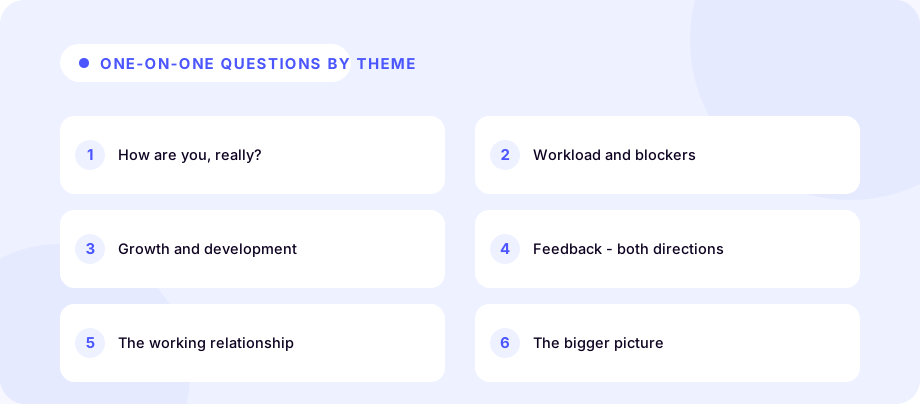
Use these as a bank, not a script. Pull five or six that fit the person in front of you, ask them openly, and let the answers lead. Rotate the themes over time so you are not asking the same person the same things every week.
Check-in and wellbeing
- How are you doing this week - really, not just the work answer?
- What's your energy like right now, on a scale from drained to firing on all cylinders?
- Is your workload feeling sustainable, or are you running hot?
- What's something good that happened recently, at work or outside it?
- Is there anything weighing on you that I should know about?
Current work and blockers
- What are you focused on right now, and what's most important among it?
- What's getting in your way this week that I could help clear?
- Where are you stuck or waiting on someone else?
- Is anything taking far longer than it should? What's behind that?
- What's one thing I could do this week to make your job easier?
- Are there any priorities that feel unclear or in conflict right now?
Growth and development
- What skill do you most want to build this quarter, and are you getting the chance to?
- What part of your work makes you lose track of time?
- Is there a project or area you'd love to get more involved in?
- Where do you feel stretched in a good way - and where in a bad way?
- What's something you've learned recently that you're proud of?
- Is there anything you want to do less of so you can do more of what matters?
Feedback (both ways)
- What feedback do you have for me - what should I do more of, or less of?
- Is there anything I'm doing that's making your job harder than it needs to be?
- Do you feel you get enough feedback from me, and is it the kind that's actually useful?
- Is there a recent decision of mine you'd have made differently?
- What's something you wish you could tell me but haven't?
- How could our 1:1s be more valuable to you?
Motivation and engagement
- What's been the most satisfying part of your work lately?
- What's been the most frustrating?
- Do you feel your work here is recognized and valued?
- When did you last feel genuinely proud of something you did here?
- Is there anything that's quietly draining your motivation right now?
- What would make next week noticeably better than this one?
Career and the future
- Where do you want to be in a year, and is that path visible here?
- What does your ideal next role look like - and what's the gap between here and there?
- Are you learning and growing in ways that matter to you, or does it feel stalled?
- If you could redesign your role, what would you add, drop, or change?
- A year from now, what would need to be true for you to be glad you stayed?
- What's one thing we could change that would make a real difference to whether you stay?
Manager effectiveness
- What support do you need from me that you're not getting?
- Am I giving you the right amount of autonomy - too much, too little?
- When you bring me a problem, do you feel heard and helped?
- Is there anything about how I lead the team that you'd change?
- What's one thing I could do to be a better manager for you specifically?
You will not use all 40 in one sitting, and you shouldn't try. The point of a deep bank is variety: it keeps your 1:1s from collapsing into the same three questions every week and gives you the right prompt for whatever the moment calls for.
How one-on-ones surface early retention and flight-risk signals
Regretted departures are rarely sudden. They build slowly, through frustrations that go unspoken until the day they harden into a decision. The value of a consistent 1:1 is that it gives those frustrations a place to surface early - and gives you a baseline against which change becomes visible.
When you talk to someone every week, you learn their normal: their usual energy, how they talk about their future, how engaged they are with long-term work. That baseline is what makes drift detectable. A few patterns to watch for in your conversations:
- A drop in energy or engagement that persists across several weeks, not just a rough patch.
- Withdrawal from the long term - vaguer answers about where they want to be in a year, less interest in projects that pay off months out.
- New or sharpening frustration about growth, recognition, or workload that you haven't managed to resolve.
- Shorter, more guarded answers from someone who used to be open, especially about the future or about how they feel.
- Quieter discretionary effort - the extra ideas, initiative, and ownership tapering off.
None of these is proof on its own. But across a few 1:1s they form a picture, and that picture is your cue to go deeper - often with a dedicated stay interview, which is a more structured version of the "what would make you stay or leave" questions above. If you want a fuller catalogue of behavioral cues, our guides on the signs an employee is about to quit and on identifying and reducing employee flight risk go deeper, and our piece on quiet quitting and how to spot it covers the specific case of disengagement that hides in plain sight.
The hard part is rarely the conversation itself - it is knowing who and when. You cannot go deep with everyone every week, and the people most worth keeping are often the best at hiding that they are slipping. This is where structured early signals help. TeamPredict surfaces early, publicly available indicators of renewed job-market interest from LinkedIn profile activity into a simple resignation-risk level per tracked employee, so you get lead time instead of a surprise. It tells you when a 1:1 has become more important than the calendar suggests - and your 1:1 gives you the conversation to act on it. The signal and the response work best together. Pairing both with strong employee engagement strategies that reduce turnover turns one-off saves into a system.
Turning one-on-ones into a retention habit
The teams that keep their best people run honest, well-prepared conversations on a regular cadence, listen carefully, and follow through on what they hear. A good 1:1 costs you 30 minutes and a willingness to act - and it can save you a resignation you never saw coming, the months of disruption that follow, and the institutional knowledge that would have walked out the door.
Start small and concrete. Build your question bank from the 40 above, protect the time on your calendar, and make one change this week based on something a team member tells you. If you'd also like earlier warning on who to prioritize, so the right conversation happens while it can still change the outcome, start a free TeamPredict trial and see your team's resignation-risk signals in one place. It takes minutes to set up, with a 30-day free trial: you won't be charged until the trial ends, and you can cancel anytime.
Frequently asked questions
- What questions should I ask in a one-on-one?
- Ask open, non-leading questions across a few themes rather than the same status update every week. Start with a genuine check-in on how the person is doing, then move to current work and blockers, growth and development, feedback in both directions, motivation, and where they want to go next. Keep a bank of 30 to 40 questions and pick five or six per meeting based on what is going on for that person. The point is to understand and unblock, not to interrogate or collect a report.
- What should a 1:1 meeting cover?
- A good 1:1 covers the person, not just the project. Make room for wellbeing and workload, current priorities and blockers you can clear, progress on growth and career goals, and two-way feedback. Let the employee set part of the agenda so it reflects what matters to them. Status updates can happen, but they should not crowd out the human conversation that makes 1:1s worth having in the first place.
- How long and how often should one-on-ones be?
- For most teams, a weekly or biweekly 1:1 of 30 to 45 minutes works well. Weekly suits fast-moving work, new hires, or anyone going through change; biweekly can be enough for steady, experienced team members. The cadence matters less than the consistency: a protected 30 minutes that actually happens beats an hour that gets cancelled whenever things get busy.
- Who should own the one-on-one agenda?
- Share it. The strongest 1:1s use a running shared document where both people add items ahead of time, but the employee should own the larger share. When the manager controls the entire agenda, the meeting drifts toward status reporting. When the employee has real input, it becomes the conversation they actually need, which is where the most useful signals show up.
- Can one-on-ones really help with retention?
- Yes. Consistent, honest 1:1s are one of the most reliable early-warning systems a manager has. Shifts in energy, withdrawal from long-term plans, vaguer answers about the future, or new frustration with growth often appear in conversation well before someone resigns. They will not catch everything, which is why pairing regular 1:1s with structured early signals gives you the fullest picture and the most lead time to act.
About TeamPredict
TeamPredict Team
We build TeamPredict - retention early-warning software that flags resignation risk from public LinkedIn signals. We write about the patterns that precede a resignation and how people-first teams act on them early. Learn more about TeamPredict
Find out who's showing exit signals.
Score one person's flight risk in a couple of minutes with the free assessment - then let TeamPredict watch the rest daily.
Run the free flight-risk assessmentFree, no signup required.