Quiet Hiring: What It Is and How to Do It Without Burning Out Your Team
If you have heard of quiet quitting and quiet firing, quiet hiring is the third sibling in the family - and the one most likely to be framed as a positive. Where quiet quitting describes employees pulling back effort and quiet firing describes managers nudging people out by neglect, quiet hiring describes employers meeting new needs without new headcount: upskilling, reassigning, and stretching the people they already have. This guide explains what quiet hiring really is, the genuine upside it can deliver, the very real risk of burning out your best people, and how to do it the right and fair way - so it strengthens retention instead of quietly draining it.

Four boxes ticked (transparent, paid, developmental, consensual), one still to go: rebalance the load.
What is quiet hiring?
Quiet hiring is meeting a business need without opening a traditional full-time req. Instead of recruiting externally, an organization acquires the skills and capacity it needs from sources it already has - most often by upskilling, reassigning, or stretching current employees, and sometimes by bringing in contractors or short-term specialists for a defined gap.
In practice it takes a few common forms:
- Internal reassignment. A priority shifts, and someone is moved - formally or informally - from their current work to the area that suddenly matters more.
- Stretch and scope expansion. An employee is asked to take on responsibilities beyond their role: a new function, a bigger remit, a project no one currently owns.
- Upskilling for a gap. Rather than hire for a missing capability, the company trains an existing employee to grow into it.
- Contractors and gig talent. For temporary or specialized needs, short-term help fills the gap without a permanent addition to the payroll.
The label is new; the underlying behavior is not. Organizations have always redeployed people when priorities change. What the term quiet hiring names is the deliberate choice to fill needs from within instead of from the outside, and the fact that it often happens quietly, without the formal role change, title, or compensation adjustment that the new work would normally come with.
That last point is where quiet hiring becomes a leadership question rather than a logistics one. The same move can be a career-making opportunity or a quiet overload, depending almost entirely on how it's done.
Quiet hiring vs quiet quitting vs quiet firing
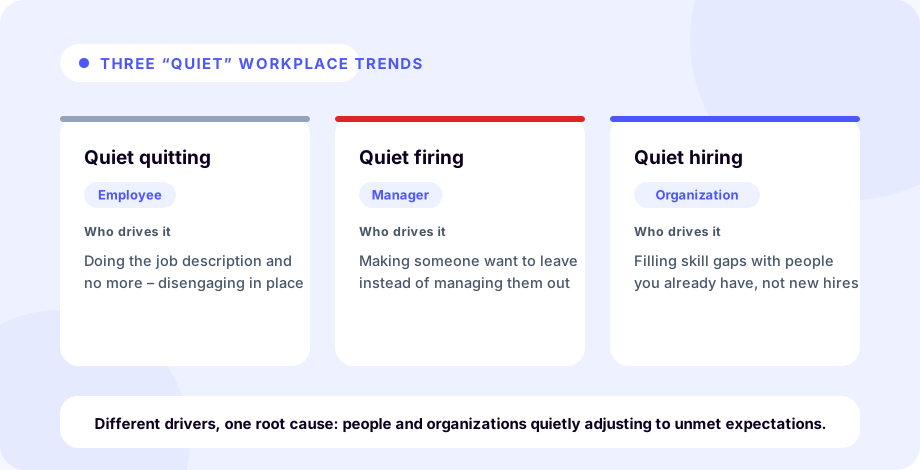
Quiet hiring is the most easily confused of the three "quiet" workplace terms, because all of them describe something happening beneath the surface of a normal job. The difference is who acts, and in which direction. Quiet quitting is an employee pulling effort back to the edges of their role. Quiet firing is a manager withdrawing support to nudge someone out. Quiet hiring is an employer asking people to stretch beyond their role to cover a new need. Two of the three pull effort down; quiet hiring pushes it up - which is exactly why, done carelessly, it can trigger the other two.
| Quiet quitting | Quiet firing | Quiet hiring | |
|---|---|---|---|
| Who drives it | The employee | The manager | The employer |
| The core move | Withdrawing discretionary effort | Withdrawing support and opportunity | Redeploying people to stretch beyond their role |
| Usual root cause | Burnout, feeling undervalued, stalled growth | Avoiding a hard conversation; a private verdict on someone | Needing new capacity without new headcount |
| What it signals | "I've disengaged from the work" | "I want you to leave, but won't say so" | "We need this covered without a new hire" |
| The fair fix | A supportive re-engagement conversation | A direct, honest performance conversation | Transparency, fair pay, development, and genuine consent |
Seen together, the three aren't separate problems so much as a chain. Mishandled quiet hiring overloads your most capable people, which breeds the resentment behind quiet quitting - and a manager who reads that withdrawal as a character flaw and responds with neglect has slid into quiet firing. Do quiet hiring fairly and you break the chain before the first link forms.
Quiet hiring examples
The term is newer than the behavior. Gartner popularized "quiet hiring" as a 2023 workplace trend, using it to describe how organizations acquire new skills and capacity without adding full-time headcount - and the label stuck because it named something leaders were already doing. In practice, it shows up in a handful of recognizable patterns:
- Covering a departure without backfilling. Someone leaves, and instead of opening a req their projects are split across the teammates who "absorb it for now." Quiet hiring by attrition.
- Absorbing a new initiative into an existing team. Leadership greenlights an AI, compliance, or growth project but funds no new roles, so a current engineer or ops lead picks it up on top of the day job.
- Upskilling into a capability gap. Rather than hire a specialist, a company trains a curious employee and grows the missing skill in-house.
- Responsibilities without the title. Someone starts running stand-ups, onboarding, and planning - doing a more senior job in all but name and pay.
- Contractors for a defined spike. For a launch or seasonal crunch, short-term specialists fill the gap instead of a permanent hire.
The first three are where quiet hiring earns its reputation as an opportunity - provided they come with support and reward. The fourth is where it most often curdles into unpaid scope creep. Same mechanism, opposite outcome; the deciding factor is the four safeguards below.
Why quiet hiring is rising
Quiet hiring isn't a fad invented to match the other two terms. It's a rational response to real pressure. Hiring is expensive, slow, and uncertain; budgets are tight; and many of the skills organizations need are easier to grow internally than to find on the open market. When leaders can't simply add headcount, they look harder at the talent already on the team.
There's a genuinely good version of this. The best companies have always treated their existing people as their first talent pool - promoting from within, moving high-potential people into stretch roles, and building skills rather than buying them every time. That pool extends beyond current staff, too: strong boomerang employees who left on good terms can return with proven skills and minimal ramp time. Seen that way, quiet hiring is just internal mobility done intentionally, and it sits comfortably alongside good succession planning: you're developing the people you have toward the needs you can see coming.
The risk is that "we can't hire, so lean on the team we have" curdles into "we can extract more from the same people indefinitely." That's the line this article is really about.
The upside: agility and real growth
When quiet hiring is done well, the benefits are real on both sides.
For the organization, it buys agility. Priorities change faster than hiring cycles. Being able to redeploy capable people toward what matters now - without waiting months to recruit - is a genuine competitive advantage, especially for lean SMB and mid-market teams that can't afford to over-hire for every possible future.
It develops people and surfaces hidden capability. A stretch assignment is one of the fastest ways anyone learns. Done right, quiet hiring gives employees new challenges, new skills, and visibility they'd otherwise have to change jobs to get. It can reveal range that no job description captured - the engineer who turns out to be a strong people lead, the support rep with a real instinct for product.
It can be a powerful retention tool. This is the part leaders often miss. A lot of good people leave precisely because they feel stuck - no new challenge, no path forward, no sense that effort compounds into growth. Stalled development is one of the most common reasons good employees leave. Offering a meaningful internal move before someone starts looking elsewhere can be exactly the thing that keeps them. Internal mobility, done fairly, is retention.
The key word in every one of those benefits is fair. Take it away, and each upside flips into its opposite.
The real risk: overloading your best people
Here's the uncomfortable truth about quiet hiring: the work flows toward your most capable, most reliable employees, the very people you can least afford to lose.
When a need appears and no one is hired to meet it, who absorbs it? Not the disengaged. It's the dependable high performer, the person who says yes, the one already trusted with the hard things. So quiet hiring, left unmanaged, concentrates extra load on exactly the people whose departure would hurt most. And it tends to do so invisibly - one "could you also take this on?" at a time, with no moment where anyone steps back and adds it all up.
The damage compounds in a few predictable ways:
- Burnout. A second job stapled onto the first, with no relief, exhausts people. Chronic overload is one of the most reliable engines of disengagement there is.
- The fairness gap. When scope grows but title, pay, and recognition don't, capable people notice. They're doing more senior work for the same reward - and they know it.
- Resentment and withdrawal. People who feel taken for granted stop volunteering. The extra effort that made them the obvious choice quietly dries up. In other words, mishandled quiet hiring is one of the surest ways to manufacture quiet quitting in your strongest contributors.
- Rising flight risk. Overloaded, under-recognized, and quietly resentful is the exact profile of someone who takes the next recruiter call. Quiet hiring done badly is a direct contributor to employee flight risk - and the irony is brutal: you skipped a hire to save money and lost the person who was holding everything together.
If the pattern becomes the norm - load piled on the willing, with no acknowledgment - it stops being an isolated mistake and starts looking like one of the structural signs of a toxic work environment. The thing meant to make you more agile makes you more fragile.
How to do quiet hiring right and fairly
The difference between a growth opportunity and a burnout engine isn't the redeployment itself - it's whether it's done openly, fairly, and with the person's genuine buy-in. Four principles separate the good version from the bad.
1. Be transparent: name what you're doing
The fastest way to poison quiet hiring is to keep it quiet from the person doing the work. Don't let scope creep in by accident. Say it plainly: "We're not hiring for this right now; we'd like you to take it on, and here's why we're asking you." Transparency turns a stealth load into an honest proposition the person can actually evaluate - and respond to. The "quiet" in quiet hiring should describe the absence of an external req, never secrecy toward your own team.
2. Compensate the new scope
If the work is meaningfully bigger, the reward has to move too. That can be a raise, a bonus, a title change, or, at minimum, concrete, visible recognition and a credible timeline for the formal change. What you cannot do is expand someone's job permanently while pretending it's the same job. The fairness gap between senior work and unchanged reward is where trust dies. Pay people for the job they're actually doing.
3. Frame it around development the person wants
A stretch assignment lands completely differently when it's tied to a skill the employee actually wants to build. So start from them, not just from the gap: What do they want to grow toward? Where do they want to go next? When quiet hiring is aligned with someone's own goals, it stops being extraction and becomes investment - the kind of development that makes people more likely to stay. A stay conversation is a good place to learn what someone genuinely wants before you hand them a new remit.
4. Get real consent, and protect their capacity
A new assignment should be an offer, not an ambush. Give people a genuine choice, including a safe way to say no or not now. And when you add something to a plate, take something off, or explicitly rebalance the workload, rather than assuming there's infinite slack. "Yes, and we'll move X off you to make room" is the sentence that keeps a stretch from becoming a crush. Consent without capacity is just a politer overload.
Run quiet hiring through those four filters (transparent, compensated, developmental, consensual) and it becomes one of the better things you can offer a strong employee. Skip them, and you're just managing people out by overwork instead of neglect.
How quiet hiring connects to retention
Step back and the throughline is clear: quiet hiring is a retention lever that swings both ways. Pulled the right way, it gives your best people growth, challenge, and a reason to build their future where they already are - often the very thing that keeps someone who'd otherwise drift. Pulled the wrong way, it overloads, under-rewards, and quietly pushes those same people toward the door.
What decides the direction is attention. Mishandled quiet hiring fails on lag: by the time a leader notices that their most loaded, most relied-upon person has gone quiet and started looking, the resentment has usually already set in. The leaders who get this right check in sooner: they redistribute load before it cracks someone, and they notice when a "great opportunity" has quietly become a burden.
That early signal is exactly what TeamPredict is built to surface. It turns early, publicly available signals into a simple resignation-risk level per tracked employee, so when the person you've leaned on hardest starts drifting toward the exit, you hear about it while rebalancing is still possible. Used well, it's a prompt to lighten the load and have the honest conversation while you still can: the difference between quiet hiring that retains people and quiet hiring that quietly loses them. If you want the structural habits that keep engagement high before any of this becomes urgent, our guide to employee engagement strategies that reduce turnover covers the foundation.
Make it a fair trade
Quiet hiring is neither the villain nor the hero some headlines make it. It's a tool: a way to stay agile and grow people by meeting new needs from within instead of always recruiting from outside. In good hands, it's internal mobility with a new name: real opportunity, faster skill growth, and a strong reason for your best people to stay. In careless hands, it's unpaid scope creep that burns out the dependable and raises flight risk across the team. The deciding factor is never the redeployment itself. It's whether you do it openly, pay for it fairly, tie it to growth people want, and give them a real choice.
Quiet hiring only works when someone is watching the load. TeamPredict flags when the person carrying the most starts drifting, weeks before a notice lands, so you can rebalance and have the right conversation in time. Start a free TeamPredict trial: it's $5 per tracked employee per month, 30 days free, no charge until the trial ends, cancel anytime.
Frequently asked questions
- What is quiet hiring?
- Quiet hiring is meeting a new business need without adding a new full-time headcount - by upskilling, reassigning, or stretching the employees you already have, or by bringing in contractors and short-term help. Instead of opening a req and recruiting externally, you redeploy existing talent toward the priority that matters most right now. Done openly and fairly it can be a real growth opportunity; done by stealth it is just unpaid scope creep.
- Is quiet hiring good or bad?
- It depends entirely on how it's done. At its best, quiet hiring gives people visible new challenges, faster skill growth, and internal mobility without a job search - a genuine win for the employee and the company. At its worst, it quietly piles a second job onto your most capable people with no extra pay, recognition, or relief, which burns them out and raises flight risk. The practice is neutral; the execution is everything.
- What is the difference between quiet hiring and quiet quitting?
- They sit at opposite ends of the effort spectrum. Quiet quitting is an employee withdrawing discretionary effort and dialing back to the boundaries of their role. Quiet hiring is an employer asking employees to stretch beyond their role to cover new needs. Handled badly, the second causes the first: people who feel quietly loaded up with extra work and no reward tend to disengage.
- How do you do quiet hiring without burning people out?
- Make it transparent, compensated, developmental, and consensual. Be honest that you're redeploying rather than hiring, adjust pay or recognition to match the new scope, frame the move around skills the person actually wants to build, take something off their plate when you add to it, and give them a real choice rather than a fait accompli. The difference between a growth opportunity and a burnout engine is whether the person came along willingly and was fairly rewarded.
- Is quiet hiring just a way to avoid hiring?
- It can be, and that's the trap to avoid. Used as a short-term cost dodge - squeezing more output from the same people to skip a hire you actually need - it erodes trust and drives turnover that costs more than the role would have. Used well, it's a deliberate talent strategy: matching internal capability to changing priorities, building skills, and reserving external hiring for genuine capability gaps.
- Where did the term quiet hiring come from?
- Gartner popularized 'quiet hiring' as a 2023 workplace trend, using it to describe how organizations acquire the skills and capacity they need without adding full-time headcount - mainly by upskilling, reassigning, and stretching existing employees, and sometimes by using contractors. The behavior long predated the label; Gartner's framing simply gave a name to a practice that intensified as hiring budgets tightened.
- What is an example of quiet hiring?
- A common example is covering a departure without backfilling it: when someone leaves, their work is split across existing teammates instead of hiring a replacement. Other examples include handing a new initiative to an existing team with no added roles, upskilling a current employee into a capability gap rather than hiring a specialist, or someone taking on a manager's responsibilities without the matching title or pay. The first versions can be genuine opportunities when they come with support and reward; the last is where quiet hiring most often becomes unpaid scope creep.
About TeamPredict
TeamPredict Team
We build TeamPredict - retention early-warning software that flags resignation risk from public LinkedIn signals. We write about the patterns that precede a resignation and how people-first teams act on them early. Learn more about TeamPredict
Find out who's showing exit signals.
Score one person's flight risk in a couple of minutes with the free assessment - then let TeamPredict watch the rest daily.
Run the free flight-risk assessmentFree, no signup required.