Employee Engagement Strategies That Actually Reduce Turnover
Most leaders treat engagement as a survey score to nudge upward once a year, but the employee engagement strategies that actually reduce turnover are the everyday practices that change how work feels - not the perks bolted on around the edges. Engagement is the emotional investment that makes someone give discretionary effort, speak up in meetings, and stay through a rough patch. When it fades, a resignation is often weeks or months away. This guide walks through nine practical strategies, each with what it is, why it works, and a concrete first step you can take this week.
A quick word on what engagement is not. Free lunches, ping-pong tables, and branded swag are pleasant, but they don't make anyone emotionally committed to their work. Real engagement comes from the relationship people have with their manager, their growth, the meaning in their work, and whether they feel seen and trusted. That's where the leverage is - and where retention is won or lost.
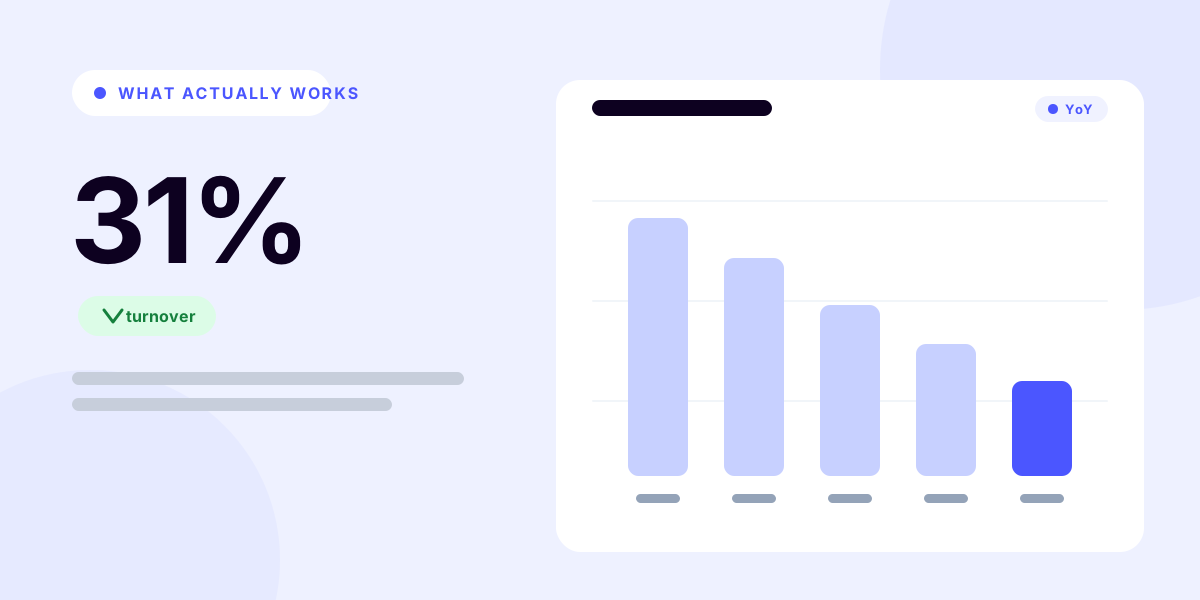
Steady engagement work, fewer regretted exits each quarter.
Why engagement is the real lever on turnover
Engagement and turnover move in opposite directions. An engaged employee is invested enough to raise concerns, lean into hard problems, and weather the inevitable bad weeks. A disengaged one has already started to pull back - and that pulling back is usually the first visible stage of a departure that hasn't been announced yet.
This is why engagement deserves more than an annual pulse survey. The day someone disengages, the clock starts. They participate less, stop volunteering for longer-term projects, and quietly conserve the energy they used to spend freely. By the time it shows up in a survey, the slide has often been underway for a while. Spotting and reversing an engagement dip early is one of the most reliable forms of proactive retention there is - and many of the same behaviors are documented in our breakdown of the 12 signs an employee is about to quit.
The strategies below target the root causes of engagement, not the symptoms. Treat them as a menu to prioritize against your own team's reality, not a checklist to launch all at once. One practice done reliably beats ten done halfway.
The employee engagement strategy framework
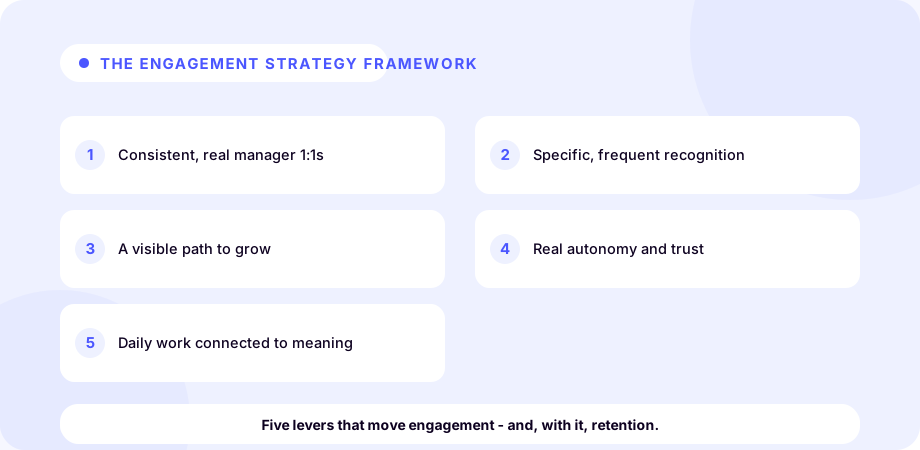
The nine moves below aren't a random list - they fit a simple employee engagement strategy framework built on one idea: engagement lives in the actual experience of the work, so every lever has to change that experience. The framework sorts the nine strategies into the five things people need from a job:
- A manager who invests in them - consistent one-on-ones and specific recognition (strategies 1-2).
- A visible future - growth and a path worth staying for (strategy 3).
- Ownership and meaning - real autonomy plus a clear line from the work to why it matters (strategies 4-5).
- A sustainable, fair deal - protected workload and honest, fair pay (strategies 6 and 8).
- A team they belong to that listens - closed-loop feedback and genuine connection (strategies 7 and 9).
Diagnose which of the five is weakest on your team and start there. That's the whole framework: match the lever to the gap, then run it reliably for a quarter before adding the next.
1. Make manager one-on-ones consistent and real
What it is: A regular, recurring conversation between every employee and their manager - weekly or biweekly - that's about the person, not just status updates. Their work, their blockers, their growth, how they're actually doing.
Why it works: The manager relationship is the single strongest driver of engagement. People give their best effort to managers who listen, coach, and remove obstacles - and they quietly disengage from managers who are absent or transactional. Consistent one-on-ones are where engagement is built or eroded, one conversation at a time. They're also your earliest warning system: a change in tone or energy shows up here before it shows up anywhere else.
First step: Audit whether every manager on your team is running recurring one-on-ones. If they're not, make them non-negotiable and hand managers a simple agenda template - wins, blockers, growth, and one open-ended "how are you really doing?" - so the time doesn't collapse back into a status check. For prompts that go beyond status, share this set of one-on-one meeting questions so managers always have something better to ask.
2. Recognize good work specifically and often
What it is: Consistent, specific acknowledgment of contributions - from a manager's timely thank-you to peer recognition and public credit for work well done.
Why it works: Discretionary effort dries up when nobody appears to notice it. Praise only counts when the person can tell you actually watched them work: name the decision they made, the mess they prevented, the customer they kept. The quiet, reliable people are the likeliest to go unthanked for years, and they rarely complain about it; they just stop volunteering, and eventually stop staying.
First step: Before this week ends, thank two people in writing for something they did this month, and name the outcome it produced. Then put a recurring reminder in your calendar so it happens again next month.
3. Give people a visible path to grow
What it is: Clear, personal development - stretch assignments, mentorship, learning budgets, and an honest sense of what the next step looks like - so people can see themselves getting better here.
Why it works: High performers are usually the most ambitious, and stagnation disengages them fastest. "I can't see a future here" is one of the most common reasons capable people start looking elsewhere; when the only way to grow is to leave, your strongest people go first. Visible growth keeps that ambition pointed inward. Because growth and turnover are so tightly linked, anticipating who is at risk matters - our guide on how to predict employee turnover before it happens covers the leading indicators worth watching.
First step: In your next one-on-one, ask each person what skill they want to build this quarter, then connect them to one concrete opportunity - a project, a course, or a mentor - to build it. Make growth a standing topic rather than a once-a-year review item.
4. Extend real autonomy and trust
What it is: Giving people genuine control over how they do their work - the methods, the schedule where the role allows, the ownership of outcomes - rather than dictating every step.
Why it works: Autonomy is one of the strongest, lowest-cost engagement levers there is. Being trusted to own a problem is energizing; being micromanaged is the opposite. When you judge people on outcomes instead of hours logged or seats occupied, you signal respect, and respect compounds into commitment. Treating capable adults as if they need watching is corrosive - and it's exactly the wrong instinct, because engagement comes from trust, not monitoring.
First step: Identify one decision or process you currently control that someone on your team could own outright. Hand it over this week, with the outcome made clear and the method left to them.
5. Connect daily work to meaning
What it is: Helping people see how their specific tasks ladder up to a customer outcome, the team's goals, and the company's larger purpose.
Why it works: Work that feels like motion without purpose drains commitment even when nothing else is wrong. Show someone the customer whose day their ticket fixed and the same task carries different weight the next time; a slightly bigger salary somewhere else also gets harder to weigh against work that visibly matters. Restoring that line of sight is fast and costs nothing.
First step: Bring one real customer outcome into your next team meeting and trace it back to the work that produced it, crediting the people involved by name. Repeat it until the team starts telling those stories without you.
6. Protect workload and wellbeing
What it is: Actively monitoring how much is on people's plates and treating a sustainable pace as a leadership responsibility, not an individual's problem to solve alone.
Why it works: Burnout is the point where disengagement stops being reversible with a pep talk. It builds fastest on the people who absorb every overflow without complaint, and it rarely announces itself; watch instead for cynicism, withdrawal, and slipping quality from someone who's usually excellent. A leader who visibly manages capacity, rather than quietly relying on the same shoulders, keeps those people engaged. For a fuller toolkit on the conditions that drive people out, our guide on employee flight risk and how to reduce it goes deeper.
First step: List what each person on your team is actually carrying this week, including the invisible glue work. Take one item off the most loaded plate, and say out loud that you did it and why.
7. Close the loop on feedback
What it is: A reliable cycle where you gather employee input - through surveys, one-on-ones, or team conversations - and then visibly act on it and report back.
Why it works: A survey that disappears into a void teaches people to stop answering honestly. When someone's comment visibly changes a process, a rota, or a decision, the whole team learns that speaking up here works, and that belief carries engagement through hard stretches. If you want a lightweight number to track the cycle, employee Net Promoter Score (eNPS) is a simple one-question measurement layer that pairs well with fuller surveys, and our free eNPS calculator does the scoring from your response counts.
First step: Dig out the last round of feedback you collected and pick the one item you can fix this month. Fix it, then credit the feedback publicly when you announce the change.
8. Pay fairly and talk about it honestly
What it is: Compensation that's internally fair and externally competitive, paired with transparency about how pay actually works - the bands, the criteria, the path to a raise.
Why it works: The moment someone discovers they're paid below the band, or can't get a straight answer about how raises happen, every strategy above starts working against a headwind. Money sits in the background of engagement until it feels unfair; then it moves to the foreground and stays there. Clear bands and honest answers keep it in the background where it belongs.
First step: Write down, in one paragraph, how a raise actually happens on your team. If you can't, that ambiguity is the first thing to fix. If you can, share it, then check your most critical roles against current market data.
9. Build connection and belonging
What it is: Deliberate effort to help people feel they belong on the team - strong peer relationships, psychological safety to speak up, and inclusion in how decisions get made.
Why it works: People stay where they feel they belong. Connection to colleagues is a powerful retention anchor that perks can't replicate - it's the difference between "a job I have" and "a team I'm part of." Belonging also fuels the psychological safety that lets people raise concerns early, which is exactly what you want: an engaged team surfaces problems while they're still fixable, instead of quietly heading for the door. This is real engagement, as opposed to the surface-level "fun" that perks try to manufacture.
First step: Look at how connected your team actually is, especially anyone remote or recently hired. Create one genuine opportunity for connection this month - a working session, a shared win to celebrate, a deliberate effort to bring a newer voice into a decision.
Engagement strategies vs. perks: how to tell the difference
It's worth being blunt about why so many engagement efforts fail. They confuse amenities with engagement. A stocked kitchen, a foosball table, and an annual offsite are perks - pleasant, sometimes culture-supporting, but powerless against a disengaged manager relationship, a stalled career, or an unsustainable workload. Teams that lean on perks while neglecting the fundamentals tend to discover that disengaged people leave anyway, just with a slightly nicer break room behind them.
The nine strategies above all share a common thread: they change the actual experience of doing the work, and they're mostly free or low-cost. That's the test. If a tactic doesn't touch management quality, growth, recognition, autonomy, meaning, workload, feedback, fairness, or belonging, it's probably a perk - nice to have, but not a lever on retention. For a broader playbook that pairs naturally with these, see our 15 employee retention strategies that actually work, and to understand the deeper drivers, our breakdown of why good employees leave - and how to keep them.
Tie engagement dips to early flight-risk signals
Here's the connection that makes all of this actionable: a sustained dip in engagement is rarely just a mood. It's frequently the leading edge of a departure. Someone who's grown quiet in one-on-ones, stopped volunteering for longer-term work, and pulled back their discretionary effort is often already weighing options - sometimes before they've consciously decided anything.
The most effective leaders pair attentive management with an early read on who might be quietly disengaging or heading for the door. That's the gap TeamPredict was built to close: it surfaces early, proactive signals of resignation risk from publicly available LinkedIn activity, summarized into a simple resignation-risk level per tracked employee. It's a complement to good management and the engagement work above - never a substitute for it, and never about surveilling people. The point is lead time: enough notice to have a supportive stay conversation, address a real concern, or - if a departure is genuinely coming - groom a successor and plan a clean handoff instead of scrambling.
If you want to put numbers behind the problem, it also helps to know how to calculate your employee turnover rate so "we should engage people better" becomes a measurable goal you can actually track.
Putting it into practice
Engagement compounds quietly. A manager who listens, a growth plan with a date on it, recognition that names the outcome: run one of these for a full quarter and measure what changes in your one-on-ones before adding the next.
If you'd like an earlier, clearer read on the people you'd least want to lose, so you can have the right conversation while engagement can still be rebuilt, start a free 30-day TeamPredict trial and see your team's resignation-risk signals in one place. It takes minutes to set up, and you won't be charged until the trial ends; cancel anytime before then and pay nothing.
Engagement is one pillar of a broader employee retention strategy. Watch for its manager-side opposite, quiet firing.
Frequently asked questions
- What are employee engagement strategies?
- Employee engagement strategies are the deliberate practices leaders use to deepen people's emotional commitment to their work and their team - things like regular manager one-on-ones, specific recognition, clear growth paths, meaningful autonomy, manageable workloads, and visibly acting on feedback. They are not perks or office amenities. Real engagement strategies change the day-to-day experience of work, which is what actually keeps people from leaving.
- How do you improve employee engagement?
- Start with the manager relationship, since it shapes engagement more than almost anything else. Make one-on-ones consistent, recognize good work specifically and often, give people a visible path to grow, and close the loop when you ask for feedback. Pick one or two of these, implement them fully, and watch what changes - scattered half-finished initiatives move the needle far less than one practice done reliably.
- What is the difference between employee engagement and employee satisfaction?
- Satisfaction measures whether people are content with their conditions - pay, perks, hours. Engagement measures whether they are emotionally invested in the work and willing to give discretionary effort. Someone can be satisfied but disengaged: comfortable enough to stay for now, but quietly coasting or open to the next opportunity. Engagement is the stronger predictor of both performance and retention.
- How is employee engagement connected to turnover?
- Engagement and turnover move in opposite directions. When engagement drops - less participation, withdrawal from longer-term work, fading discretionary effort - it is often an early signal that someone is mentally checking out, and disengagement frequently precedes a resignation by weeks or months. Reversing an engagement dip early is one of the most reliable ways to prevent a regretted departure.
- Do perks like free lunches and ping-pong tables improve engagement?
- Rarely on their own. Perks are pleasant and can support a good culture, but they don't address the things that actually drive engagement - good management, growth, recognition, meaningful work, and reasonable workload. Teams that lean on perks while ignoring those fundamentals tend to find that disengaged people leave anyway, just with a slightly nicer break room behind them.
About TeamPredict
TeamPredict Team
We build TeamPredict - retention early-warning software that flags resignation risk from public LinkedIn signals. We write about the patterns that precede a resignation and how people-first teams act on them early. Learn more about TeamPredict
Don't wait for the resignation letter.
TeamPredict flags resignation risk early from public LinkedIn signals, so you have lead time to retain your best people.
Start 30-Day Free TrialNo charge today · Cancel anytime