How to Predict Employee Turnover Before It Happens
Losing a strong performer rarely happens overnight: it builds quietly, over months, in patterns that are visible long before anyone hands in a resignation letter. Learning how to predict employee turnover is really about reading those patterns early: spotting the leading indicators of disengagement and flight risk while you still have time to do something about them. This guide takes a people-analytics approach, covering the data signals that actually forecast departures, how to combine the numbers with human judgment, whether to build or buy a predictive process, and how to act on what you find supportively rather than intrusively.
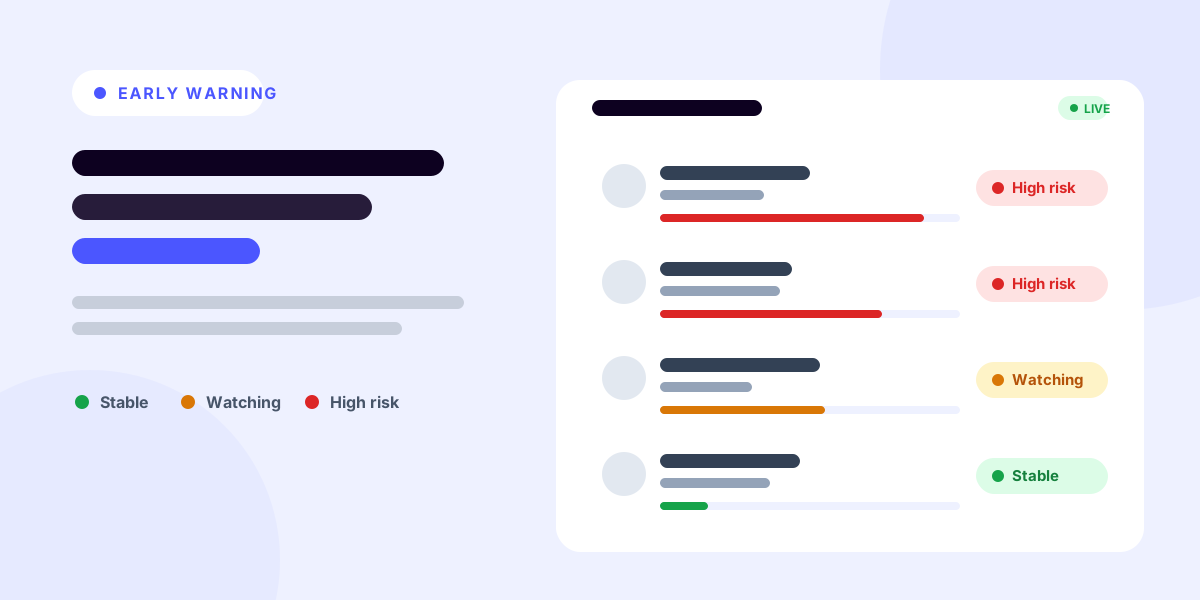
Resignation risk scored from public signals, weeks before the notice letter lands.
Why most teams predict turnover too late
Most organizations only "predict" turnover in the rear-view mirror. They calculate attrition after the fact, run an exit interview, and learn, too late, that the person had been quietly checked out for two quarters. By the time someone resigns, the decision is usually made; counteroffers rarely fix the underlying reasons people leave.
The shift that changes everything is moving from lagging indicators to leading indicators.
- Lagging indicators tell you what already happened: turnover rate, regretted attrition, exit-interview themes. They're essential for measuring the problem (see our guide on how to calculate employee turnover rate), but they can't help the person who already left.
- Leading indicators tell you what's likely to happen: engagement trends, stalled growth, manager friction, market activity. These are the signals you can act on while retention is still possible.
Prediction isn't about certainty. You will never know with confidence that one specific person will resign on one specific day. What you can do is estimate elevated risk. Elevated risk plus enough lead time is exactly what good retention work needs.
The data signals that predict turnover
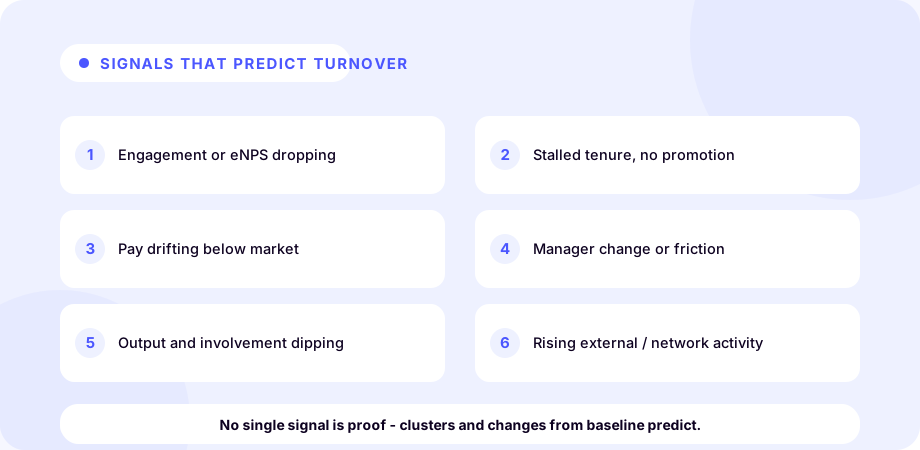
No single metric forecasts a departure. Turnover is multi-causal, so the most reliable approach is to watch a portfolio of signals and pay attention when several move in the wrong direction at once. Here are the categories that consistently carry predictive weight.
1. Engagement and participation trends
The clearest early warning is a change in someone's normal pattern. Engagement survey scores trending down, fewer questions in meetings, declining participation in optional initiatives, or a once-vocal contributor going quiet: these shifts often precede a resignation by months. Track the direction and slope more than the absolute number. A high performer drifting from "highly engaged" to "neutral" is a louder signal than someone who has always been quietly steady.
2. Tenure curves and time-in-role
Risk isn't evenly distributed across a career. There are predictable tenure cliffs (common inflection points such as the end of a first year, or the two-to-three-year mark in a role with no movement) where people reassess whether to stay. Mapping your team against these curves tells you when attention is most warranted. Someone who has been in the exact same role, level, and scope for an unusually long time relative to peers is statistically more open to a change.
3. Manager quality
People join companies and leave managers; it's a cliche because it's largely true. Manager-level patterns are among the most predictive data you have: if one team shows disproportionate attrition, skipped 1:1s, low manager-effectiveness scores, or recent reorg churn, everyone reporting into that situation carries elevated risk. A recent change of manager is itself a trigger event worth flagging.
4. Pay equity and compensation drift
Compensation rarely makes someone stay, but compensation problems reliably push people out. The signal to watch is drift: market rates rising faster than internal salaries, internal inequities where newer hires out-earn loyal tenured staff, or someone whose pay has been flat through several strong review cycles. You don't need exact market data to spot the pattern: relative stagnation is the warning.
5. Promotion velocity and growth trajectory
Ambitious people watch their own momentum closely. Promotion velocity (how quickly someone is progressing relative to expectations and peers) is a strong predictor. A stalled trajectory, a missed expected promotion, or a lack of visible next step is a classic precursor to a quiet job search. Growth doesn't always mean a title; a flat learning curve and no new scope count too.
6. External and market activity
Some of the earliest signals live outside your four walls. When someone begins updating their professional profile, reconnecting with their network, adding skills or certifications, or otherwise becoming more visible in the market, it often reflects a mindset shift toward exploring options. This is publicly available activity (the kind a recruiter would notice), and read in aggregate it's one of the most timely leading indicators available. Read it as someone signaling openness, and make sure they have reasons to stay.
For a fuller catalogue of behavioral tells, see 12 signs an employee is about to quit, and for how to score and prioritize risk across a team, employee flight risk: how to identify and reduce it.
Combining quantitative and qualitative signals
Here's the trap people-analytics teams fall into: treating prediction as a purely numerical exercise. Numbers tell you who and when; they almost never tell you why. And the "why" is what makes an intervention work.
The strongest predictive process layers two lenses:
- Quantitative signals - the measurable trends above. They're scalable, consistent, and good at flagging where to look. Their weakness is context: a metric can't tell the difference between someone disengaging because they're leaving and someone who's simply heads-down on deep work.
- Qualitative signals - what managers actually observe and hear. A changed tone in 1:1s, vaguer answers about long-term goals, declining discretionary effort, new external commitments, or a gut feeling something's off. These are rich but inconsistent and easy to miss at scale.
The practical method is a simple loop:
- Let the data direct attention. Use quantitative signals to produce a short list of who warrants a closer look, and treat that list purely as a starting point.
- Confirm with human context. Have the manager add what they know. Often the data and the manager's instinct agree; when they conflict, the conversation itself is the insight.
- Translate into a risk level, not a label. A simple shared scale (low / medium / high risk) keeps the focus on prioritization and action rather than on putting a scarlet letter on anyone.
- Pair every flag with a cause hypothesis. "High risk: likely stalled growth and a flat comp trajectory" is actionable. "High risk" alone just creates anxiety.
This is also where ethics gets operationalized. The goal of combining signals is to understand someone well enough to support them - not to build a case against them.
Building vs. buying a predictive process
What you need to start predicting turnover is a consistent process, and that requires neither a data-science team nor a machine-learning model. Here's how to think about building versus buying.
Start by building the basics
Most teams can stand up a credible early-warning system from data they already have:
- Regular check-ins and pulse surveys to track engagement slope over time.
- A quarterly risk review where managers, with HR, rate each key person low / medium / high and note the suspected driver.
- A simple dashboard combining tenure, time-in-role, last promotion, last raise, and manager.
- A "stay conversation" cadence: proactive talks about what's working and what would make someone leave, held before problems harden.
This lightweight build catches a surprising amount and builds the muscle of acting on signals rather than just collecting them.
Consider buying when you need scale or external signals
A dedicated tool earns its place when:
- You're tracking enough people that manual review breaks down.
- You want consistent external signals - like market and profile activity - that are hard to monitor by hand and easy to do clumsily.
- You lack the capacity to build and maintain a model, and want something that surfaces risk levels out of the box.
- You need standardization so risk assessment doesn't depend on which manager happens to be paying attention.
This is the gap TeamPredict is built to fill: it watches publicly available LinkedIn profile activity for the people you choose to track and distills it into a simple resignation-risk level per person, giving you proactive lead time without standing up your own data pipeline. Many teams blend both approaches - internal qualitative signals from managers plus a tool that surfaces the external market activity they can't see otherwise.
Whichever path you choose, the deciding question is the same: will this give us enough lead time to act? A perfect model that flags risk the week someone resigns is useless. A rough signal that buys you two months is gold.
Acting on predictions ethically and supportively
A turnover prediction is only as good as what you do next, and how you do it. Treat every prediction as a prompt to manage better, and say so plainly to your team. The framing matters enormously, for trust and for results.
Principles for acting well:
- Lead with curiosity, not accusation. A risk flag is a cue to have a genuine conversation, never to confront someone with "we think you're leaving."
- Use signals to start stay conversations rather than exit conversations. Ask what's working, what's frustrating, and what would make the next year worth staying for. People rarely volunteer this unprompted.
- Respect privacy and rely on appropriate data. Build prediction on aggregate trends, voluntary feedback, and publicly available information, never on covert monitoring of private messages or activity people reasonably expect to be private.
- Act on the cause, not the symptom. If the driver is stalled growth, talk about a development path. If it's pay drift, fix the inequity. A nice conversation that changes nothing concrete won't retain anyone. Our guide to why good employees leave - and how to keep them goes deep on matching interventions to root causes.
- Plan for both outcomes. Sometimes the right person will leave, and that's okay. Lead time also lets you groom a successor, document knowledge, and plan a smooth transition instead of scrambling.
For the systemic fixes that lower risk across the board - not just for flagged individuals - pair your predictions with proven employee retention strategies that actually work. Prediction tells you where to aim; retention strategy is the ammunition.
A simple operating rhythm
To make all of this routine rather than reactive:
- Monitor continuously, not annually. Risk changes faster than a yearly survey can catch.
- Review risk levels regularly with managers - a short standing agenda item.
- Trigger a conversation for anyone whose risk rises, focused on support.
- Match the response to the cause, and follow through with something concrete.
- Close the loop by tracking whether your interventions actually moved the signal.
The bottom line
Predicting employee turnover means noticing early that something has shifted, and acting while it still matters. The teams that do this well combine simple quantitative signals (engagement slope, tenure curves, manager quality, pay and promotion drift, market activity) with the human context only a present manager can add, and they treat every prediction as an invitation to support someone rather than to police them.
You can start today with the data and conversations you already have. And when you're ready to see the external signals you can't track by hand, the early, market-facing movement that often comes first, start a free 30-day trial of TeamPredict (no charge until the trial ends; cancel anytime) and give yourself the lead time to keep your best people before they're gone.
Frequently asked questions
- Can you really predict employee turnover before someone resigns?
- You can't predict any single resignation with certainty, but you can estimate elevated risk. By tracking leading indicators - engagement trends, manager quality, promotion velocity, pay equity, and market activity - you can flag who is more likely to leave and intervene weeks or months before a resignation letter lands. The goal is lead time, not a crystal ball.
- What are the best leading indicators of employee turnover?
- The most useful leading indicators are declining engagement or participation, a stalled promotion or pay trajectory, a recent manager change, time stuck at a tenure 'cliff,' and increased external market activity such as profile updates. No single signal is decisive - clusters of signals appearing together are far more predictive than any one indicator alone.
- Should I build or buy a turnover prediction process?
- Start by building a lightweight process from data you already have: regular check-ins, engagement pulses, and a simple risk review. Consider buying a tool when you need to scale, want consistent external signals, or lack the data-science capacity to maintain a model. Many teams blend both - internal qualitative signals plus a tool that surfaces market activity.
- Is predicting turnover the same as monitoring employees?
- No. Healthy turnover prediction relies on aggregate trends, voluntary feedback, and publicly available information - never covert surveillance of private communications. The intent matters: you are looking for reasons to support and retain people earlier, not to police them. Predictions should trigger care, development, and honest conversations.
- How far in advance can turnover be predicted?
- It varies. Engagement decline and disengagement often build over months, giving long lead time, while a sudden trigger like a competing offer can compress the window to weeks. Tracking signals continuously rather than once a year is what turns a surprise resignation into an early, addressable conversation.
About TeamPredict
TeamPredict Team
We build TeamPredict - retention early-warning software that flags resignation risk from public LinkedIn signals. We write about the patterns that precede a resignation and how people-first teams act on them early. Learn more about TeamPredict
Find out who's showing exit signals.
Score one person's flight risk in a couple of minutes with the free assessment - then let TeamPredict watch the rest daily.
Run the free flight-risk assessmentFree, no signup required.