Quiet Firing: What It Is, the Signs, and Why It Backfires
Most leaders can spot an unfair firing. Far fewer notice quiet firing - the slow version, where a manager nudges someone toward the exit by quietly withholding the things that make a job worth keeping: growth, feedback, recognition, good projects, and raises. No one is ever told to leave; the role is simply hollowed out until staying feels pointless. This guide explains what quiet firing is, the signs from both the employee's and an observer's view, why it backfires on the manager and the company, how it differs from quiet quitting, and what good leaders do instead.
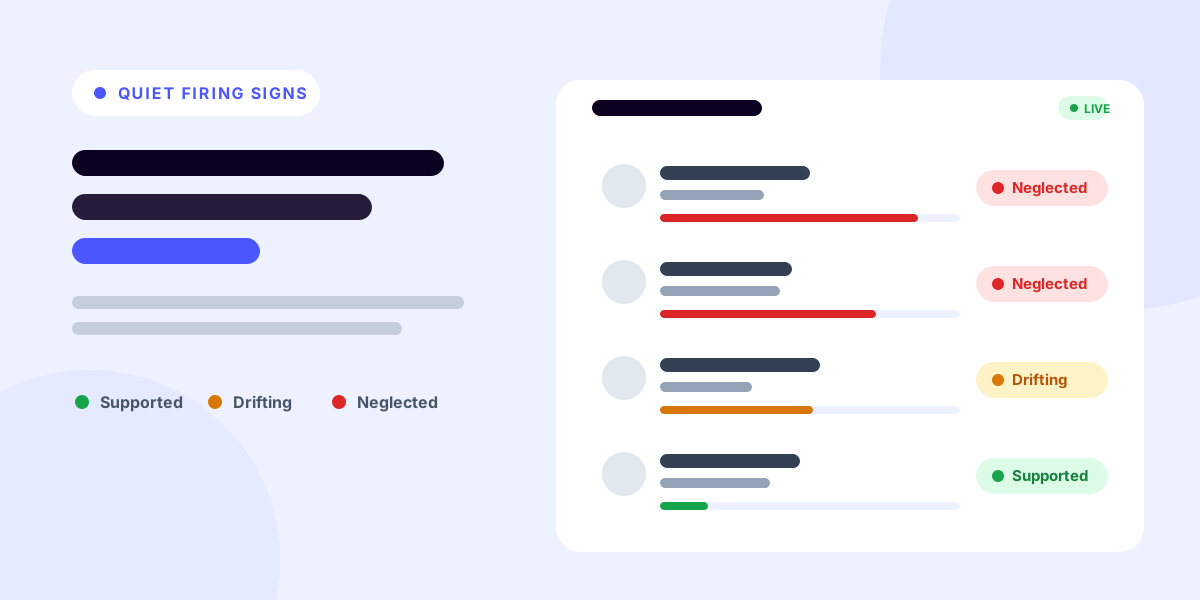
Pull back support quietly and the signal still lands - three people drifting toward neglected.
What is quiet firing?
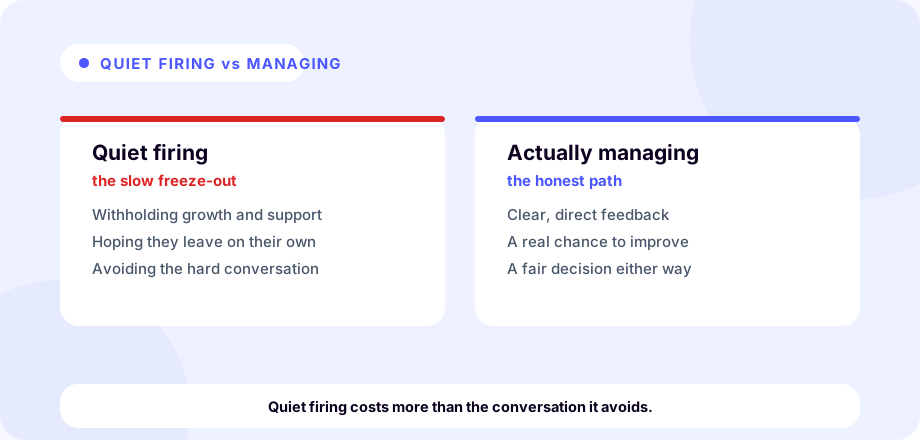
Quiet firing is managing someone out by neglect. Instead of having an honest conversation about performance, fit, or a role that has outgrown the person in it, a manager gradually removes the support and opportunity that person needs to succeed - and waits for them to take the hint and resign.
It rarely looks like cruelty. More often it looks like absence. The manager stops investing. The stretch projects go to someone else. The one-on-ones get shorter, then sporadic, then forgotten. Feedback becomes vague or disappears entirely. The raise conversation never quite happens. None of it is dramatic enough to confront, which is exactly the point: quiet firing offloads a hard, accountable decision onto the employee, who is left to conclude - alone - that there's no future here.
Sometimes it's deliberate, a way to avoid the discomfort or paperwork of a real performance process. More often it's semi-conscious: a manager who has privately given up on someone and lets that verdict leak out through a hundred small withdrawals. Either way, the effect is the same. The person is being pushed, not led.
It helps to name what quiet firing is not. It isn't a single tough quarter, an honest "no" on one promotion, or a manager who is temporarily stretched thin. Quiet firing is the sustained, one-directional pattern of withdrawing investment from a specific person without ever telling them why.
The signs of quiet firing
Because quiet firing works through omission, it's easier to feel than to prove. Below are the signals from two vantage points - the employee living it, and the colleague or HR leader watching it happen.
Signs you may be on the receiving end
If you're the employee, quiet firing often shows up as a steady narrowing of your world at work:
- You're consistently passed over - for raises, promotions, and the visible, career-making projects - without a clear reason ever given.
- Feedback dries up. You get vague reassurance or silence instead of specifics, so you can't tell what to fix or whether anything is wrong.
- Your one-on-ones shrink or vanish. They get shorter, get rescheduled, or quietly stop, and your manager seems relieved when they do.
- You're left out of the room. Meetings, decisions, and information that affect your work start happening without you.
- Your responsibilities erode. Interesting work is reassigned, your scope quietly shrinks, and you're handed busywork instead.
- Growth stalls. Development conversations, mentoring, and learning budget evaporate - the signal that no one is investing in your future here.
- The relationship cools. Your manager becomes distant or transactional, and warmth is replaced by polite avoidance.
Any one of these can be innocent. The pattern - several of them, pointed at you, sustained over months, with no straight answer when you ask - is the tell.
Signs an observer or HR leader can spot
From the outside, quiet firing is visible in the gap between someone's track record and their current treatment:
- A previously trusted, capable employee is slowly sidelined with no documented performance issue to explain it.
- A specific person is routinely excluded from projects, promotions, or recognition that their peers receive.
- A manager avoids rather than addresses - no feedback on record, no improvement plan, just distance.
- Engagement drops sharply for one person on an otherwise stable team, often followed by the early signs of disengagement.
- The story doesn't add up: the manager hints the person is "not working out" but has never said so to the person, and never started a fair process.
For leaders, this last gap is the reddest flag. A real performance problem comes with documentation, conversations, and a chance to improve. Quiet firing comes with none of that - only a quietly shrinking role and a manager hoping the problem resigns itself. Many of these patterns overlap with the broader signs an employee is about to quit; the difference with quiet firing is that the manager is the one setting them in motion.
Why quiet firing backfires
Managers reach for quiet firing because it feels easier than a hard conversation. It isn't. It's slower, more expensive, and more damaging - and it usually fails on its own terms.
It destroys trust - and not just with one person
People are not oblivious. The employee being managed out usually knows exactly what's happening; they just can't prove it. And teams are porous: colleagues watch a respected peer get frozen out and quietly update their own assumptions about how this company treats people when it's done with them. One quiet firing teaches your whole team that loyalty is a one-way street. That lesson is hard to unlearn.
It spreads disengagement
When good people see neglect used as a management tool, they disengage to protect themselves. Discretionary effort drops, ambition gets cautious, and the most marketable employees - the ones with options - start looking first. What began as a manager's problem with one person becomes a culture problem across a team. This is the soil that quiet quitting grows in, and quiet firing is one of its most reliable causes.
It raises flight risk across the board
Quiet firing doesn't just push out its intended target. It raises flight risk for the bystanders, who now have evidence that this is not a place that invests in people. The strongest performers leave first, because they can. If you want to understand and reduce that exposure systematically, our guide to employee flight risk covers how it builds and how to get ahead of it, and much of what drives it is exactly the kind of neglect quiet firing institutionalizes. It's also a core reason good employees leave: a slow signal, building over months, that their growth no longer matters here.
It carries legal and ethical risk
Quiet firing is usually a management failure rather than a clearly illegal act - but it can become a legal one. If the pattern of neglect lines up with a protected characteristic, or reads as retaliation or constructive dismissal, it can hand an employee the basis for a claim. And unlike a documented, fair process, quiet firing leaves you with the worst possible paper trail: no record of real performance issues, just a capable person who was visibly and inexplicably sidelined. Even where it's technically lawful, it's an ethical failure of management - and it tends to cost more in turnover, rehiring, and reputation than the honest conversation it was meant to avoid.
It often doesn't even work
Here's the quiet irony: people don't always take the hint. Some stay, demoralized, doing the minimum, becoming exactly the disengaged employee the manager imagined - a self-fulfilling prophecy. The manager ends up with the outcome they feared and none of the clarity they needed, having spent months making it worse.
Quiet firing vs quiet quitting
These two terms are often confused, but they're best understood as two sides of the same disengagement - viewed from opposite ends of the relationship.
- Quiet quitting is employee-driven. An employee withdraws discretionary effort and dials their work back to the boundaries of the job description. They still meet expectations but stop reaching beyond them.
- Quiet firing is manager-driven. A manager withdraws investment, opportunity, and support to nudge an employee toward leaving, without an honest conversation.
The key connection: quiet firing frequently causes the quiet quitting that follows. When a manager stops investing in someone, that person reasonably stops over-investing in return. What a manager then labels "low commitment" is often a rational response to being quietly written off. Reading quiet quitting as the employee's character flaw - when the manager's neglect set it in motion - is one of the most common and damaging misdiagnoses in management.
| Quiet quitting | Quiet firing | |
|---|---|---|
| Who drives it | The employee | The manager |
| The core move | Withdrawing discretionary effort | Withdrawing support and opportunity |
| Usual root cause | Burnout, feeling undervalued, stalled growth | Avoiding a hard conversation; a private verdict on someone |
| What it signals | "I've disengaged from the work" | "I want you to leave, but won't say so" |
| The fair fix | A supportive re-engagement conversation | A direct, honest performance conversation |
Seen together, they're not two separate problems. They're a feedback loop - and the manager is usually the one with the power to break it.
What good managers do instead
Sometimes a role genuinely isn't working, and an exit is the right outcome. The alternative to quiet firing is honesty: handling both underperformance and exits directly, fairly, and out loud.
1. Have the conversation you're avoiding
If someone isn't meeting the bar, tell them - specifically and early. Name the gap, bring concrete examples, and make it a two-way conversation, not a verdict delivered from a height. The goal is a person who leaves the room knowing exactly where they stand and what "good" looks like, not one left to decode your silence. This is uncomfortable, which is precisely why quiet firing exists as an escape hatch. Resist it.
2. Separate "can't" from "won't"
Before you write anyone off, get curious about the cause. Is it a skills gap you can close with coaching? A workload or life situation that's temporary? A mismatch between the person and the role that a different seat could fix? Disengagement is often a symptom, and many of the root causes are things a manager has direct power to change. A stay conversation is a good way to surface what's really going on before you conclude that nothing can be done.
3. Build a real, supported plan
If there's a genuine performance gap, address it the honest way: a clear, documented set of expectations, the support to meet them, regular feedback, and a realistic timeline. A fair process protects everyone - the employee gets a true chance to improve, the team sees that standards are applied with integrity, and the company stands on solid ground if the role does end up not working out.
4. If it has to end, end it with respect
When performance truly can't improve, or the fit isn't there, manage the exit openly. A direct, humane, well-handled departure is vastly better - for the person, the team, and your reputation - than months of neglect that everyone can see and no one will name. People remember how you let them go, and so does everyone still watching.
5. Re-engage the people you actually want to keep
For the strong performers who've started to drift, neglect is the worst possible response. Re-engagement is the work: fix the workload and recognition gaps, reconnect the job to growth, and then follow through visibly on what you hear. Sometimes the most powerful re-engagement is a genuine new opportunity - a fair, intentional quiet hiring move that redeploys someone toward a challenge they actually want rather than letting their role quietly shrink. Our guides to employee engagement strategies that reduce turnover and retention strategies that actually work lay out the structural habits that keep this from becoming necessary in the first place. And if neglect has already crept in as a norm, it's worth checking honestly for the wider signs of a toxic work environment - quiet firing is rarely a problem of one manager alone.
Getting ahead of the drift
Quiet firing thrives on lag. By the time a manager notices that a once-strong contributor has gone quiet and started looking, the trust is usually already spent. The leaders who avoid this listen sooner, and act before neglect hardens into resignation.
That early signal is exactly what TeamPredict is built to surface. It watches the early, public signs of flight risk and distills them into a resignation-risk level for each tracked employee, so a drifting relationship surfaces while there is still time to repair it. Used well, it's a prompt to have the supportive, honest conversation earlier, while it can still change the outcome: the opposite of quiet firing.
Quiet firing is the management shortcut that costs the most. It trades one uncomfortable conversation for eroded trust, spreading disengagement, higher flight risk, and a worse outcome than the honest path it was meant to avoid. The fix is clearer management: tell people the truth, invest in the ones you want to keep, and handle the ones who must leave with respect. If you'd like an early, respectful read on who might be quietly drifting toward the exit, so you can lead the right conversation in time, start a free TeamPredict trial. It's $5 per tracked employee per month, 30 days free: no charge until the trial ends, cancel anytime. The honest conversation still has to come from you; TeamPredict just makes sure you have it in time.
Frequently asked questions
- What is quiet firing?
- Quiet firing is when a manager gradually pushes an employee toward quitting by withdrawing the things that make a job worth keeping - growth, feedback, recognition, good projects, and raises - instead of having an honest performance conversation. It is managing someone out by neglect rather than addressing the issue directly. The person isn't fired, but they're quietly nudged toward the door until leaving feels like their only option.
- What are the signs of quiet firing?
- Common signs include being passed over for raises, promotions, and high-visibility projects; vague or absent feedback; shrinking one-on-ones; exclusion from meetings and decisions that affect your work; and a manager who has clearly disengaged from your development. From an observer's view, you'll often see a once-trusted colleague slowly sidelined without any documented performance issue to explain it.
- What is the difference between quiet firing and quiet quitting?
- They are two sides of the same disengagement. Quiet quitting is an employee withdrawing discretionary effort and dialing back to the boundaries of their role. Quiet firing is a manager withdrawing support, opportunity, and investment to nudge someone out. One is driven by the employee, the other by the manager - and quiet firing frequently causes the quiet quitting that follows.
- Is quiet firing illegal?
- Quiet firing is usually an ethical and management failure rather than a clearly illegal act, but it can create real legal exposure. If the neglect maps onto a protected characteristic, or looks like retaliation or constructive dismissal, it can become the basis of a claim. Even where it is technically legal, it erodes trust, damages your reputation, and tends to cost more than an honest conversation would have.
- What should a manager do instead of quiet firing?
- Have the direct, fair conversation you're avoiding. Name the specific gap, share concrete examples, listen for root causes, and agree on a clear plan with support and a realistic timeline. If performance genuinely can't improve, manage the exit openly and respectfully. Either path beats neglect - it preserves trust, protects the rest of the team, and treats the person like an adult.
About TeamPredict
TeamPredict Team
We build TeamPredict - retention early-warning software that flags resignation risk from public LinkedIn signals. We write about the patterns that precede a resignation and how people-first teams act on them early. Learn more about TeamPredict
Find out who's showing exit signals.
Score one person's flight risk in a couple of minutes with the free assessment - then let TeamPredict watch the rest daily.
Run the free flight-risk assessmentFree, no signup required.