Succession Planning: A Practical Guide for Lean Teams
Most small companies discover the cost of a missing backup plan the hard way: a key person resigns, and suddenly nobody else knows how the billing runs, who the top client really trusts, or why the system is built the way it is. Succession planning is how you avoid that scramble - the ongoing practice of identifying business-critical roles and quietly preparing people who could step into them. This guide lays out a practical, right-sized succession planning process for lean teams, with no enterprise jargon and no 200-page binder.
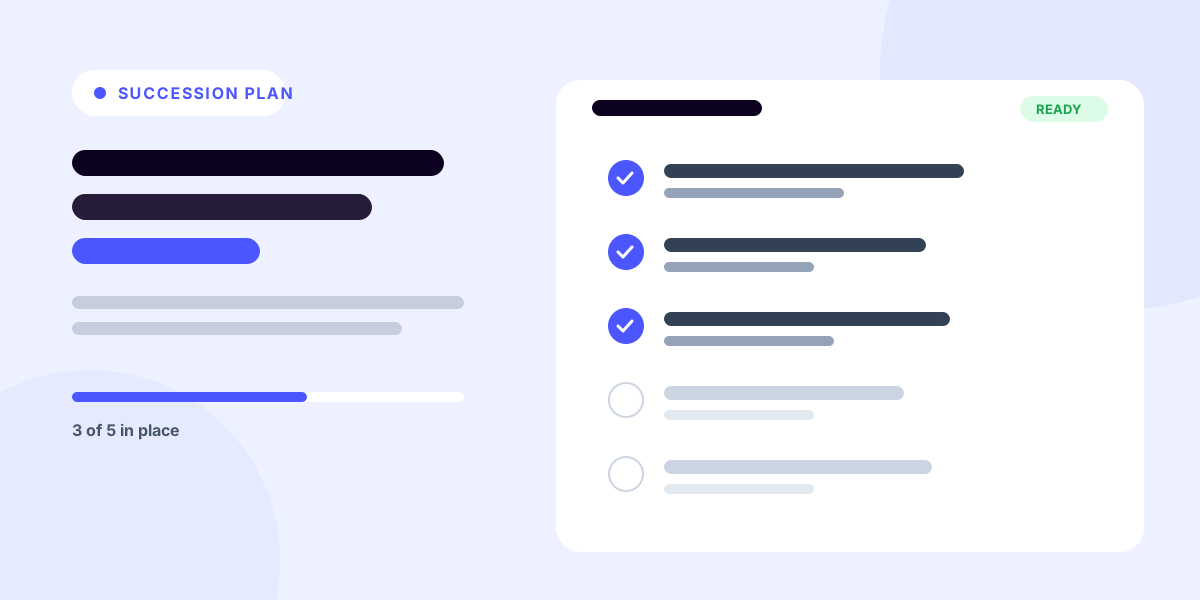
Three critical roles have a ready successor; two are still building bench strength.
What is succession planning (and why lean teams need it)
Succession planning is the deliberate process of making sure that when someone leaves a critical role - by resigning, getting promoted, or simply being unavailable - someone else can step in without the business stalling. It is part risk management and part people development, and it works best as a continuous habit rather than a once-a-year event.
There is a common myth that succession planning is only for the boardroom - a CEO grooming an heir. In reality, the roles that hurt most when they empty out in a small company are rarely the most senior ones. They are the people who quietly hold things together: the operations lead who knows every vendor, the one engineer who understands the legacy system, the account manager every big client asks for by name.
For a lean team, the stakes are actually higher than for a large enterprise. A 5,000-person company that loses one specialist has bench depth and redundancy. A 40-person company that loses its only person who understands payroll, the data pipeline, or the largest customer relationship can lose weeks of momentum overnight. This is key-person risk, and succession planning is how you defuse it before it detonates.
It also pairs naturally with retention. The same attention that helps you keep great people - understanding who they are, what they do, and what would make them leave - is exactly what tells you which roles need a backup plan. If you want the retention side of that equation, our guide on 15 employee retention strategies that actually work is a good companion to this one.
A simple succession planning framework
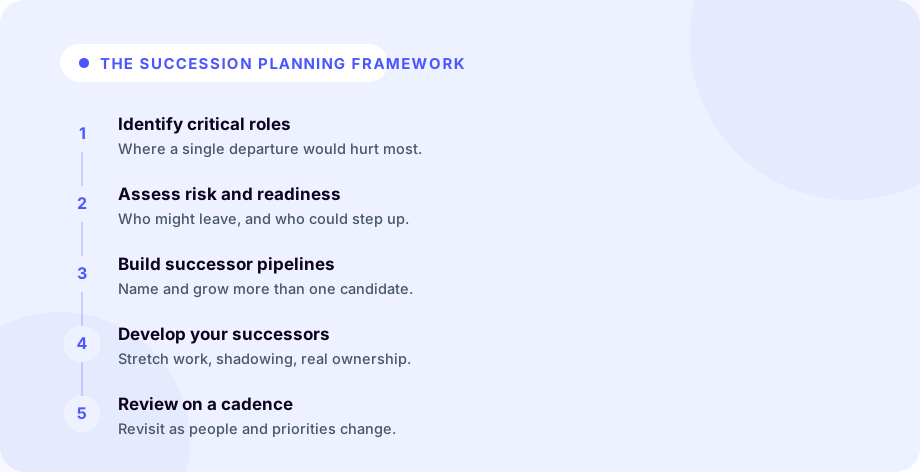
You do not need specialized software or an HR team of ten to do this well. A five-step framework covers everything that matters:
- Identify critical roles - where would a departure hurt most?
- Assess risk and readiness - how likely is each role to open up, and who could fill it?
- Build successor pipelines - name realistic candidates for each critical role.
- Develop your successors - close the gap between "could do it someday" and "ready now."
- Review the plan - keep it current as people, roles, and risks change.
The rest of this guide walks through each step. The goal is a living, one-page plan you actually use - not a polished document that gets filed and forgotten.
Step 1: Identify your critical and single-point-of-failure roles
Start by finding the roles that genuinely matter, not by listing everyone. Two questions cut through the noise:
- What breaks if this person is out for a month? If the honest answer is "a lot," it is a critical role.
- Could anyone else do this tomorrow? If the answer is "no one," you have a single point of failure.
Critical roles usually share a few traits. Look for:
- Specialized or undocumented knowledge - a system, process, or codebase only one person truly understands.
- Key relationships - the person a major client, partner, or supplier trusts and contacts directly.
- Revenue or compliance impact - roles where a gap directly threatens income, legal standing, or delivery.
- Hard-to-hire skills - positions that take months to fill from the outside market.
Note that critical roles are not always senior. The title on the org chart matters far less than the concentration of risk in one person. A mid-level operations coordinator can be a more dangerous single point of failure than a VP with three capable lieutenants.
Write down your critical roles in one short list. For most lean teams this is somewhere between three and ten roles - not the whole company. Resist the urge to map everything; succession planning that tries to cover every seat tends to cover none of them well.
Step 2: Assess flight risk and successor readiness
Once you know which roles matter, assess two things for each: how likely the seat is to open up soon, and how ready anyone is to fill it. Together these tell you where to focus first.
Gauge the flight risk on each critical role
A role only needs an urgent backup plan if the person in it might actually leave. This is where succession planning and flight-risk awareness intersect directly - and where most teams get caught off guard, because resignations almost always feel sudden to the manager even when the signs were building for months.
Pay attention to the patterns that tend to precede a departure: stalled growth conversations, quieter one-on-ones, visible frustration over pay or workload, or increased external professional activity. Our breakdown of the 12 signs an employee is about to quit covers these in depth, and employee flight risk: how to identify and reduce it lays out a simple way to score likelihood for any individual.
The reason this matters so much for succession planning is lead time. If you know a critical-role holder is at elevated risk of leaving, you can start grooming a successor now - months before a resignation - instead of starting from zero the day they hand in their notice. A successor who has had three months of deliberate preparation is a completely different situation from one named in a panic. (Tools like TeamPredict exist precisely to surface that early, proactive signal from public LinkedIn activity, so the lead time isn't left to luck.)
Assess successor readiness with a simple 9-box idea
For each critical role, you also need to know whether anyone could realistically step up - and how soon. A lightweight version of the classic 9-box grid makes this easy without the corporate overhead.
Picture a simple grid with two axes:
- Performance (low / medium / high) - how well someone delivers in their current role today.
- Potential (low / medium / high) - how much room they have to grow into bigger responsibility.
Where someone lands tells you what to do with them:
- High performance, high potential - your strongest succession candidates. Invest in stretching them.
- High performance, lower potential - invaluable in their current role; reward and retain, but they may not be your next leader.
- Lower performance, high potential - often new or mismatched; coach and watch.
You do not need a literal nine-square chart. The point is to separate "great at today's job" from "ready to grow into tomorrow's," because they are not the same thing - and confusing them is how organizations promote a brilliant individual contributor into a role they are not set up to succeed in.
Then layer on a plain readiness timeline for each potential successor against a specific role:
- Ready now - could step in with minimal support.
- Ready in 1–2 years - clear candidate, needs targeted development.
- Ready later / not a fit - keep developing, but don't count on them for this seat.
A critical role with a high flight-risk holder and no "ready now" or "ready soon" successor is your top priority. That combination is exactly where a sudden departure does the most damage.
Step 3: Build your successor pipelines
Now connect roles to people. For each critical role, name one or two realistic potential successors and where they sit on the readiness timeline. This is your talent pipeline, and for a lean team it can live in a single spreadsheet:
| Critical role | Flight risk of current holder | Successor(s) | Readiness | Key gaps |
|---|---|---|---|---|
| Ops lead | Elevated | Jordan | 1–2 years | Vendor management, hiring |
| Lead engineer | Stable | (none yet) | - | No backup - top priority |
A few principles keep pipelines honest:
- It's fine to have gaps. A role with no internal successor is the most valuable thing this exercise surfaces - now you know to develop someone, document the knowledge, or plan to hire ahead.
- Don't over-promise to candidates. Identifying someone as a potential successor is not a guarantee of promotion. Be thoughtful about what you communicate so you motivate rather than create entitlement or disappointment.
- Consider more than one path. Sometimes the best successor is an internal lateral move, sometimes a planned external hire, sometimes splitting one overloaded role into two.
The mere act of building this table is valuable on its own. It turns vague unease ("we'd be in trouble if Sam left") into specific, fixable actions.
Step 4: Develop your successors
A pipeline only reduces risk if the people in it are actually getting more ready over time. Development is where most succession plans quietly die - they get written, then nobody closes the gaps. For each successor, pick a small number of concrete moves:
- Document the role's knowledge. Have the current holder write down the undocumented stuff - processes, logins, relationships, the "why." This alone reduces single-point-of-failure risk even before a successor is ready.
- Delegate real responsibility. Give the successor a genuine slice of the critical role now - owning a client, running a process, leading a project - not just shadowing.
- Close specific skill gaps. Use the "key gaps" column from your pipeline table to drive targeted coaching, mentoring, or training.
- Create exposure. Bring the successor into the meetings, relationships, and decisions they would inherit, so the handoff isn't their first contact.
Development also doubles as retention. High-potential people want growth, stretch, and a visible path forward - so investing in your successors is one of the best ways to keep them from becoming flight risks themselves. If you're not sure what your strongest people want next, a stay interview is a direct way to ask, and our piece on why good employees leave explains what tends to push them out when that growth stalls.
Step 5: Review the plan on a regular cadence
Succession planning is never "done." People grow, leave, change roles; new critical roles appear; flight risk rises and falls. A plan written once and never revisited is worse than useless, because it gives false confidence.
Build a light review rhythm instead:
- Quarterly: a 30-minute pass over your critical-role list. Has anyone's flight risk changed? Has a successor become "ready now"? Did a new single point of failure appear?
- At every major change: when someone resigns, gets promoted, or a new key role is created, update the relevant rows.
- Annually: a deeper look at whether your development efforts are actually moving people up the readiness timeline.
Tie the review to data you already track. If you watch your employee turnover rate and overall flight-risk signals, succession reviews become a natural extension of conversations you're already having - not a separate chore. The teams that do this well treat it the way they treat a fire drill: a small, routine practice that makes a real emergency far less dramatic.
Common succession planning mistakes to avoid
A few patterns trip up lean teams more than others:
- Trying to plan for everyone. Cover your handful of critical roles well rather than the whole org poorly.
- Confusing performance with potential. Your best individual contributor isn't automatically your best successor for a leadership role.
- Treating it as a one-time project. Without a review cadence, the plan goes stale within a quarter.
- Ignoring flight-risk signals. The whole value of succession planning is lead time. If you're blind to who might leave, you lose the head start it's meant to give you.
- Keeping it secret to a fault. You needn't broadcast the full plan, but development conversations and growth paths should be real and visible to the people you're investing in.
Putting it all together
Succession planning for a lean team comes down to a simple, repeatable loop: know which roles would hurt most to lose, watch how likely each is to open up, keep a short pipeline of people who could step in, develop them deliberately, and revisit the whole thing every quarter. None of it requires enterprise tooling - just a one-page plan and the discipline to keep it alive.
The single biggest force multiplier is lead time: the earlier you know a critical-role holder might be heading for the door, the more of this you can do calmly and well instead of in a panic. That's exactly the gap TeamPredict is built to close - surfacing early, proactive resignation-risk signals from public LinkedIn activity so you can groom a successor and plan ahead before a resignation lands. If you'd like that head start for your own critical roles, start a free 30-day TeamPredict trial - no charge until the trial ends, cancel anytime - and give your team the time to plan instead of scramble.
Succession planning and strong employee retention reinforce each other - invest in both.
Filling roles from within is closely related to quiet hiring.
Frequently asked questions
- What is succession planning?
- Succession planning is the ongoing process of identifying business-critical roles and developing internal people who could step into them if the current holder leaves, is promoted, or is unavailable. For lean teams it is less about formal org charts and more about reducing key-person risk so that no single departure stalls the business.
- What are the steps in succession planning?
- A simple five-step succession planning process works for most small and mid-sized companies: identify critical and single-point-of-failure roles, assess each role's flight risk and the readiness of potential successors, build successor pipelines, develop those people deliberately, and review the plan on a regular cadence. Start with one or two roles rather than trying to map the whole company at once.
- Does a small company really need succession planning?
- Yes - arguably more than a large one. In a 10- to 200-person company, one person often holds critical knowledge, a key client relationship, or a system only they understand. A single resignation can stall the business. Lightweight succession planning gives you a backup plan before you need it, without enterprise bureaucracy.
- How is succession planning different from replacement planning?
- Replacement planning is reactive - naming who would fill a seat tomorrow if it opened. Succession planning is proactive and developmental - building a pipeline of people over months so they are ready when the time comes. Replacement planning is a list; succession planning is a capability you grow.
- How does knowing flight risk help with succession planning?
- Succession planning becomes far more effective when you know which critical-role holders are most likely to leave soon. Early flight-risk signals give you lead time to accelerate a successor's development, document knowledge, and plan a clean transition - instead of scrambling after a resignation lands on your desk.
About TeamPredict
TeamPredict Team
We build TeamPredict - retention early-warning software that flags resignation risk from public LinkedIn signals. We write about the patterns that precede a resignation and how people-first teams act on them early. Learn more about TeamPredict
Find out who's showing exit signals.
Score one person's flight risk in a couple of minutes with the free assessment - then let TeamPredict watch the rest daily.
Run the free flight-risk assessmentFree, no signup required.