The Real Cost of Employee Turnover (and How to Reduce It)
Every HR leader knows turnover is expensive, but few can say what it actually costs their business - and that gap makes it hard to win budget for retention. The cost of employee turnover is far more than a recruiter's fee and a job ad; it's a stack of visible and hidden costs that compound every time someone walks out the door, especially when it's someone you wanted to keep. This guide breaks down where those costs hide, gives you a simple framework and worked example to estimate your own number, and lays out the most effective ways to bring it down.
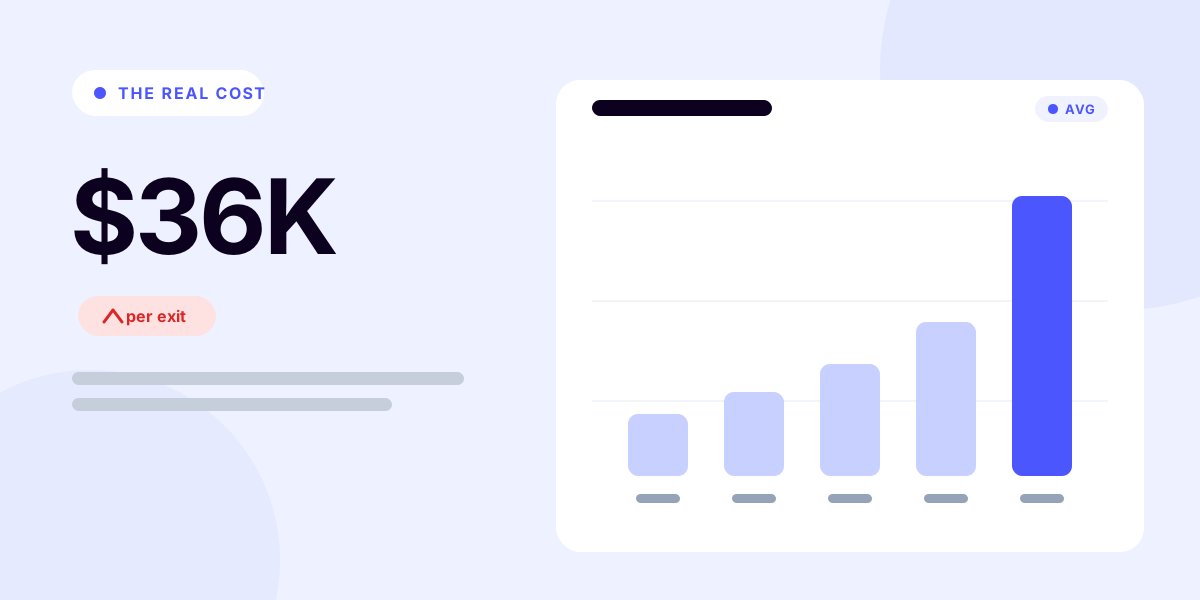
Recruiting and onboarding are visible; it's the slow ramp to full productivity that quietly dominates.
Why turnover costs more than it looks
When a valued employee resigns, the obvious expense is finding their replacement. But the replacement fee is the tip of the iceberg. The full cost of employee turnover plays out over months - starting before the person has even given notice and continuing long after their successor's first day.
It helps to split the total into two buckets: the visible costs you can put on an invoice, and the hidden costs that never show up in a single line item but usually dwarf the visible ones. Most organizations dramatically underestimate the second bucket, which is exactly why retention so often loses the budget argument to more measurable line items.
One framing worth keeping in mind throughout: the costs are concentrated in regrettable turnover - the departure of people you genuinely wanted to keep. Losing someone whose exit is neutral or healthy carries little of the cost below. If you haven't separated the two yet, our guide on how to calculate employee turnover rate covers tagging departures as regrettable or not, which is what makes a cost estimate meaningful.
The visible costs of turnover
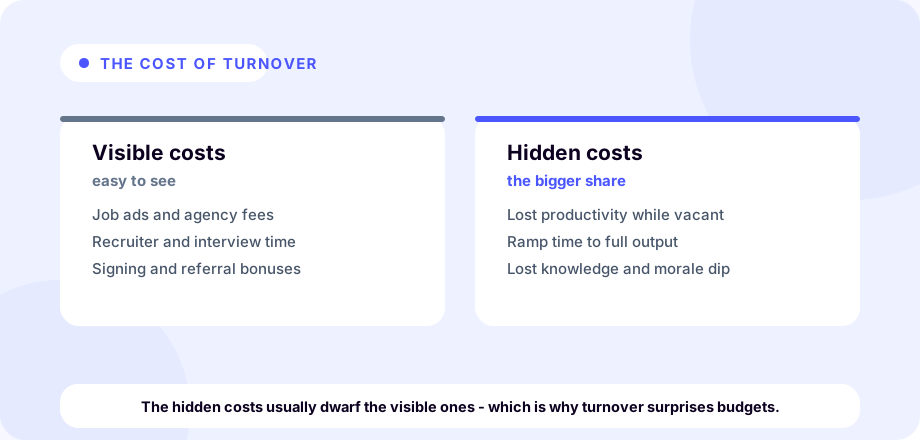
These are the costs most finance partners already recognize, because they map cleanly to spend:
- Recruiting and sourcing. Job ads, recruiter time, agency or search fees for harder roles, and the hours your team spends screening and interviewing candidates.
- Hiring and administration. Background checks, assessments, offer logistics, relocation or sign-on bonuses, and the HR and IT setup that comes with a new hire.
- Onboarding. Equipment, software seats, training programs, and the structured first weeks needed to get someone functional.
- Overlap and backfill. Temporary contractors, overtime, or a short period of paying two people while one transitions out.
Add these up and you already have a real number. But if you stop here, you'll understate the true cost of turnover by a wide margin - because the most expensive parts never reach an invoice.
The hidden costs of turnover
This is where the real damage lives, and where most estimates fall short. None of these line up neatly with a receipt, but together they typically exceed everything in the visible bucket.
Lost productivity
A departing employee rarely leaves at full output. Productivity often dips during the notice period - and sometimes for weeks before, as disengagement sets in. Then the seat sits empty for however long it takes to hire. During that gap, the work either doesn't get done or gets absorbed by others at the expense of their own priorities.
Ramp time
Even a strong new hire isn't fully effective on day one. Depending on the role's complexity, it can take weeks for a frontline position and many months for a senior or specialized one before the person is performing at the level of who they replaced. Every week of that ramp is partial output you're paying full salary for - and the more senior the role, the longer and costlier the runway.
Knowledge loss
This is the hardest cost to see and the slowest to recover. When someone leaves, they take undocumented context with them: how a process really works, why a decision was made, which customer hates which thing, where the bodies are buried in the codebase. No job description captures it, and rebuilding it is slow and error-prone. For critical roles, this is a strong argument for getting ahead of departures through succession planning and deliberate knowledge transfer rather than scrambling after the fact.
Morale and team overload
When one person leaves, their work doesn't disappear - it lands on whoever's left. That added load raises their stress and, often, their own flight risk, which is how a single departure quietly seeds the next one. There's a signal cost too: when a respected colleague walks and nothing visibly changes, everyone else recalibrates whether staying is worth it.
Customer and project impact
Some roles sit directly between your company and its revenue. When an account manager, key engineer, or specialist leaves, projects slip, relationships cool, and customers feel the gap - sometimes well before the resignation is even announced. That impact can outlast the vacancy by months.
Because so many of these costs accrue before and around the departure, they reward acting early. Spotting the signs an employee is about to quit and responding while there's still room to act is often the difference between a planned transition and an expensive scramble.
How to estimate your own cost of turnover
Generic percentages are easy to quote and easy to dismiss in a budget meeting. A number you built from your own roles is far harder to argue with. Here's a simple framework.
A simple formula
At its core, the calculation is just two pieces added together:
Cost per departure = direct replacement costs + indirect (hidden) costs
Then, to size the annual impact:
Annual cost of turnover = cost per departure x number of regrettable departures per year
You don't need perfect precision. A defensible estimate that captures the hidden costs beats a precise-looking figure that ignores them. If you'd rather not build the spreadsheet, the calculator below - the same free employee turnover cost calculator from our tools pages - runs this exact math from a few inputs, and shows the savings from cutting turnover by a point or two, which is usually the line that gets the budget approved.
Don't know it? Use our turnover rate calculator first.
Gallup estimates replacing an employee costs one-half to two times their annual salary, with frontline roles at the low end and leaders and specialized roles at the high end. 50% is a conservative middle for a mixed team.
Estimated departures per year
15
Estimated cost per departure
$35,000
Estimated annual cost of turnover
$525,000
Potential annual savings
$105,000
if turnover drops by 3 percentage points
A clearly-labeled worked example
The numbers below are purely illustrative - made up to show the method, not industry data or a benchmark. Plug in your own figures when you run this for real.
Imagine a mid-market company estimating the cost of losing someone in a $70,000 role.
Direct costs (visible):
- Recruiting, advertising, and interviewing time: $4,000
- Agency / sourcing support: $6,000
- Onboarding, equipment, and training: $3,000
- Direct subtotal: $13,000
Indirect costs (hidden):
- Lost productivity while the seat is empty (say the role is vacant for two months at roughly half its value): about $6,000
- Ramp time before the replacement is fully effective (say four months at, on average, 50% productivity): about $12,000
- Knowledge loss, team overload, and customer impact (a deliberately conservative placeholder for hard-to-quantify costs): $5,000
- Indirect subtotal: $23,000
Cost per departure: $13,000 + $23,000 = $36,000 - a little over half of the role's annual salary in this illustration.
Now scale it. If this company expects to lose 5 comparable people to regrettable turnover in a year:
Annual cost of turnover = $36,000 x 5 = $180,000.
The exact figures will be wrong for your business - that's fine. What this illustration shows is the shape of the cost: in this example the hidden bucket ($23,000) outweighs the visible one ($13,000), and the senior or specialized the role, the more lopsided that ratio tends to get. Run it for a single representative role first; that one number usually reframes the retention conversation on its own.
A step-by-step to estimate it
- Pick a representative role. Start with one role that matters - ideally one where regrettable turnover actually hurts. Don't try to model the whole company at once.
- Add up the direct costs. Recruiting, agency fees, hiring admin, onboarding, equipment, and any overlap or backfill spend.
- Estimate lost productivity. How long does the seat typically sit empty, and what's that role's output worth per month? Use a fraction of salary as a proxy if you need to.
- Estimate ramp time. How many months until a new hire performs at the level of who they replaced, and at roughly what average productivity during that ramp? Multiply the shortfall by monthly salary.
- Add a conservative figure for knowledge loss, team load, and customer impact. You can't measure these precisely; include a deliberately modest placeholder rather than pretending they're zero.
- Sum it into a cost per departure, then multiply by your expected regrettable departures per year to size the annual total.
- Pressure-test and reuse it. Sanity-check the result with a manager who's lived through one of these exits, then reuse the model for other roles.
Do this once and you'll have a number you can defend - and one that makes the business case for the retention investments below almost write itself.
How to reduce the cost of employee turnover
Once you can see the cost, the goal becomes obvious: avoid the regrettable departures that carry most of it, and give yourself enough lead time to act before a decision is final. The most effective levers are also, reassuringly, just good management.
- Managers and regular one-on-ones. People leave managers more than companies. Equip frontline managers to hold honest, recurring conversations that surface concerns before they harden into a decision.
- Visible growth paths. Stalled careers are a leading cause of regrettable exits. Make the next step real and visible rather than a vague annual promise.
- Fair, transparent pay. You don't have to top the market, but unexplained or below-band pay becomes a resignation reason the moment people compare notes. Run proactive comp reviews instead of waiting for a competing offer.
- Meaningful recognition. Specific, timely recognition tied to real impact is low-cost and chronically underused. People rarely leave roles where they feel genuinely seen.
- Sustainable workloads. Chronic overload quietly drives out your most reliable people, because they absorb the overflow. Sometimes the best retention move is simply taking something off someone's plate.
For a fuller playbook, see 15 employee retention strategies that actually work. When someone does leave, a structured exit interview template helps you capture the real drivers so the next departure is less likely - and keeping in touch with strong leavers can turn some of them into boomerang employees, a faster and cheaper rehire than starting a search from scratch. And if you're evaluating tooling to support this, our guide on how to choose employee retention software walks through what to look for.
The thread connecting every one of these levers is lead time. Almost all of them (a career conversation, a pay adjustment, a workload fix, a successor groomed quietly in the background) work far better when you start early. The most expensive turnover is the kind you only learn about when the resignation lands on your desk, because by then the decision is usually made and you've already absorbed weeks of disengaged output.
This is the gap TeamPredict is built to close. By surfacing early, proactive signals of resignation risk from publicly available LinkedIn profile activity and summarizing them into a simple resignation-risk level per tracked employee, it gives leaders the one thing a cost model alone can't: time to act before someone has decided to go. Used well, it gives a manager a head start: a chance to have the right conversation early and avoid the costs above rather than tally them after the fact. At $5 per tracked employee per month, the math against even one prevented regrettable departure is not close.
Turn the cost into a case for acting early
The most important takeaway is a habit, not a number. The cost of employee turnover is large, mostly hidden, and concentrated in the people you least want to lose. Once you've estimated it for even one role, the case for proactive retention stops being abstract: a modest, early intervention almost always costs a fraction of a full replacement cycle. The most reliable way to bring these costs down is a deliberate, ongoing employee retention program.
If you want that lead time for your own team, the chance to act on rising risk before it becomes a resignation, start a free 30-day TeamPredict trial. You won't be charged until the trial ends, and you can cancel anytime. It turns retention from a year-end expense report into a proactive, week-by-week practice.
Frequently asked questions
- How much does employee turnover cost?
- There's no single figure, but a useful rule of thumb is that replacing someone costs a meaningful fraction of their annual salary - and often more for senior, specialized, or hard-to-fill roles. The total includes visible costs like recruiting and onboarding plus hidden costs like lost productivity, ramp time, knowledge loss, and added load on the remaining team. The honest answer is to estimate it for your own roles rather than rely on a generic percentage.
- How do you calculate the cost of turnover?
- Add up the direct costs of replacing someone (recruiting, hiring, onboarding, and any sign-on or agency fees) plus the indirect costs (lost productivity while the seat is empty, ramp time before the replacement is fully effective, knowledge loss, and the load on teammates). Estimate a per-departure cost for a representative role, then multiply by the number of regrettable departures you expect in a year to size the total.
- What are the hidden costs of employee turnover?
- The hidden costs are usually larger than the visible ones: lost productivity before and after someone leaves, the months of ramp time before a replacement is fully effective, institutional knowledge that walks out the door, added workload and morale strain on the remaining team, and the impact on customers or projects that depended on the person who left.
- Is it cheaper to retain an employee or replace them?
- In almost all cases, retaining is cheaper - often dramatically so for senior or specialized roles. Most turnover costs accrue around the departure and the long ramp that follows, so a retention move made early (a growth conversation, a comp adjustment, a workload fix) tends to cost a fraction of a full replacement cycle.
- How can I reduce the cost of employee turnover?
- Focus on regrettable departures, since those carry the highest replacement cost, and act early. The highest-leverage levers are good managers and regular one-on-ones, visible growth paths, fair and transparent pay, meaningful recognition, and sustainable workloads - plus early detection of flight risk so you have lead time to act before someone has decided to leave.
About TeamPredict
TeamPredict Team
We build TeamPredict - retention early-warning software that flags resignation risk from public LinkedIn signals. We write about the patterns that precede a resignation and how people-first teams act on them early. Learn more about TeamPredict
Find out who's showing exit signals.
Score one person's flight risk in a couple of minutes with the free assessment - then let TeamPredict watch the rest daily.
Run the free flight-risk assessmentFree, no signup required.