What Is an Employee Value Proposition (EVP)? How to Build One
If you've ever struggled to explain why a great candidate should choose you over a better-funded competitor, or why your best people stay when they could leave tomorrow, you're really asking about your employee value proposition. An employee value proposition (EVP) is the complete set of rewards and experiences a person receives in exchange for working at your company: pay, benefits, growth, culture, meaning, and flexibility. Put simply, it's the honest answer to "why work here, and why stay?" This guide breaks down the six components of an EVP and gives you a step-by-step process to define one that holds up in the real world and actually keeps people.
A quick caution before we start: the most common EVP mistake is treating it as a marketing exercise. A polished careers-page tagline that the daily job doesn't back up is a liability, not an EVP. The strongest employee value propositions are described, not invented. They reflect what's already true and worth being proud of, then commit to making it more true over time.
Start with the pillars you can honestly stand behind, then close the gaps one at a time.
What an employee value proposition actually is
Your EVP is the total deal of working at your company: everything someone gives (their time, skill, and effort) weighed against everything they get back. Some of that is tangible and easy to name, like salary and health coverage. Much of it is intangible and harder to measure but often more decisive: whether their manager is any good, whether the work means something, whether they can grow.
It helps to distinguish the EVP from its close cousin, the employer brand. The employer brand is how your company is perceived as a place to work: the reputation. The EVP is the substance behind that reputation: the real experience. The brand is the marketing; the EVP is the product. When the brand promises more than the EVP delivers, new hires feel oversold and leave fast, which damages the brand far more than candid messaging ever would. The goal is an EVP true enough that honest messaging works.
This matters for retention specifically because so many regretted departures trace back to a quiet gap between what someone was promised and what they got. Understanding why good employees leave - and how to keep them almost always comes back to a broken piece of the value proposition: growth that stalled, a culture that soured, pay that drifted below market. A clear EVP gives you a framework to catch those gaps before they cost you a person.
The six components of an EVP
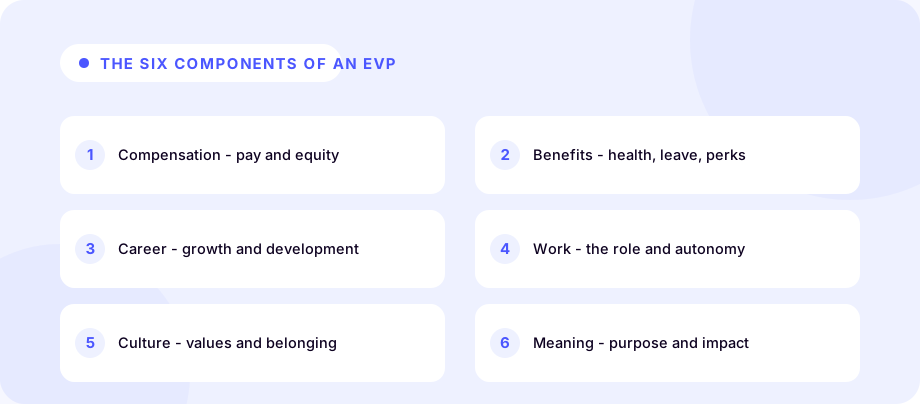
Most employee value propositions are built from six components. You don't need to win on every one (almost no company does). What matters is being honest about each and genuinely strong on the few your people value most.
1. Compensation
This is the most visible component: base salary, bonuses, equity, and how pay is structured and communicated. Compensation rarely buys loyalty on its own, but below-market or opaque pay is one of the fastest ways to lose people. You don't have to be the highest payer in your market. You do have to be fair, competitive enough, and transparent about how pay works: bands, criteria, and the path to a raise. Ambiguity about money breeds the kind of suspicion that quietly pulls people toward the exit.
2. Benefits
Everything beyond direct pay: health, dental, and vision coverage; retirement contributions; paid time off and parental leave; and the supporting perks that make life easier. Benefits are partly table stakes (fall short of the norm in your market and you'll feel it in hiring) and partly a chance to signal what you value. Generous leave says something different than a foosball table. The test for any benefit is simple: does it meaningfully improve people's lives, or is it decoration?
3. Career growth
The opportunity to develop, advance, and build skills that matter: mentorship, real projects, clear promotion paths, and learning budgets. For ambitious people, career growth is often the single most important component, and a stalled career is one of the most common reasons strong performers leave. People rarely quit because they've learned everything; they quit because they've stopped learning anything. An EVP that credibly promises growth, and delivers it, is a powerful retention anchor.
4. Work environment and culture
The daily experience of the job: management quality, the team you work with, psychological safety, how decisions get made, and whether the place is healthy to be in. This is the component people feel most and articulate least. The manager relationship sits at the center of it: it shapes someone's experience more than almost anything else on this list. Culture is whether people feel respected, trusted, and able to do good work; the ping-pong tables and values posters are set dressing. It's also the component most vulnerable to slow erosion, which is why it's worth watching for signs of a toxic work environment before they take root.
5. Meaning and purpose
Whether the work feels significant: connected to a mission, a customer, or an outcome people care about. Not every company is curing disease, and that's fine; meaning can come from craft, from impact on customers, or from being part of a team that does excellent work. People want their effort to matter. When work feels pointless, even good pay and a nice culture struggle to hold someone for long.
6. Flexibility
Autonomy over where, when, and how people work - remote and hybrid options, flexible hours, and the trust to manage one's own time and approach. Flexibility has shifted from a perk to a baseline expectation for much of the workforce, and for many people it's now a deciding factor weighed directly against salary. Flexibility is as much about trust as logistics: being treated like an adult who can manage their own work is itself part of the value.
How to build an employee value proposition: a step-by-step process
A good EVP isn't written in a conference room and announced. It's discovered, articulated, and then lived. Here's a practical sequence.
Step 1: Listen before you write
Start with the people who already chose to stay. Your current employees, especially your strongest performers, are the best source of truth about what your value proposition actually is. Run stay interviews and ask directly: what keeps you here, what would tempt you away, and what almost made you leave. Pair that with patterns from departures and exit conversations. You're listening for the gap between what you think you offer and what people actually value.
Step 2: Audit each of the six components honestly
Go through compensation, benefits, career growth, work environment and culture, meaning and purpose, and flexibility, and rate yourself candidly on each. Where are you genuinely strong? Where are you average? Where are you weak or actively at risk? Resist the urge to grade on a curve. An honest audit is more useful than a flattering one, because you're going to make promises based on it, and reality will be checked against those promises every single day.
Step 3: Identify your real strengths
You can't lead with all six, and trying to makes your EVP generic. Find the two or three components you're truly strong on: the things that are distinctly, defensibly true about working at your company. Maybe it's exceptional growth and unusual autonomy. Maybe it's a genuinely healthy culture and meaningful work. These become the spine of your value proposition. The honest weaknesses you found aren't hidden; they're things to improve and, where they matter, to be straightforward about.
Step 4: Articulate it clearly and specifically
Now write it down, for real this time. Capture, in plain language, the distinct deal of working at your company: what people get, who it's right for, and what you ask in return. Specific beats aspirational. "We invest in your growth" is a slogan anyone can claim. "Engineers here ship to production in week one and own a feature area within a quarter" is a promise a candidate can actually evaluate, and one you can be held to. Vague EVPs attract everyone and fit no one.
Step 5: Close the gap between promise and reality
This is the step that separates real EVPs from marketing. Wherever your stated value proposition outruns the daily experience, you have a gap, and gaps are where new hires sour and good people leave. Pick the most important gaps and fix them: tighten up manager quality, make the growth path real, bring pay closer to market. An EVP you can't deliver on is worse than no EVP at all, because it manufactures disappointment at scale.
Step 6: Make it visible and keep it alive
A finished EVP should show up everywhere the employee experience is shaped: job postings, interviews, onboarding, and especially in how managers lead day to day. It should also evolve. Companies change: a scrappy startup's EVP looks nothing like the same company's three years and two hundred people later. Revisit it regularly, and treat any drift between promise and reality as a signal to act. Done well, your EVP becomes a shared language for what you're building and a yardstick for employee retention strategies that actually work.
Why a clear EVP is a retention tool, not just a hiring one
It's tempting to think of the employee value proposition as a recruiting asset: something you dust off when you're trying to fill roles. It does help you hire, and hiring people who genuinely want what you offer is itself a retention strategy: fit at the door means fewer regretted exits later.
But the deeper value is internal. A well-defined EVP gives you and your managers a shared, concrete understanding of what you're promising people, which means you can actually tell when reality starts to drift from the promise. A growth path that quietly stalled. A culture that's eroding under a stretched manager. Compensation that's slipped below market while you weren't looking. Each of these is a crack in the value proposition, and each is an early reason a good person starts looking elsewhere. Knowing your EVP makes those cracks legible. It's a frame that turns employee engagement strategies and one-on-ones from generic best practice into targeted maintenance of a promise you've actually made.
Where early signals fit in
Even the strongest EVP can't catch everything in time. People's circumstances change, the market shifts, and sometimes a piece of the value proposition breaks for one person before you'd ever notice it across the team. By the time a stalled career or a fading sense of meaning shows up in a survey, the person has often already started weighing options, and a regretted resignation lands as a surprise.
That's the gap TeamPredict was built to close. It surfaces early, proactive signals of resignation risk from publicly available LinkedIn activity, summarized into a simple resignation-risk level per tracked employee. It works alongside a strong EVP and good management, reading only public activity. The point is lead time: enough notice to have a supportive stay conversation, revisit which part of the value proposition may have slipped, and, if a departure is genuinely coming, groom a successor and plan a clean handoff instead of scrambling. For more on reading those early warning signs, see our guide to employee flight risk and how to reduce it.
Putting it into practice
A great employee value proposition is the real, honest deal of working at your company rather than a clever line on your careers page: strong where it counts, candid where it isn't, and lived consistently enough that the people you most want to keep have every reason to stay. Build it by listening to your best people, auditing the six components without flattering yourself, leading with your genuine strengths, and closing the gap between what you promise and what you deliver. A strong EVP is the foundation a durable employee retention program is built on.
If you'd like an earlier, clearer read on the people you'd least want to lose, so you can act while the value proposition can still be repaired, start a free 30-day TeamPredict trial and see your team's resignation-risk signals in one place. It takes minutes to set up, and you won't be charged until the trial ends; cancel anytime before then and pay nothing.
Frequently asked questions
- What is an employee value proposition?
- An employee value proposition (EVP) is the complete set of rewards and experiences someone receives in exchange for working at your company - compensation, benefits, career growth, work environment and culture, meaning and purpose, and flexibility. It's the honest answer to the question every candidate and current employee is asking: why should I work here, and why should I stay? A real EVP isn't a tagline on a careers page. It's the lived reality of the job, which is why the strongest ones are described accurately rather than aspirationally.
- What are the components of an EVP?
- Most employee value propositions are built from six components: compensation (pay and equity), benefits (health, retirement, leave, and perks), career growth (development, promotion, and skill-building), work environment and culture (management quality, team, and how decisions get made), meaning and purpose (whether the work feels significant), and flexibility (autonomy over where, when, and how people work). You don't need to win on all six. You need to be honest about each and genuinely strong on the ones your people value most.
- How do you create an EVP?
- Start by listening: ask your current employees - especially your strongest performers - what actually keeps them, using stay interviews and exit data. Audit each of the six components honestly, identify the two or three you're truly strong on, and articulate those as a clear, specific promise. Then close the gap between the promise and the daily reality so the EVP holds up after someone is hired. Finally, make it visible in hiring, onboarding, and how managers lead, and revisit it as the company changes.
- What is the difference between an EVP and an employer brand?
- Your employer brand is how your company is perceived as a place to work - the external reputation. Your employee value proposition is the substance behind that perception: the actual deal people get. The brand is the marketing; the EVP is the product. When the two diverge - when the brand promises more than the EVP delivers - new hires feel misled and leave quickly, which damages the brand far more than honesty ever would.
- How does an EVP help with retention?
- A clear, accurate EVP retains people in two ways. First, it attracts candidates who actually want what you offer, so they're more likely to stay once hired. Second, it gives you and your managers a shared language for what you're promising, making it easier to spot when reality drifts from the promise - a stalled career, an eroding culture, pay that's fallen behind - before someone decides to leave. The EVP turns retention from a vague aspiration into something specific you can deliver and defend.
About TeamPredict
TeamPredict Team
We build TeamPredict - retention early-warning software that flags resignation risk from public LinkedIn signals. We write about the patterns that precede a resignation and how people-first teams act on them early. Learn more about TeamPredict
Put a score on how your team feels.
Turn promoter, passive and detractor counts into an eNPS you can track over time, with the free calculator.
Calculate your eNPSFree, no signup required.