 cultureamp.com
Verified July 30, 2026
How Much Does Culture Amp Really Cost in 2026?
Culture Amp doesn't publish prices - this page lays out exactly what IS known (billing, packaging, tiers) from their own pricing page as of July 30, 2026, and how to budget for the sales conversation.
- Founded
- 2009
- Funding
- ~$300M raised
- Employees
- ~700-800
- Customers
- 6,000+ organizations
Melbourne, Australia
Last round: US$100M Series F at a US$1
Shrinking: 70 roles cut (~9%) in July 2026, 60 (~6%) in November 2025 - the third and second rounds since 2023
their own published claim
The numbers, as published
Not published - annual quote via sales
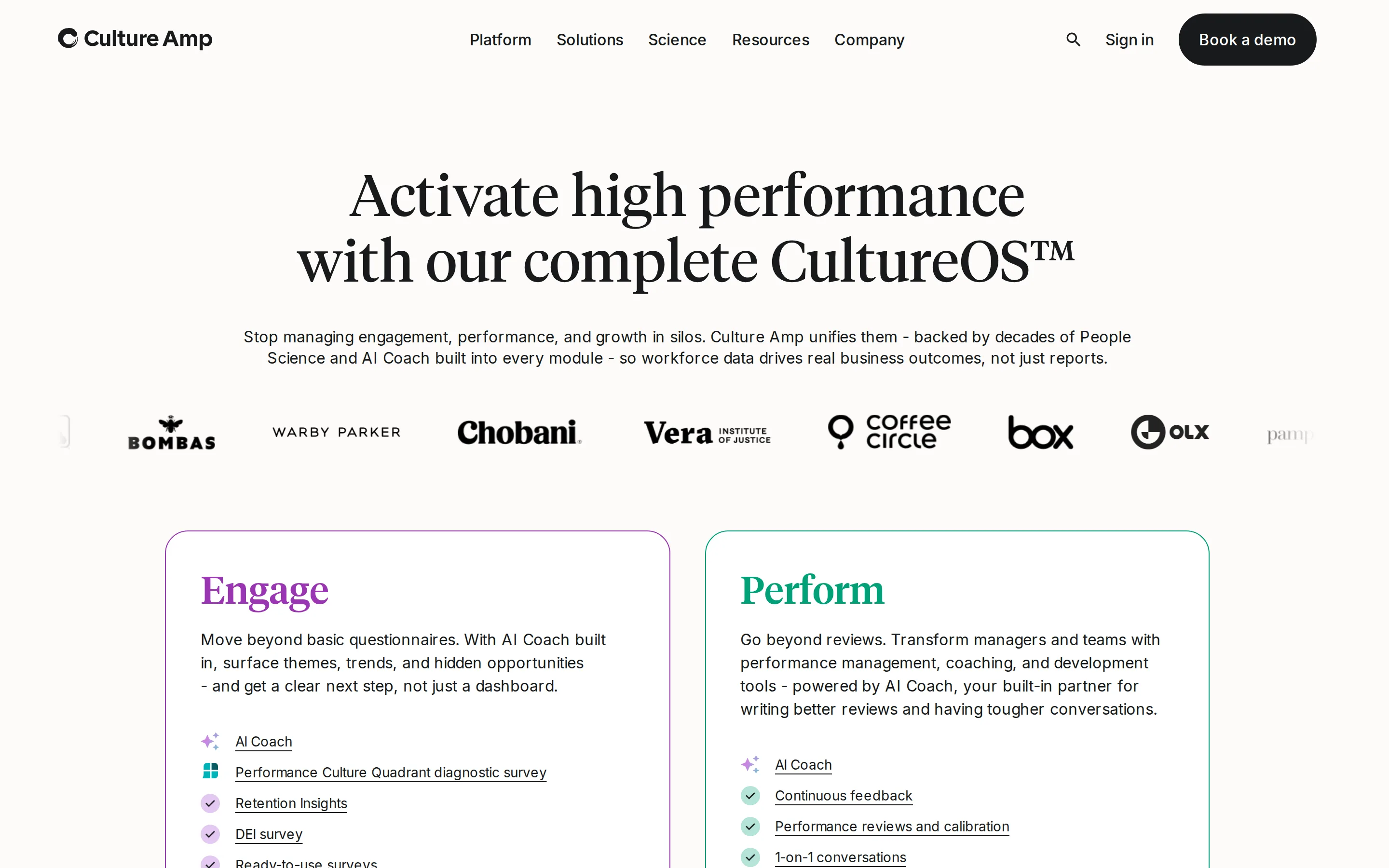
- No public prices: the pricing page offers Engage, Perform, and a full-platform bundle - each 'Request a quote' via sales, with service tiers by headcount (under 200, 200-999, 1,000+). Develop is still sold but no longer listed as its own pricing-page package.
- All products are billed annually - there is no monthly option.
- Independent buyer guides consistently describe it as a premium-priced platform; you won't know your number until you've talked to sales.
Source: Culture Amp's pricing page, read on July 30, 2026. Vendors change pricing - as of 2026, check their site before you commit.
Contract
Annual billing; quote-based
Free trial
No self-serve free trial - demo with sales
Budget comparison
TeamPredict does one different job - person-level resignation early-warning - at $5/tracked employee/mo (or $50/yr), month-to-month, no minimum. Our pricing →
Don't take our word for it
This Is the Page Those Numbers Came From
Comparison pages go stale quietly, and the usual tell is a price with no date and no source. Here is Culture Amp's own pricing page exactly as it looked when we read it, so you can see what we saw and check whether it still says the same thing today.
The real math
Where Culture Amp Costs More (and Where It Costs Less)
Per-user pricing and flat platform pricing cross over somewhere. Below that point one is cheap and the other is absurd, and above it they swap. These charts plot only rates the vendors publish.
What each one costs per year, as your team grows
Published rates only, verified July 30, 2026. Flat platform pricing and per-user pricing cross over - where they cross is the whole decision for a small team.
- 15Five
- Total Platform $16/user/mo, billed annually
- Lattice
- Foundations $13/user/mo, billed annually, with the $4,000/yr minimum spend
- Workleap
- Standard tier, a flat $4,999/yr however many people you have (Pro is $11,999/yr for more features); Enterprise is quote-only above 250 employees
- TeamPredict
- $5/tracked employee/mo, month-to-month, no minimum - charted here tracking every employee, which is the most expensive way to run it
Not plotted: Culture Amp, Leapsome, Workday Peakon publish no rates, so any line for them would be invented. Ask them for a quote and plot it yourself.
Annual cost for a 25-person company
Our arithmetic over each vendor's published rates, verified July 30, 2026. Cheapest first.
- TeamPredict$1,500/yr · $60 per person
- Lattice$4,000/yr · $160 per person
- 15Five$4,800/yr · $192 per person
- Workleap$4,999/yr · $200 per person
Worth knowing: TeamPredict bills per tracked employee, and most teams track a shortlist rather than everyone - so the real bill is usually a fraction of the line above. Culture Amp, Leapsome, Workday Peakon publish no rates and are left out rather than guessed at.
Annual cost for a 100-person company
Our arithmetic over each vendor's published rates, verified July 30, 2026. Cheapest first.
- Workleap$4,999/yr · $50 per person
- TeamPredict$6,000/yr · $60 per person
- Lattice$15,600/yr · $156 per person
- 15Five$19,200/yr · $192 per person
Worth knowing: TeamPredict bills per tracked employee, and most teams track a shortlist rather than everyone - so the real bill is usually a fraction of the line above. Culture Amp, Leapsome, Workday Peakon publish no rates and are left out rather than guessed at.
No public number - how to budget anyway
We don't print guessed prices: a made-up number would be worse than none. What the sales conversation will cover, based on how Culture Amp packages the product: No public prices: the pricing page offers Engage, Perform, and a full-platform bundle - each 'Request a quote' via sales, with service tiers by headcount (under 200, 200-999, 1,000+). Develop is still sold but no longer listed as its own pricing-page package. Go in with your headcount, the modules you actually need, and a walk-away number - and get the quote in writing with renewal terms.
What the sticker price leaves out
The published rate is rarely the whole bill. For Culture Amp, these are the things that move the real number.
- You cannot budget from the website at all: no rate is published at any headcount.
- Annual billing only, so the commitment is a year regardless of how adoption goes.
- People Science consulting is a paid add-on on top of the platform.
- Reviewers report that live support is thinner on lower tiers, and that some HRIS integrations sit behind higher plans.
Price history
There is no price history, because Culture Amp has never published a price
2022 to today
Every archived version of the plans-and-pricing page routes to "Request a quote". The page has only ever shown headcount bands (under 200, 200-999, 1,000+) and the line: "Pricing depends on the number of employees, product chosen, and service tier."
Aug 2026
Still quote-only, still annual billing only, and the pricing page now lists two purchasable packages (Engage and Perform) plus a full-platform bundle.
How we checked: Their own pricing page, read live. Culture Amp publishes no rates, so there is no number for us to track over time - which is itself the most useful thing to know before you book the call. Culture Amp can change prices at any time - this is history, not a forecast.
Why this matters more than the sticker price
You are not buying today's price, you are buying the renewal. A vendor's published-price history is the closest thing to a forecast you can get for free: it shows whether increases are a habit, whether products get removed from the plan you bought, and whether transparency itself is trending in the right direction.
We check this by reading archived copies of each vendor's own pricing page, so the before-and-after is their wording, not our characterisation of it.
Who actually uses Culture Amp
The review base is the honest answer to “is this built for a team like mine?” For Culture Amp it's mid-market (63% of reviewers).
- Small business ≤50 staff
- 9%
- Mid-market 51-1,000
- 63%
- Enterprise 1,000+
- 28%
Source: G2 reviewer breakdown for Culture Amp. Capterra reports a very different split on a smaller base (36% small / 34% mid / 29% enterprise). G2's larger review base is the better signal, but the disagreement is real and worth knowing.
What you're paying for
Culture Amp is a employee experience & engagement platform. The employee-experience heavyweight: research-backed engagement surveys, benchmarks, and people-science consulting, with Perform and Develop add-ons.
Best for: Organizations of a few hundred people and up that want serious, research-grade engagement measurement and can run an annual procurement.
Checked July 30, 2026. Counts marked approximate come from the platforms' own listings via search results (G2 blocks automated reads), so treat them as a floor and check the live listing before you buy.
Culture Amp, the last few years
Product and company milestones through August 3, 2026. Worth reading before you sign: what a vendor shipped, bought, or shut down recently tells you more about the next three years than a feature list does.
Jul 2021
Raises US$100M Series F at a US$1.5B valuation.
Mar 2024
Acquires people-analytics platform Orgnostic, the engine behind its retention insights.
Feb 2025
Named #1 in three G2 Winter 2025 Grid Reports at once: Employee Engagement, Performance Management, Career Management.
May 2025
Announces AI Coach, trained on what it describes as 1.5 billion workplace datapoints.
Oct 2025
Expands AI Coach across the platform at no extra charge.
Nov 2025
Cuts ~60 roles (~6% of staff) in the same month as the AI Coach platform launch.
Dec 2025
Filed accounts show a US$24.4M FY25 loss on US$177M revenue, with growth slowing to 10.8% (from 32% in FY23).
Jan 2026
Founder Didier Elzinga steps down as CEO after ~17 years; CFO/COO Caroline Rawlinson takes over.
Jul 2026
Cuts 70 roles (~9% of staff), the third layoff round since 2023.
FAQ
Culture Amp Pricing, Answered
The cost questions buyers actually ask, with dates on every answer.
Deciding between tools? See TeamPredict vs Culture Amp or the best Culture Amp alternatives.
Whatever You Pick, Don't Get Surprised by a Resignation.
Culture Amp and TeamPredict do different jobs. Ours is warning you which tracked person may be about to leave - $5 per tracked employee, live in minutes, cancel anytime.
No charge today · Cancel anytime